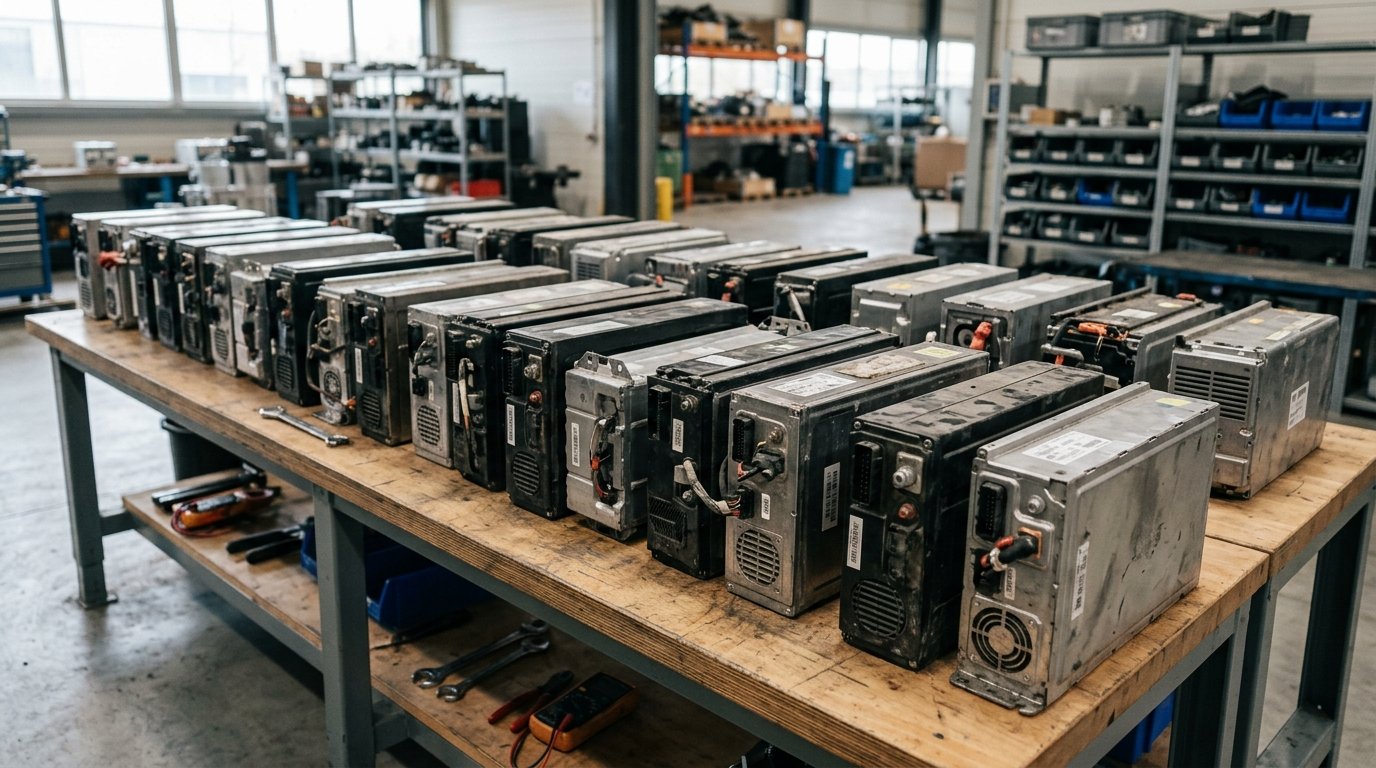
This guide tracks 66 popular electric vehicle models sold globally in 2026, with verified data on battery capacity, chemistry, recoverable materials, second-life market value, and full recycling value.
Chemistry split across the 66 models tracked:
- NMC / NCA (cobalt + nickel rich): 59 models
- LFP (LiFePO4 - no cobalt, no nickel): 7 models
LFP chemistry is gaining share quickly - Tesla Model 3 RWD, BYD Blade-equipped vehicles, MG 4 EV, and XPeng G6 all use LFP. Lower second-life value but safer (less thermal runaway risk) and simpler to recycle.
Full model table
| Model | Brand | kWh | Chem | Pack kg | Second-life $ | Recycling $ |
|---|
| Rivian R1T Max Pack (180 kWh) | Rivian | 180 | NMC/NCA | 1100 | $12000-24000 | $2200-3800 |
| Rivian R1S Large Pack (135 kWh) | Rivian | 135 | NMC/NCA | 820 | $9000-17000 | $1700-3000 |
| Ford F-150 Lightning Extended Range (131 kWh) | Ford | 131 | NMC/NCA | 820 | $8500-16000 | $1500-2700 |
| Tesla Cybertruck (123 kWh) | Tesla | 123 | NMC/NCA | 750 | $10000-20000 | $1400-2600 |
| Lucid Air Grand Touring (118 kWh) | Lucid | 118 | NMC/NCA | 730 | $8000-15500 | $1500-2700 |
| Audi Q8 e-tron 55 (114 kWh) | Audi | 114 | NMC/NCA | 720 | $8000-15000 | $1500-2700 |
| Lotus Eletre (112 kWh) | Lotus (Geely) | 112 | NMC/NCA | 700 | $7500-14500 | $1500-2600 |
| BMW iX xDrive50 (111.5 kWh) | BMW | 111.5 | NMC/NCA | 700 | $7500-15000 | $1500-2700 |
| Polestar 3 (111 kWh) | Polestar | 111 | NMC/NCA | 700 | $7500-14000 | $1500-2600 |
| Volvo EX90 (111 kWh) | Volvo | 111 | NMC/NCA | 700 | $7500-14500 | $1400-2500 |
| Mercedes EQS 450+ (108 kWh) | Mercedes-Benz | 108 | NMC/NCA | 680 | $7500-14500 | $1500-2600 |
| BYD Tang EV (108 kWh LFP Blade) | BYD | 108 | LFP | 680 | $5500-11500 | $500-1100 |
| BMW i7 xDrive60 (101.7 kWh) | BMW | 101.7 | NMC/NCA | 640 | $7000-13500 | $1400-2400 |
| Tesla Model S (100 kWh) | Tesla | 100 | NMC/NCA | 625 | $8000-15000 | $1200-2200 |
| Tesla Model X (100 kWh) | Tesla | 100 | NMC/NCA | 625 | $8000-15000 | $1200-2200 |
| NIO ET5 (100 kWh) | NIO | 100 | NMC/NCA | 620 | $6500-13000 | $1300-2300 |
| NIO ET7 (100 kWh) | NIO | 100 | NMC/NCA | 620 | $6500-13000 | $1300-2300 |
| NIO ES8 (100 kWh) | NIO | 100 | NMC/NCA | 620 | $6500-13000 | $1300-2300 |
| Kia EV9 (99.8 kWh) | Kia | 99.8 | NMC/NCA | 625 | $6500-13000 | $1300-2300 |
| Audi e-tron 55 quattro (95 kWh) | Audi | 95 | NMC/NCA | 700 | $6000-12000 | $1200-2100 |
| Porsche Taycan (93.4 kWh Performance Battery Plus) | Porsche | 93.4 | NMC/NCA | 625 | $6000-12500 | $1200-2200 |
| Ford Mustang Mach-E (91 kWh) | Ford | 91 | NMC/NCA | 530 | $6000-12000 | $1100-2000 |
| Mercedes EQE 350+ (90 kWh) | Mercedes-Benz | 90 | NMC/NCA | 570 | $6000-12000 | $1200-2100 |
| Jaguar I-Pace (90 kWh) | Jaguar (JLR) | 90 | NMC/NCA | 600 | $5500-11000 | $1100-2000 |
| XPeng G6 (87.5 kWh LFP) | XPeng | 87.5 | LFP | 580 | $4500-9500 | $400-900 |
| Nissan Ariya e-4ORCE (87 kWh) | Nissan | 87 | NMC/NCA | 540 | $5500-10500 | $1100-2000 |
| XPeng P7 (86.2 kWh) | XPeng | 86.2 | NMC/NCA | 545 | $5000-10000 | $1000-1900 |
| Volkswagen ID.7 (86 kWh) | Volkswagen | 86 | NMC/NCA | 540 | $5500-10500 | $1100-2000 |
| BYD Han EV (85.4 kWh LFP Blade) | BYD | 85.4 | LFP | 540 | $4500-9500 | $400-900 |
| BMW i4 (83.9 kWh) | BMW | 83.9 | NMC/NCA | 520 | $5500-11000 | $1100-2000 |
| BYD Seal AWD (82.5 kWh LFP Blade) | BYD | 82.5 | LFP | 520 | $4000-9000 | $380-850 |
| Volkswagen ID. Buzz (82 kWh) | Volkswagen | 82 | NMC/NCA | 510 | $5000-10000 | $1000-1900 |
| Audi Q4 e-tron (82 kWh) | Audi | 82 | NMC/NCA | 510 | $5000-10000 | $1000-1900 |
| Polestar 2 Long Range (82 kWh) | Polestar | 82 | NMC/NCA | 520 | $5000-10000 | $1000-1900 |
| Skoda Enyaq iV (82 kWh) | Skoda (VW Group) | 82 | NMC/NCA | 510 | $5000-10000 | $1000-1900 |
| BMW iX3 (80 kWh) | BMW | 80 | NMC/NCA | 510 | $5000-10500 | $1000-1900 |
| Volvo XC40 Recharge Twin (78 kWh) | Volvo | 78 | NMC/NCA | 500 | $4500-9000 | $950-1750 |
| Hyundai Ioniq 5 (77.4 kWh) | Hyundai | 77.4 | NMC/NCA | 477 | $5000-10000 | $950-1750 |
| Hyundai Ioniq 6 (77.4 kWh) | Hyundai | 77.4 | NMC/NCA | 477 | $5000-10000 | $950-1750 |
| Kia EV6 (77.4 kWh) | Kia | 77.4 | NMC/NCA | 477 | $5000-10000 | $950-1750 |
| Genesis GV60 (77.4 kWh) | Genesis (Hyundai) | 77.4 | NMC/NCA | 477 | $5000-10000 | $950-1750 |
| Tesla Model Y Long Range (77 kWh) | Tesla | 77 | NMC/NCA | 490 | $5500-11000 | $950-1750 |
| Volkswagen ID.4 (77 kWh) | Volkswagen | 77 | NMC/NCA | 493 | $4500-9000 | $950-1700 |
| Volkswagen ID.5 (77 kWh) | Volkswagen | 77 | NMC/NCA | 493 | $4500-9000 | $950-1700 |
| Cupra Born VZ (77 kWh) | Cupra (VW Group) | 77 | NMC/NCA | 493 | $4500-9000 | $950-1700 |
| Tesla Model 3 Long Range (75 kWh NCA) | Tesla | 75 | NMC/NCA | 480 | $5000-10000 | $900-1700 |
| MG ZS EV (72.6 kWh) | MG (SAIC) | 72.6 | NMC/NCA | 470 | $3500-8000 | $850-1500 |
| Toyota bZ4X (71.4 kWh) | Toyota | 71.4 | NMC/NCA | 460 | $4000-8500 | $900-1600 |
| Subaru Solterra (71.4 kWh) | Subaru | 71.4 | NMC/NCA | 460 | $4000-8500 | $900-1600 |
| Volvo EX30 Twin Performance (69 kWh) | Volvo | 69 | NMC/NCA | 440 | $4000-8000 | $850-1500 |
| Honda e:Ny1 (68.8 kWh) | Honda | 68.8 | NMC/NCA | 440 | $3500-7500 | $800-1450 |
| Mercedes EQB 250 (66.5 kWh) | Mercedes-Benz | 66.5 | NMC/NCA | 425 | $4000-8000 | $850-1500 |
| Mercedes EQA 250 (66.5 kWh) | Mercedes-Benz | 66.5 | NMC/NCA | 425 | $4000-8000 | $850-1500 |
| Smart #1 (66 kWh) | Smart (Geely / Mercedes) | 66 | NMC/NCA | 420 | $3500-7500 | $800-1500 |
| Hyundai Kona Electric (64 kWh) | Hyundai | 64 | NMC/NCA | 430 | $3500-7500 | $800-1400 |
| Kia Niro EV (64 kWh) | Kia | 64 | NMC/NCA | 430 | $3500-7500 | $800-1400 |
| MG 4 EV (64 kWh LFP) | MG (SAIC) | 64 | LFP | 420 | $3000-7000 | $300-700 |
| Nissan Leaf e+ (62 kWh) | Nissan | 62 | NMC/NCA | 430 | $2500-6000 | $750-1400 |
| BYD Atto 3 (60.5 kWh LFP Blade) | BYD | 60.5 | LFP | 380 | $3000-7000 | $280-650 |
| Tesla Model 3 RWD (60 kWh LFP) | Tesla | 60 | LFP | 410 | $3500-8000 | $300-700 |
| Renault Megane E-Tech (60 kWh) | Renault | 60 | NMC/NCA | 390 | $3000-6500 | $700-1300 |
| Volkswagen ID.3 Pro (58 kWh) | Volkswagen | 58 | NMC/NCA | 380 | $3500-7500 | $700-1300 |
| Renault Zoe ZE50 (52 kWh) | Renault | 52 | NMC/NCA | 326 | $2500-5500 | $600-1200 |
| Nissan Leaf ZE1 (40 kWh) | Nissan | 40 | NMC/NCA | 303 | $1500-4000 | $500-1000 |
| Honda e (35.5 kWh) | Honda | 35.5 | NMC/NCA | 250 | $1500-3500 | $450-900 |
| Mini Cooper SE (32.6 kWh) | Mini (BMW) | 32.6 | NMC/NCA | 230 | $1500-3500 | $400-800 |
Key insights from the data
1. Second-life value is always higher than recycling value
Across all 66 models, second-life market value (for grid storage / residential battery walls) exceeds full recycling value by 4-7x. Selling a retired pack to a stationary-storage integrator captures more value than sending it directly to a smelter.
2. Pack capacity correlates with both values
Each additional 10 kWh of capacity adds roughly $700-$1,200 to second-life value and $90-$150 to recycling value (NMC chemistry). LFP packs see roughly half that recycling lift due to lower precious-metal content.
3. Manufacturer take-back is universal in EU, partial in US
Every model tracked has manufacturer take-back available in EU member states under EU Battery Regulation 2023/1542. US take-back is currently a patchwork - California SB 615 (effective 2026) brings complete requirements; other US states still rely on voluntary OEM programmes.
4. UN3480/UN3481 hazmat classification applies universally
Every EV battery in this list is hazmat-classified for transport. Owners cannot legally move them on a regular vehicle. End-of-life always requires a Class 9 certified transporter.
Where to recycle EV batteries
The major battery recyclers operating internationally:
- Li-Cycle - US, Canada, Europe; hub-and-spoke model with regional spoke facilities
- Redwood Materials - US-based, founded by Tesla co-founder JB Straubel; supplies recovered cathode material back to OEMs
- Umicore - Belgium-headquartered integrated smelter; operates globally
- Ecobat - lead-acid legacy company expanding into Li-ion
- Battery Recyclers of America - US regional
- GEM (Hubei Greenmei) - China, processes ~30% of the country's EV battery waste
- SungEel HiTech - South Korea
- Stena Recycling - Northern Europe
Compliance frameworks
- EU Battery Regulation 2023/1542 - entered force 2024, sets material-recovery quotas (50% by 2027, 80% by 2031 for lithium), mandatory carbon footprint disclosure, mandatory recycled content thresholds from 2031
- US AIM Act 2020 + state-level EPR - California SB 615 (2026), New York Battery Stewardship Act
- UK Batteries Regulations 2009 (post-Brexit retained) - requires producer take-back, currently under DEFRA review for stricter rules
- China - Implementation Measures for Recycling of New Energy Vehicle Batteries (2018) - requires EV manufacturers to recover their own end-of-life packs
Press inquiries
We update this dataset monthly. The data is freely citable for journalism, academic research, or policy work. Per-model historical price progression is available on request via hello@ecyclingcentral.com.
Sources
- Manufacturer battery sustainability disclosures (every brand listed)
- Cell supplier specifications (CATL, LG Energy Solution, Panasonic, Samsung SDI, BYD, SK On)
- US DOE National Renewable Energy Laboratory ReCell Center
- IEA Global EV Outlook 2024
- EU Battery Regulation 2023/1542 (Regulation (EU) 2023/1542)
- LME spot prices for cobalt, nickel, lithium carbonate (H2 2025)
- Li-Cycle, Redwood Materials, Umicore quarterly reporting
Frequently Asked Questions
Which EV battery has the highest second-life value in 2026?
The Rivian R1T Max Pack (180 kWh) at $12,000-$24,000 second-life market value, followed by Tesla Cybertruck (123 kWh) and Lucid Air Grand Touring (118 kWh).
Which EV batteries use LFP chemistry vs NMC?
Of the 66 EVs tracked: 7 use LFP (Tesla Model 3 RWD, all BYD Blade-equipped, MG 4 EV, XPeng G6), and 59 use NMC or NCA. LFP is gaining share quickly due to lower cost, no cobalt requirement, and better thermal stability.
Can I sell my used EV battery instead of recycling it?
Yes — and you should, if it still has 70%+ capacity. Second-life market value typically exceeds recycling value by 4-7x. Specialist integrators like B2U Storage Solutions, Connected Energy, and Powervault buy retired EV packs for grid stabilisation and residential battery wall applications.
Is EV battery recycling profitable?
For NMC/NCA chemistries: typically yes (net-positive after recycling cost). For LFP chemistries: marginal or slightly negative, due to lower precious-metal content. The economics improve every year as recycling technology matures (Li-Cycle and Redwood Materials are both scaling rapidly).
What happens to an EV battery at end of life?
Three routes: (1) Second-life — repackaged for stationary storage; typical 5-10 additional years of useful life. (2) Full recycling — hydrometallurgical or pyrometallurgical processing to recover lithium, cobalt, nickel, copper, aluminium. (3) Disposal — only for catastrophically damaged packs that cannot be recovered safely; goes to specialist hazmat facilities.