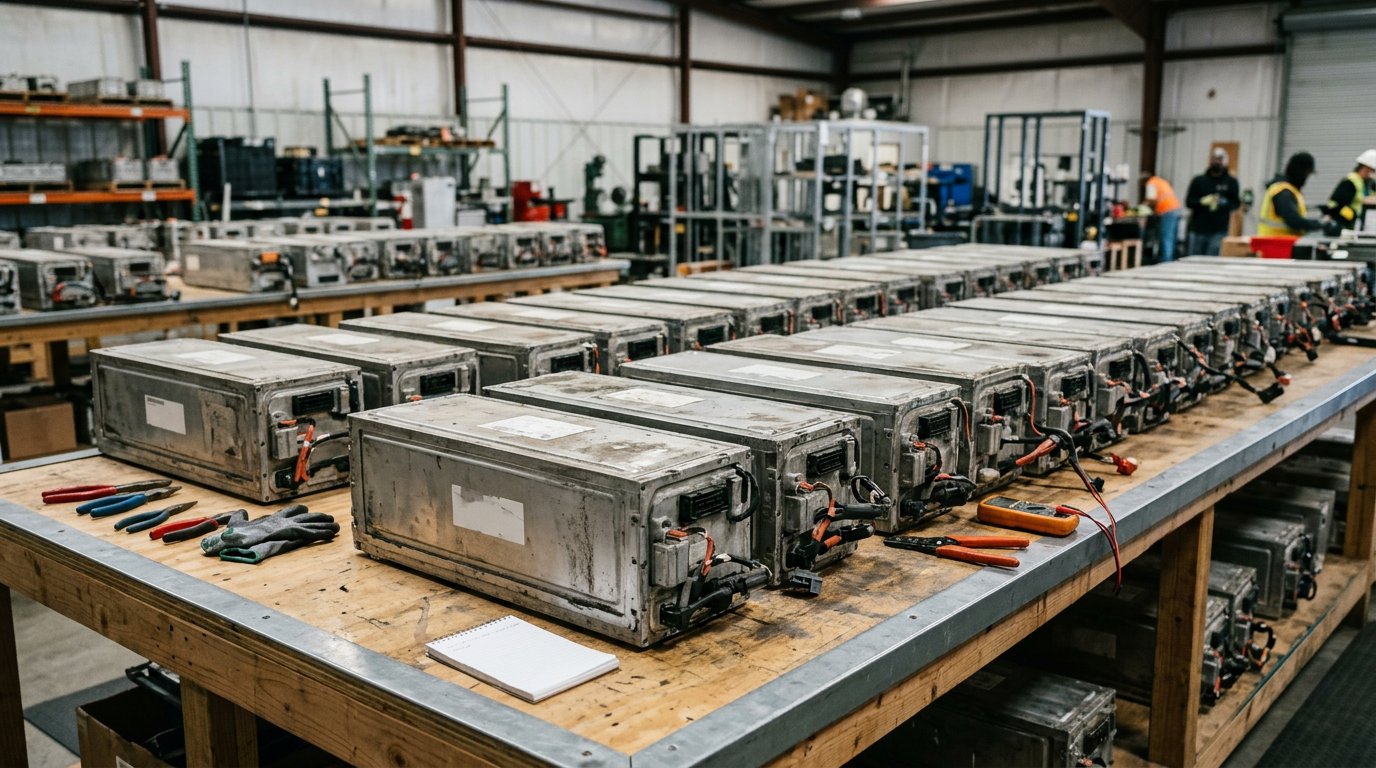
The Tesla Model X (100 kWh) Battery Recycle + Resale (2026) addresses the end-of-life management for batteries from electric vehicles manufactured between 2017 and 2024. These packs, featuring NCA chemistry supplied by Panasonic, hold a gross capacity of 100 kWh and weigh approximately 625 kg. As these batteries approach their second decade in service, options for recycling or repurposing emerge as critical considerations. By 2026, the Tesla Model X (100 kWh) Battery Recycle + Resale initiative aims to maximize material recovery and extend battery life through secondary applications such as grid storage systems before full dismantling and recycling.
ials** (US) - integrated cell-to-cell recycling, supplies recovered cathode material back to Tesla
- Umicore (Belgium, global) - integrated smelter
- Ecobat - lead-acid + lithium-ion
- Tesla closed-loop programme (where available - see take-back URL below)
Manufacturer take-back
Tesla sustainability + battery recycling
In the EU, manufacturers are obligated under EU Battery Regulation 2023/1542 (effective 2024) to provide free take-back for EV batteries. In the US, state-level laws vary - California's SB 615 (effective 2026) requires similar manufacturer responsibility.
Compliance and safety
EV batteries are classified as UN3480 / UN3481 (lithium-ion battery) under hazardous-materials transport regulations. Movement requires:
- Class 9 hazmat-certified transporter
- Damaged-pack protocol (typically requires container with non-conductive padding)
- Documentation: Bill of Lading + UN packaging certificate
Cannot be transported on a regular vehicle without certified packaging.
Where this fits in the bigger picture
By 2030, the IEA projects 1.4 million tonnes of EV battery waste annually globally. The Tesla Model X (100 kWh) contributes to this stream when retired. With 12 kg of lithium per pack, recovering even a fraction returns critical minerals to the supply chain - recovered lithium typically costs 30-50% less in carbon footprint than freshly mined material (NREL ReCell Center data).
Related guides
Sources
- Tesla battery sustainability disclosure
- US DOE National Renewable Energy Laboratory ReCell Center
- IEA Global EV Outlook 2024
- EU Battery Regulation 2023/1542
- Cell supplier (Panasonic) published specifications
- LME spot prices for cobalt, nickel, lithium carbonate
Frequently Asked Questions
How much is a used Tesla Model X (100 kWh) battery worth?
Second-life market value (for grid storage, residential battery wall, off-grid use) typically $8000-15000 USD. Full recycling material value $1200-2200 USD. Almost always more economic to extend useful life via second-life rather than scrap immediately.
What chemistry is the Tesla Model X (100 kWh) battery?
NCA, supplied by Panasonic. The pack weighs 625 kg and stores 100 kWh of energy.
How is the Tesla Model X (100 kWh) battery recycled?
Major recyclers (Li-Cycle, Redwood Materials, Umicore) dismantle the 625 kg pack, test cells for second-life eligibility (70%+ capacity), then non-viable cells go through hydrometallurgical or pyrometallurgical processing to recover lithium (12 kg), cobalt (8 kg), nickel (78 kg), copper, and aluminium.
Does Tesla take back the Tesla Model X (100 kWh) battery?
Yes. See [Tesla take-back programme](https://www.tesla.com/support/sustainability-recycling). Under EU Battery Regulation 2023/1542 (effective 2024), all EU sales include free manufacturer take-back at end-of-life. US take-back is currently voluntary with state-level requirements emerging (California SB 615 effective 2026).
Can I transport an EV battery myself?
No. The Tesla Model X (100 kWh) battery is UN3480/UN3481 hazmat-classified. Movement requires a Class 9 certified transporter with proper packaging and Bill of Lading. Damaged packs have additional protocol. Cannot be moved on a regular vehicle.