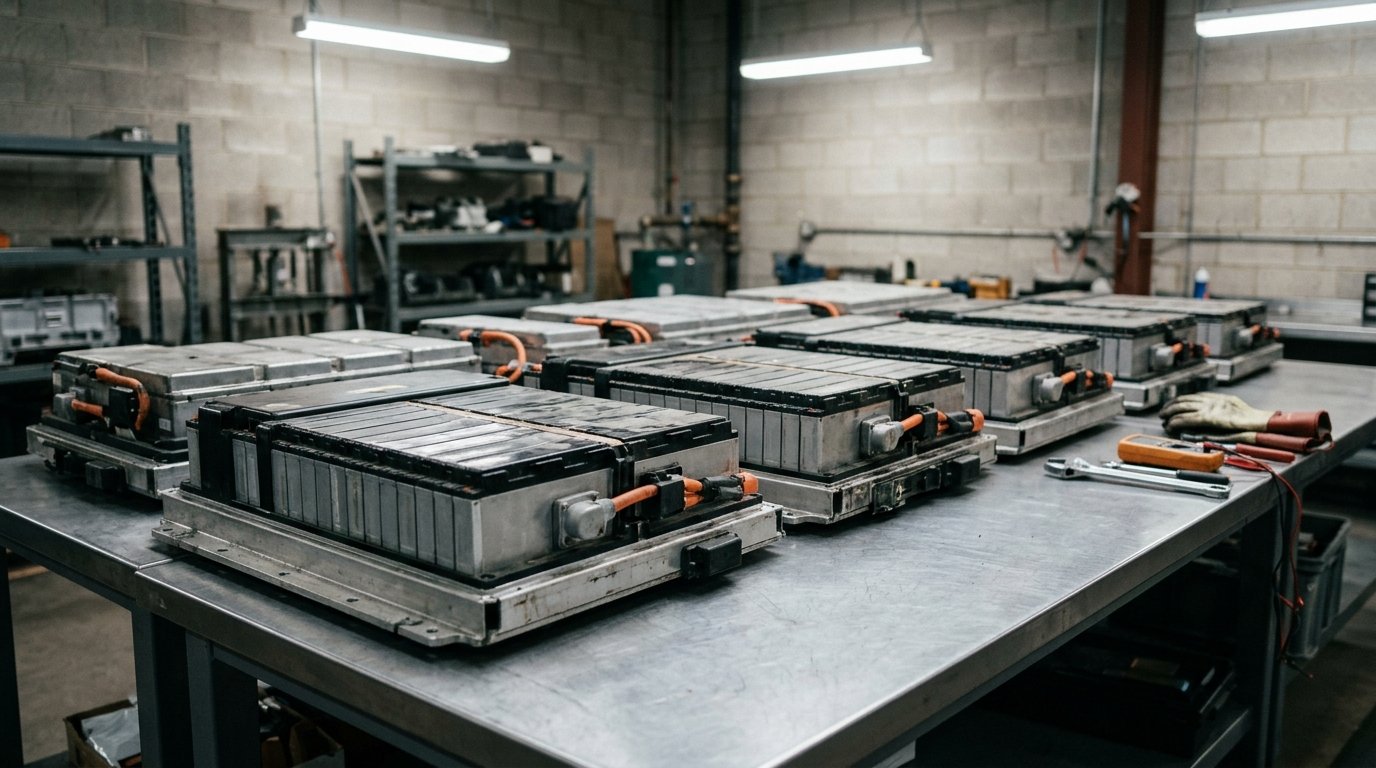
The Hyundai Ioniq 5 (77.4 kWh) Battery Recycle + Resale (2026) offers a detailed look at the lifecycle of this electric vehicle's battery, focusing on its recycling and second-life applications. This guide delves into how the Hyundai Ioniq 5 (77.4 kWh), produced from 2021 onwards, navigates end-of-life scenarios. The battery pack, weighing in at 477 kg with a capacity of 77.4 kWh and using NMC chemistry supplied by SK On, finds new life either through repurposing for grid storage or complete material recycling.
** (US) - integrated cell-to-cell recycling, supplies recovered cathode material back to major OEMs
- Umicore (Belgium, global) - integrated smelter
- Ecobat - lead-acid + lithium-ion
- Hyundai closed-loop programme (where available - see take-back URL below)
Manufacturer take-back
Hyundai sustainability + battery recycling
In the EU, manufacturers are obligated under EU Battery Regulation 2023/1542 (effective 2024) to provide free take-back for EV batteries. In the US, state-level laws vary - California's SB 615 (effective 2026) requires similar manufacturer responsibility.
Compliance and safety
EV batteries are classified as UN3480 / UN3481 (lithium-ion battery) under hazardous-materials transport regulations. Movement requires:
- Class 9 hazmat-certified transporter
- Damaged-pack protocol (typically requires container with non-conductive padding)
- Documentation: Bill of Lading + UN packaging certificate
Cannot be transported on a regular vehicle without certified packaging.
Where this fits in the bigger picture
By 2030, the IEA projects 1.4 million tonnes of EV battery waste annually globally. The Hyundai Ioniq 5 (77.4 kWh) contributes to this stream when retired. With 9 kg of lithium per pack, recovering even a fraction returns critical minerals to the supply chain - recovered lithium typically costs 30-50% less in carbon footprint than freshly mined material (NREL ReCell Center data).
Related guides
Sources
- Hyundai battery sustainability disclosure
- US DOE National Renewable Energy Laboratory ReCell Center
- IEA Global EV Outlook 2024
- EU Battery Regulation 2023/1542
- Cell supplier (SK On) published specifications
- LME spot prices for cobalt, nickel, lithium carbonate
Frequently Asked Questions
How much is a used Hyundai Ioniq 5 (77.4 kWh) battery worth?
Second-life market value (for grid storage, residential battery wall, off-grid use) typically $5000-10000 USD. Full recycling material value $950-1750 USD. Almost always more economic to extend useful life via second-life rather than scrap immediately.
What chemistry is the Hyundai Ioniq 5 (77.4 kWh) battery?
NMC, supplied by SK On. The pack weighs 477 kg and stores 77.4 kWh of energy.
How is the Hyundai Ioniq 5 (77.4 kWh) battery recycled?
Major recyclers (Li-Cycle, Redwood Materials, Umicore) dismantle the 477 kg pack, test cells for second-life eligibility (70%+ capacity), then non-viable cells go through hydrometallurgical or pyrometallurgical processing to recover lithium (9 kg), cobalt (6 kg), nickel (65 kg), copper, and aluminium.
Does Hyundai take back the Hyundai Ioniq 5 (77.4 kWh) battery?
Yes. See [Hyundai take-back programme](https://www.hyundai.com/worldwide/en/company/sustainability). Under EU Battery Regulation 2023/1542 (effective 2024), all EU sales include free manufacturer take-back at end-of-life. US take-back is currently voluntary with state-level requirements emerging (California SB 615 effective 2026).
Can I transport an EV battery myself?
No. The Hyundai Ioniq 5 (77.4 kWh) battery is UN3480/UN3481 hazmat-classified. Movement requires a Class 9 certified transporter with proper packaging and Bill of Lading. Damaged packs have additional protocol. Cannot be moved on a regular vehicle.