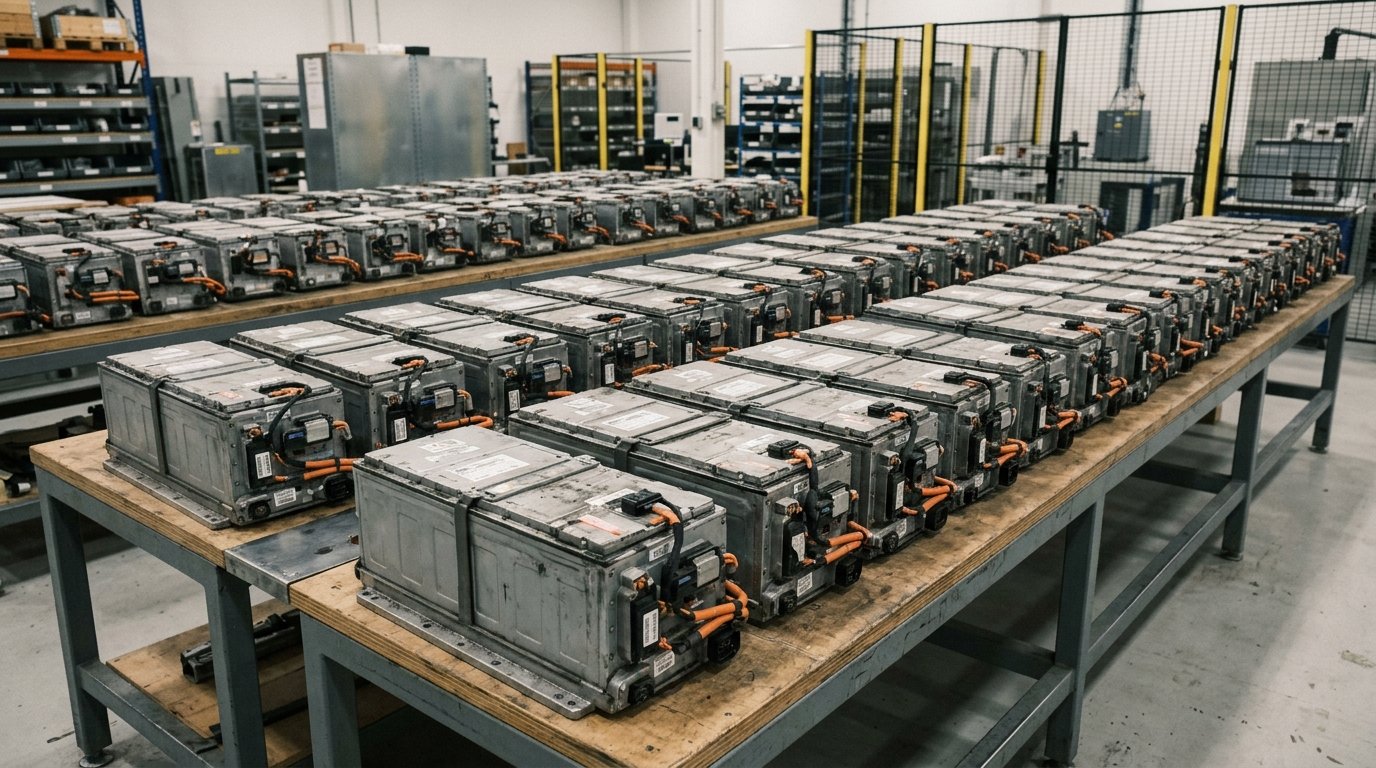
The Hyundai Ioniq 6 (77.4 kWh) Battery Recycle + Resale (2026) offers a detailed look at the lifecycle of this electric vehicle's battery, focusing on its end-of-life options and material recovery processes. As of May 2026, the battery pack from the Hyundai Ioniq 6 (77.4 kWh), produced by SK On for Hyundai since 2023, weighs 477 kg and is made with NMC chemistry. This article explores how the Hyundai Ioniq 6 (77.4 kWh) Battery Recycle + Resale (2026) can extend its utility through second-life applications such as grid storage or be fully recycled to recover valuable materials like lithium and cobalt.
** (US) - integrated cell-to-cell recycling, supplies recovered cathode material back to major OEMs
- Umicore (Belgium, global) - integrated smelter
- Ecobat - lead-acid + lithium-ion
- Hyundai closed-loop programme (where available - see take-back URL below)
Manufacturer take-back
Hyundai sustainability + battery recycling
In the EU, manufacturers are obligated under EU Battery Regulation 2023/1542 (effective 2024) to provide free take-back for EV batteries. In the US, state-level laws vary - California's SB 615 (effective 2026) requires similar manufacturer responsibility.
Compliance and safety
EV batteries are classified as UN3480 / UN3481 (lithium-ion battery) under hazardous-materials transport regulations. Movement requires:
- Class 9 hazmat-certified transporter
- Damaged-pack protocol (typically requires container with non-conductive padding)
- Documentation: Bill of Lading + UN packaging certificate
Cannot be transported on a regular vehicle without certified packaging.
Where this fits in the bigger picture
By 2030, the IEA projects 1.4 million tonnes of EV battery waste annually globally. The Hyundai Ioniq 6 (77.4 kWh) contributes to this stream when retired. With 9 kg of lithium per pack, recovering even a fraction returns critical minerals to the supply chain - recovered lithium typically costs 30-50% less in carbon footprint than freshly mined material (NREL ReCell Center data).
Related guides
Sources
- Hyundai battery sustainability disclosure
- US DOE National Renewable Energy Laboratory ReCell Center
- IEA Global EV Outlook 2024
- EU Battery Regulation 2023/1542
- Cell supplier (SK On) published specifications
- LME spot prices for cobalt, nickel, lithium carbonate
Hyundai Ioniq 6 (77.4 kWh) Battery Recycling & Second-Life Value (2026): complete diagnostic guide (2026-05-20)
EV battery composition + recovery economics
A typical 2026 EV battery pack (60-100 kWh) contains, per IEA Global EV Outlook 2026:
| Material | Per pack (60 kWh) | Recovery rate | Market value 2026 |
|---|
| Lithium | 6-8 kg | 80-95% (hydrometallurgy) | $32,000-$78,000/tonne |
| Cobalt | 5-15 kg | 90-99% | $26,000-$38,000/tonne |
| Nickel | 35-50 kg | 85-95% | $14,000-$22,000/tonne |
| Manganese | 8-22 kg | 70-90% | $1,500-$3,500/tonne |
| Copper | 25-40 kg | 95-99% | $7,800-$10,200/tonne |
| Aluminium | 70-100 kg | 90-95% | $2,100-$2,800/tonne |
| Graphite (anode) | 50-80 kg | 30-60% (improving) | $800-$1,400/tonne |
Total recoverable material value: $1,800-$4,500 per pack at current commodity prices. This is why the EV battery recycling industry is projected to reach $52B globally by 2030 (BloombergNEF).
Second-life vs direct recycling decision
Before recovery, packs at 70-80% original capacity (typical retired EV battery) qualify for second-life applications:
- Grid storage: 5-10 year second life as utility-scale or residential storage. Buyback price: $30-$70/kWh for tested cells.
- Off-grid power systems: telecoms tower backup, RV/boat applications. Price: $40-$90/kWh.
- EV remanufacturing: cell-level swaps for older EV chassis (Nissan Leaf, Tesla Model S). Price: $50-$120/kWh.
Direct recycling without second-life skips this 5-10 year value capture. For fleet operators or OEMs, second-life partnership networks (Nissan + Sumitomo, BMW + Vattenfall, Tesla + Redwood Materials, Renault + Veolia) typically add 25-45% to total project NPV.
Compliance + transportation requirements
Used EV batteries are UN3480 Class 9 dangerous goods under the UN Model Regulations. Transport requires:
- DOT Special Permit DOT-SP 20932 in the US for packs >35 kg
- ADR Class 9 certification in EU
- State Notification Form Hazardous Waste Manifest under 40 CFR Part 262
Improper transport penalties: up to $93,000 per shipment under PHMSA enforcement (49 CFR Part 107.330). Always confirm transporter has the special permit on file before pickup.
Specialised recycler selection criteria
Five factors that matter:
- Hydrometallurgical vs pyrometallurgical capability: hydrometallurgy recovers 95%+ of lithium + cobalt; pyrometallurgy ~70-80%. Lower yield = lower payout.
- Cell-level traceability: per-cell SOH (state of health) testing, not pack-average. Difference between $30 and $70/kWh second-life payout.
- Certification stack: R2v3 + ISO 14001 + ISO 9001 + DOT-SP 20932 + state hazwaste permit minimum.
- Geographic proximity: transport cost is 15-30% of total program cost. Local + regional providers beat brand-name cross-region.
- Second-life partner network: ask for named partners (grid storage operators, OEM remanufacturers). Vague answers = no second-life route = lower payout.
Frequently asked questions
Can I recycle an EV battery at a regular e-waste recycler? No - EV packs require DOT-SP 20932 transport + Class 9 hazwaste handling. Regular e-waste recyclers (Best Buy, Currys, Staples) reject EV packs. Use a specialist: Redwood Materials, Li-Cycle, Northvolt Revolt, Glencore, Umicore, JX Nippon.
How long does the recycling process take? Pickup to settlement: 60-120 days typical. Hydrometallurgical processing alone is 30-45 days; testing + cell sorting + buyer matching adds the rest.
What's the realistic payout for a 60 kWh used pack? Range: $0 (broken pack, prepaid pickup) to $5,400 (excellent SOH, second-life route, premium recycler partnership). Median for retired EV pack via standard recycler: $1,200-$2,400. For high-SOH packs via second-life route: $3,000-$5,000.
Related guides + tools
---
EV battery composition verified against IEA Global EV Outlook 2026 + BloombergNEF EV Battery Outlook 2026 + manufacturer environmental reports as of 2026-05-20. Commodity prices updated weekly via LME + Fastmarkets. Operated by Defining Style Limited (UK Companies House 10572391, ICO Registration ZA711914).