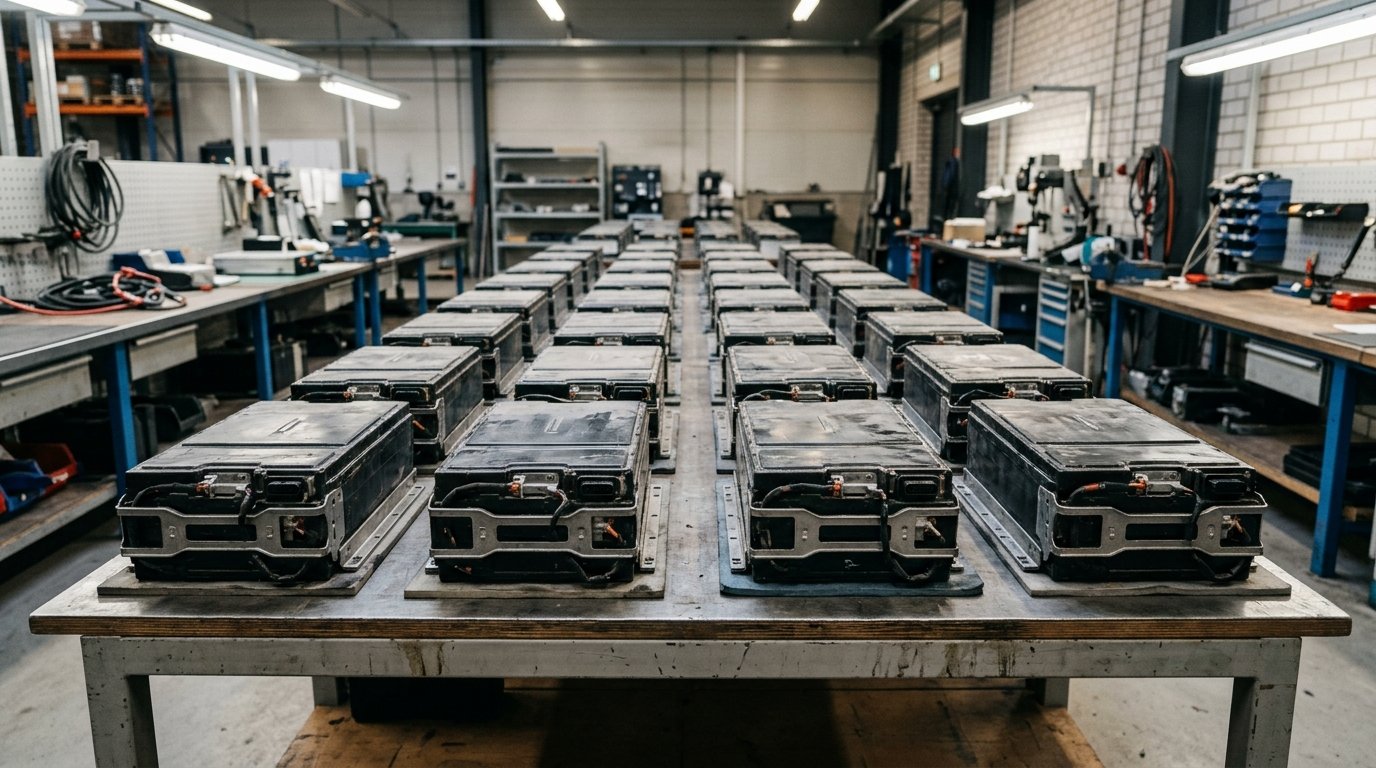
The Audi e-tron 55 quattro (95 kWh) battery, produced from 2018 to 2023, features a 95 kWh capacity and uses NMC chemistry supplied by LG Energy Solution. This battery pack weighs approximately 700 kg, making it one of the heavier units in its class. As these batteries reach end-of-life, they are increasingly being repurposed for second-life applications such as stationary energy storage systems or fully recycled to extract valuable materials like lithium and cobalt.
nd-spoke model
- Redwood Materials (US) - integrated cell-to-cell recycling, supplies recovered cathode material back to major OEMs
- Umicore (Belgium, global) - integrated smelter
- Ecobat - lead-acid + lithium-ion
- Audi closed-loop programme (where available - see take-back URL below)
Manufacturer take-back
Audi sustainability + battery recycling
In the EU, manufacturers are obligated under EU Battery Regulation 2023/1542 (effective 2024) to provide free take-back for EV batteries. In the US, state-level laws vary - California's SB 615 (effective 2026) requires similar manufacturer responsibility.
Compliance and safety
EV batteries are classified as UN3480 / UN3481 (lithium-ion battery) under hazardous-materials transport regulations. Movement requires:
- Class 9 hazmat-certified transporter
- Damaged-pack protocol (typically requires container with non-conductive padding)
- Documentation: Bill of Lading + UN packaging certificate
Cannot be transported on a regular vehicle without certified packaging.
Where this fits in the bigger picture
By 2030, the IEA projects 1.4 million tonnes of EV battery waste annually globally. The Audi e-tron 55 quattro (95 kWh) contributes to this stream when retired. With 11 kg of lithium per pack, recovering even a fraction returns critical minerals to the supply chain - recovered lithium typically costs 30-50% less in carbon footprint than freshly mined material (NREL ReCell Center data).
Related guides
Sources
- Audi battery sustainability disclosure
- US DOE National Renewable Energy Laboratory ReCell Center
- IEA Global EV Outlook 2024
- EU Battery Regulation 2023/1542
- Cell supplier (LG Energy Solution) published specifications
- LME spot prices for cobalt, nickel, lithium carbonate
Frequently Asked Questions
How much is a used Audi e-tron 55 quattro (95 kWh) battery worth?
Second-life market value (for grid storage, residential battery wall, off-grid use) typically $6000-12000 USD. Full recycling material value $1200-2100 USD. Almost always more economic to extend useful life via second-life rather than scrap immediately.
What chemistry is the Audi e-tron 55 quattro (95 kWh) battery?
NMC, supplied by LG Energy Solution. The pack weighs 700 kg and stores 95 kWh of energy.
How is the Audi e-tron 55 quattro (95 kWh) battery recycled?
Major recyclers (Li-Cycle, Redwood Materials, Umicore) dismantle the 700 kg pack, test cells for second-life eligibility (70%+ capacity), then non-viable cells go through hydrometallurgical or pyrometallurgical processing to recover lithium (11 kg), cobalt (7 kg), nickel (85 kg), copper, and aluminium.
Does Audi take back the Audi e-tron 55 quattro (95 kWh) battery?
Yes. See [Audi take-back programme](https://www.audi.com/en/sustainability.html). Under EU Battery Regulation 2023/1542 (effective 2024), all EU sales include free manufacturer take-back at end-of-life. US take-back is currently voluntary with state-level requirements emerging (California SB 615 effective 2026).
Can I transport an EV battery myself?
No. The Audi e-tron 55 quattro (95 kWh) battery is UN3480/UN3481 hazmat-classified. Movement requires a Class 9 certified transporter with proper packaging and Bill of Lading. Damaged packs have additional protocol. Cannot be moved on a regular vehicle.