Quick Answer
E-waste (electronic waste) is any discarded device with a plug, battery, or circuit board. This includes everything from smartphones and laptops to refrigerators and solar panels.
The world generates approximately 62 million tonnes of e-waste per year (UN Global E-Waste Monitor 2024) - equivalent to dumping 800 million laptops every 12 months. Only 22% is formally collected and recycled. The remaining 78% goes to landfill, informal scrap yards, or undocumented international export.
The technical definition
The most authoritative international definition comes from the EU Waste Electrical and Electronic Equipment Directive (WEEE Directive 2012/19/EU), which defines WEEE as:
> Equipment which is dependent on electric currents or electromagnetic fields in order to work properly, and equipment for the generation, transfer and measurement of such currents and fields, and designed for use with a voltage rating not exceeding 1,000 volts for alternating current and 1,500 volts for direct current.
In practical terms: anything you plug in, runs on a battery, or has a circuit board.
The US EPA uses a similar definition under the umbrella term "used electronics" or "e-waste," though no federal US law mirrors the EU's complete scope. US definitions are state-by-state, with the broadest scope in California (Electronic Waste Recycling Act of 2003) and Washington (Electronic Product Recycling Programme).
The UN Global E-Waste Monitor - the most-cited international source - uses six WEEE categories aligned with EU classification:
- Temperature exchange equipment: refrigerators, freezers, AC units, heat pumps, dehumidifiers
- Screens and monitors: TVs, monitors, laptops, tablets
- Lamps: LED bulbs, CFL bulbs, fluorescent tubes
- Large equipment: washing machines, dryers, dishwashers, cookers, large IT equipment
- Small equipment: kettles, toasters, microwaves, vacuum cleaners, hairdryers, electric toothbrushes, power tools, toys, smoke detectors
- Small IT and telecommunications equipment: smartphones, GPS devices, calculators, routers, computers under specific weight limits
This six-category framework is the industry standard for both regulation and statistics.
What e-waste is NOT
For clarity: - Used clothing is not e-waste (it's textile waste) - Used cars are not e-waste (they're end-of-life vehicles, separate stream - though their EV batteries enter the e-waste pathway) - Construction materials are not e-waste - Bulk plastic packaging is not e-waste (though small packaging electronics like RFID tags occasionally are) - Single-use medical devices are usually classified as biomedical waste, not e-waste - even if electronic
The boundary case: batteries. EU classifies batteries separately under the EU Battery Regulation (2023/1542), but the practical disposal pathway is integrated with e-waste recycling.
Global volumes - the numbers
2024 baseline (UN Global E-Waste Monitor 2024) - Total generated: 62 million tonnes per year (2022 data, latest available) - Per capita: 7.8 kg per person globally; 17.5 kg in Europe; 16.2 kg in Oceania; 14.5 kg in Americas; 6.4 kg in Asia; 2.5 kg in Africa - Formally collected and recycled: 13.8 million tonnes (22.3%) - Documented as recycled in informal sector: 14 million tonnes (22.6%) - counted but lower-quality processing - Undocumented (landfill, dumping, illegal export): 34.2 million tonnes (55.1%) - environmental and health risk
2030 projection
UN expects e-waste generation to reach 82 million tonnes per year by 2030 - a 32% increase over 2022. Key drivers: - Rising consumption in developing economies - Falling device lifespans (modern smartphones last 3-4 years vs 6-8 years in 2010) - Mass adoption of solar panels, EV batteries, IoT devices - Replacement of legacy infrastructure (smart meters, AI servers)
Without intervention, formal recycling rates are unlikely to keep pace.
Country-level highlights
| Region | E-waste/year | Per capita | Recycling rate |
|---|
| China | 14.0 million tonnes | 9.5 kg | 16% |
| US | 7.5 million tonnes | 22.4 kg | 15% |
| EU-27 | 5.4 million tonnes | 12.0 kg | 39% |
| India | 4.4 million tonnes | 3.0 kg | 1% |
| UK | 1.5 million tonnes | 22.0 kg | 41% |
| Japan | 2.6 million tonnes | 20.5 kg | 28% |
| Australia | 0.6 million tonnes | 21.7 kg | 13% |
| Germany | 1.7 million tonnes | 20.5 kg | 52% |
The EU and Switzerland lead the world on collection rates (50%+) due to mandatory EPR laws enacted 2003-2012.
The US lags (15%) because federal regulation is absent - only 25 of 50 states have mandatory laws, and even within those states convenience and enforcement vary widely. See our 50-state e-waste law tracker for detail.
What's growing fastest
The fastest-growing categories of e-waste:
- Photovoltaic (solar) panels - installed base grew 800% from 2015-2025, panels installed in 2010-2015 are now reaching end-of-life
- EV batteries - first generation Tesla Model S (2012), Nissan Leaf (2010-2017) reaching 8-12 year service life. See our EV Battery Aftermarket Dashboard 2026
- Wireless earbuds - sealed designs (Apple AirPods scored 0/10 on iFixit repairability) means high replacement rate
- Smart home devices - voice assistants, security cameras, smart bulbs typically last 3-5 years
- E-bike batteries - explosive growth in EU and Asia, lithium-ion cells with 5-7 year service life
What's actually inside
A representative breakdown of materials in a tonne of mixed e-waste (per UNEP estimates):
| Material | Mass per tonne | Estimated value |
|---|
| Iron / steel | 480 kg | $190 |
| Plastic | 240 kg | $400 |
| Aluminium | 50 kg | $120 |
| Copper | 40 kg | $360 |
| Glass | 27 kg | $30 |
| Lead | 18 kg | $40 |
| Tin | 9.5 kg | $250 |
| Nickel | 8 kg | $135 |
| Zinc | 5.5 kg | $20 |
| Antimony | 2 kg | $25 |
| Silver | 80 g | $90 |
| Gold | 12 g | $1,800 |
| Palladium | 4 g | $190 |
| Other | balance | $50 |
| Total | 1 tonne | ~$3,700 recoverable |
Per the Scrap Value Calculator, individual devices contain proportionally: - Smartphone: $2.78 in recoverable material - Laptop: $17.84 - Desktop computer: $36.93 - EV battery: $51.59 - Refrigerator: $35.26
The $3,700 per tonne is in raw recovered material at industrial spot prices. Refining and processing costs typically take 40-60% of this value, leaving $1,500-$2,200 in net recovered value per tonne for the recycler.
This is why formal e-waste recycling can operate as a profitable industry - it doesn't require government subsidy in most jurisdictions. The economic challenge is collection and logistics, not the underlying material value.
The hazardous component problem
E-waste is not just landfill volume. It contains substances that cause specific environmental and health harm if mishandled:
Lead - Where: CRT television and monitor glass (1-3kg per unit), solder on circuit boards (~50g per device), some battery chemistries - Risk: neurotoxin; affects children's cognitive development at extremely low blood concentrations - Disposal: must go to specialist lead-handling facility
Mercury - Where: backlights in pre-LED LCD displays (~5mg per CCFL backlight), thermometers, thermostats, fluorescent tubes (3-15mg per tube) - Risk: bioaccumulates in food chain; severe neurological harm - Disposal: never crush; recover at HHW collection
Cadmium - Where: NiCd batteries (legacy), some semiconductors, CRT phosphors - Risk: kidney and bone damage; carcinogen - Disposal: hazardous waste stream
Brominated flame retardants (PBDEs, TBBPA) - Where: circuit boards and plastic device housings - Risk: endocrine disruption; bioaccumulation - Disposal: incineration releases dioxins; must go to specialist recycler with controlled atmosphere processing
Refrigerant gases (CFCs, HFCs) - Where: refrigerators, air conditioners, heat pumps, dehumidifiers - Risk: extremely high greenhouse warming potential (1,400-3,200x CO2). CFCs also destroy ozone layer. - Disposal: must be recovered by EPA Section 608-certified technician (US) or F-Gas Regulation-certified technician (EU/UK). See our refrigerator recycling verification checklist.
Lithium (in lithium-ion batteries) - Where: every device made after 2012, EV batteries, e-bike batteries - Risk: fire and explosion when crushed, punctured, or short-circuited. Cause of 70%+ of recycling-facility fires. - Disposal: separate battery stream, never mix with general e-waste
Arsenic, antimony, beryllium, hexavalent chromium - Where: various semiconductors, alloy contacts, anti-corrosion coatings - Risk: carcinogenic; lung damage from inhalation - Disposal: managed within specialist e-waste processing
The cumulative hazardous-material burden in 62 million tonnes of e-waste per year is substantial. Improper disposal causes documented health harm in informal-sector recycling communities (e.g. Agbogbloshie, Ghana; Guiyu, China; pre-2010 enforcement crackdown).
Where e-waste actually goes
The formal pathway (22% of global volume)
- Collected at retailer takeback, council facility, or curbside
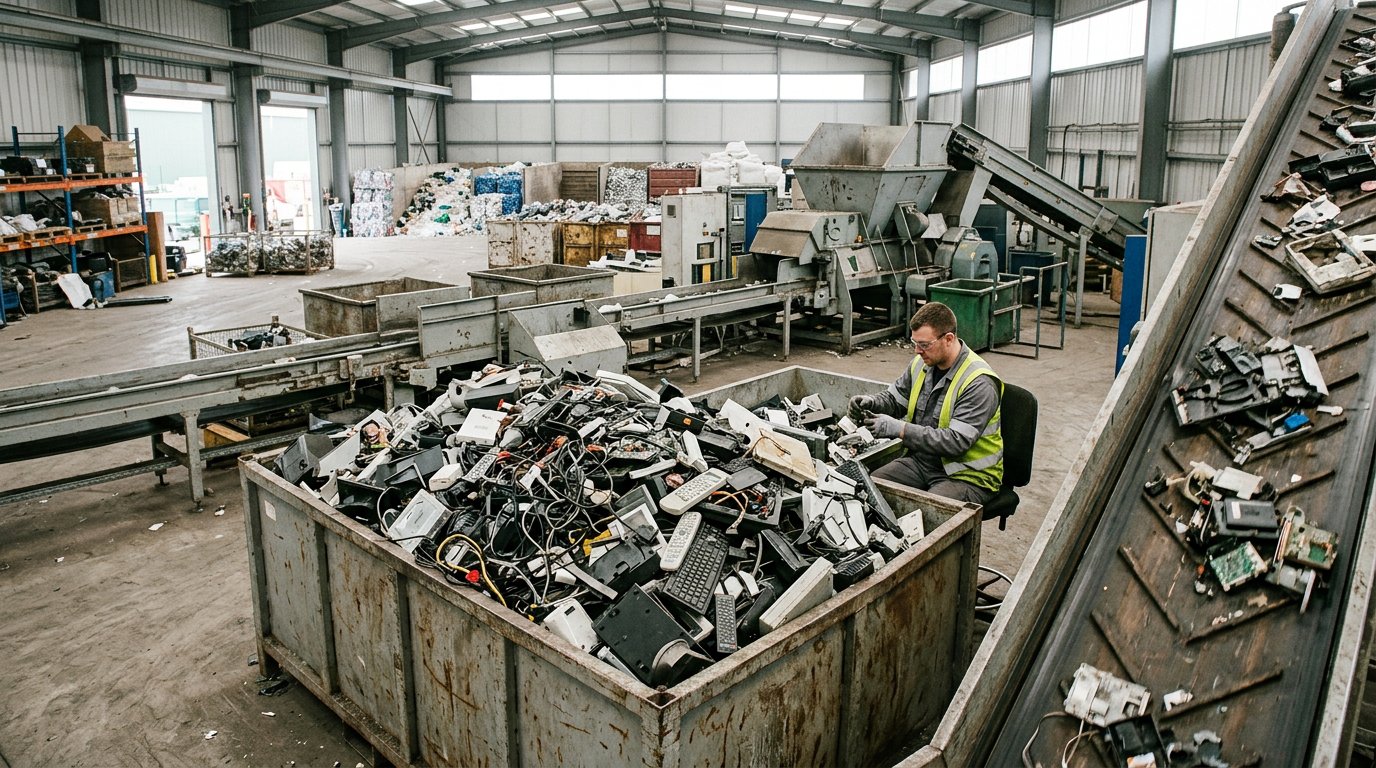
- Aggregated at Material Recovery Facility (MRF)
- Manual sorting by device type
- Battery and refrigerant removal
- Mechanical shredding and material separation
- Refining (steel to electric arc furnaces, copper to refineries, plastics to pellets)
- Hazardous components to specialist disposal
- Recovered materials re-enter manufacturing supply chain
Recovery rate at modern integrated facilities: ~95% by mass.
The informal pathway (~22% of global volume)
Concentrated in West Africa (Ghana, Nigeria, Ivory Coast) and South/Southeast Asia (India, Pakistan, Bangladesh). Workers - often including children - manually disassemble devices to extract copper, gold, and rare metals.
Methods used: - Open-air burning of plastic-coated wires to recover copper (releases dioxins) - Acid leaching with cyanide or nitric acid to recover gold (groundwater contamination) - Manual smashing of CRT screens (lead exposure)
Health impacts on workers and surrounding communities are documented in WHO reports, peer-reviewed studies (Wittsiepe et al. 2017; Caravanos et al. 2011), and journalist exposés.
The Basel Convention (1989, ratified by 191 countries) prohibits transboundary movement of hazardous waste from OECD to non-OECD countries - but enforcement is partial, and the line between "used electronics for refurbishment" (legal) and "scrap e-waste for disposal" (illegal export) is exploited.
Landfill (a portion of the 55%)
Most US states (and 25 with no mandatory law) allow consumer electronics in regular trash. Hazardous components leach over decades: - Lead from CRT glass into groundwater - Mercury vapour into atmosphere - Plastic micro-fragmentation into soil - Brominated flame retardants persist for centuries
Modern lined landfills reduce leaching but don't eliminate it. Pre-1990s landfills (most existing landfill capacity in the US and EU) have minimal liner protection.
Informal export (the remainder)
Despite the Basel Convention, an estimated 5-15 million tonnes of e-waste annually moves from OECD to non-OECD countries via shipping containers labelled as "used electronics for refurbishment." A portion is genuinely refurbished and reused; the remainder enters the informal recycling pathway.
R2 and e-Stewards certifications were created specifically to give consumers and businesses a way to verify their recycler doesn't participate in undocumented export.
Why the recycling rate is so low
Three structural reasons formal recycling is stuck around 22% globally:
Reason 1: Economic competition from informal sector
Informal recyclers operate at lower cost (no environmental controls, low/no labour wages, no compliance overhead). They can pay scrap collectors more than formal recyclers in many jurisdictions, capturing the supply.
Reason 2: Convenience friction
Even in well-regulated markets like the EU, surveys consistently find that "I don't know how/where to recycle" is the #1 reason households don't recycle electronics. Convenience matters more than regulation.
Reason 3: Lack of infrastructure in developing countries
Most growth in e-waste generation is happening in countries (India, China, Indonesia, Brazil, Nigeria) where formal recycling infrastructure is decades behind device adoption rates.
The UN Global E-Waste Monitor's 2030 forecast assumes these dynamics persist - without intervention, the formal recycling rate will likely decline as a percentage of total volume even as absolute volume grows.
What works to increase recycling rates
Empirical evidence from the past 25 years of policy experimentation:
What works - Manufacturer-funded EPR (extended producer responsibility) laws - proven to drive recycling rates from <10% to 40-60% within 5-10 years (EU experience) - Landfill bans combined with takeback infrastructure - California and Washington showed 30%+ rate increases within 3 years of ban implementation - Free residential drop-off - convenience is the single biggest factor in collection rates - Retailer takeback obligations - UK WEEE Regulations 2013 nearly doubled UK collection rates - Deposit-return schemes for batteries - 80%+ collection rates achievable
What doesn't work - Voluntary manufacturer programmes - collection rates stay <15% in voluntary jurisdictions - Consumer education campaigns alone - without infrastructure, awareness doesn't translate to behaviour - High recycling fees (paid by consumer at disposal) - backfires; encourages illegal dumping - Landfill bans without enforcement - Indiana and South Carolina ban CRTs from landfill but minimal enforcement and rates remain low
The policy debate in the US over the next 5-10 years is largely about extending EPR-style laws to the 25 states without them, and adding categories (solar panels, mattresses, batteries) to existing state laws.
What you can do as an individual
In rough order of impact:
High impact
- Repair before replace - extending device life by 1-2 years cuts the per-year e-waste contribution proportionally. See our Manufacturer Recycling Scorecard 2026 for which brands actually support repair.
- Buy refurbished - refurbished smartphones and laptops are functionally identical to new at 40-70% of cost, and prevent new manufacturing emissions.
- Choose repairable brands - Framework laptops, Lenovo ThinkPads, Pixel phones all score 7-10 on iFixit repairability. Apple AirPods score 0.
Medium impact
- Use formal recycling routes when you do dispose - see Complete Guide to Electronics Recycling 2026 for the 6 routes
- Don't hoard old devices - drawer-stored devices often end up in landfill via house clearance or moves; recycling now is better than recycling never
- Wipe data securely so you can pass devices to charity or trade-in rather than recycle. See Data Wiping Guide.
Lower impact (still worthwhile)
- Vote for EPR legislation in non-mandatory states (in the US, 25 states still have no law)
- Support Right to Repair legislation - see our Right to Repair Laws State-by-State Guide
- Pressure manufacturers via reviews and direct customer feedback channels - Apple's 2022 Self Service Repair launch followed years of pressure
Frequently asked questions
Is e-waste really the fastest-growing waste stream? Yes - UN data confirms e-waste generation is growing approximately 3.4% per year globally, faster than any other major waste category.
How long does e-waste last in landfill? Plastic components: 500+ years. Metal components: indefinitely until corroded (decades to centuries). Hazardous components: continuous leaching at decreasing rates over decades.
What percentage of my old phone gets recycled? At a modern integrated R2 or e-Stewards certified facility: approximately 95% by mass is recovered. The remaining 5% includes hazardous components that go to specialist disposal and small contaminants that can't be cost-effectively separated.
Does recycling actually save energy versus making new electronics? Yes - substantially. Recycling 1 tonne of aluminium saves 95% of the energy required to mine and refine new aluminium from bauxite. Recycling steel saves 60%. Recycling copper saves 85%. The carbon-emissions reductions are correspondingly large.
Why do new phones break so much faster than old ones? Multiple factors: thinner glass, sealed batteries with no replacement provision, more complex software causing battery degradation cycles, and design choices that prioritise aesthetics over repairability. See our Manufacturer Recycling Scorecard for which manufacturers buck this trend.
What's the worst e-waste destination? Open-air burning in informal scrap yards in the global south. Recovers copper but releases dioxins and heavy metals into the surrounding environment, with documented health impacts on workers and communities.
Are electric vehicles part of the e-waste problem? EV batteries are large, valuable, and dangerous to handle - but they're also among the most aggressively recycled categories because of recoverable lithium, cobalt, nickel, and copper value. See our EV Battery Aftermarket Dashboard 2026.
What about solar panels? Solar panels reaching end-of-life is a fast-growing category. The EU has had mandatory recycling under WEEE since 2014. The US is following - Washington State first to mandate (2017), several others considering. Each panel contains 16.5kg of recoverable silver alone.
Will AI servers create a massive new e-waste category? Yes. AI training infrastructure (NVIDIA H100/H200 GPUs, hyperscale data centres) is being installed at unprecedented rates with 3-5 year refresh cycles. The 2027-2030 wave of AI hardware retirement will be a major new e-waste category - high in copper, gold, and rare metals (good for recyclers), high in lithium battery backup systems (fire risk).
What's the role of consumers vs governments vs manufacturers? All three are required. Manufacturer-funded EPR laws (government creates, manufacturers fund) handle the structural problem. Consumer behaviour matters at the margin - choosing repairable products and using formal recycling routes when disposing.
Can e-waste be eliminated entirely? Not with current technology. Even devices designed for full circularity (Framework laptop, Fairphone) contain materials that eventually wear out and require recycling. The achievable goal is closing the loop - recovered materials become new device components, reducing dependence on primary mining.
Sources - UN Global E-Waste Monitor 2024 - published by ITU + UNITAR; the authoritative source on global e-waste statistics - EU WEEE Directive 2012/19/EU (full text via eur-lex.europa.eu) - EU Battery Regulation 2023/1542 - US EPA Sustainable Materials Management programme - Basel Convention on transboundary movement of hazardous waste - WHO E-Waste and Children's Health technical series - Wittsiepe et al. (2017) - health study at Agbogbloshie, Ghana - Caravanos et al. (2011) - informal sector e-waste sampling - Ponemon Institute / IBM Cost of a Data Breach Report 2024 - NCSL State Electronic Waste Recycling Laws database
Disclaimer
This guide reflects 2026 data and policy. E-waste statistics are updated by the UN Global E-Waste Monitor approximately every 2-3 years; values cited here will refresh in 2026-2027. eCycling Central is an independent information directory operated by Defining Style Limited (UK Companies House 10572391).