Quick Answer
Electronics recycling is the process of collecting end-of-life electronic devices and recovering their constituent materials (precious metals, base metals, plastics, glass) for use in new products, while safely managing hazardous components (lithium batteries, mercury, lead, refrigerants).
In 2026, roughly 22% of the world's e-waste is formally recycled (UN Global E-Waste Monitor 2024). The remaining 78% goes to landfill, informal scrap markets, or undocumented export. This guide explains how to make sure your old electronics end up in the 22%, not the 78%.
What counts as electronics worth recycling
The legal definition varies by jurisdiction, but the practical scope of "electronics recycling" covers: - IT equipment: laptops, desktops, monitors, servers, peripherals (keyboards, mice, printers) - Mobile devices: smartphones, tablets, e-readers, smartwatches - Audio/video: televisions, hi-fi equipment, speakers, headphones, gaming consoles - Major appliances: refrigerators, washing machines, dishwashers, dryers, ovens, microwaves, air conditioners - Small appliances: kettles, toasters, hairdryers, vacuum cleaners - Telecoms: routers, modems, landline phones, fax machines - Lighting: LED bulbs, CFL bulbs, fluorescent tubes - Tools and toys: power tools, electric toys, drones - Energy storage: household batteries (alkaline, lithium-ion), EV batteries, e-bike batteries - Renewables: solar panels, wind turbine components
The EU's WEEE Directive (Waste Electrical and Electronic Equipment) classifies these into 10 categories, while US state laws cover narrower scopes - typically just "covered electronic devices" (CEDs): televisions, monitors, laptops, desktops, and tablets above a certain screen size.
Why electronics need separate recycling
Unlike paper or aluminium cans, electronics contain a complex mix of valuable and hazardous materials that require specialised handling.
The valuable materials
A single tonne of mobile phones contains approximately 350g of gold, 3.5kg of silver, 130kg of copper, and 12kg of palladium (per UN E-Waste Monitor 2024). At 2026 commodity prices, that's recoverable material worth $40,000-$60,000 per tonne - significantly higher per unit weight than gold ore at most operating mines.
A typical laptop contains 220 milligrams of gold, 1.1 grams of silver, 290 grams of copper, and 80 milligrams of palladium. At today's spot prices and a 40% recycler buyback rate, that's around $17.84 per laptop in recoverable material value alone - see our Scrap Value Calculator for live figures by device.
A single tonne of solar panels yields about 16.5kg of silver, $250+ of recoverable copper, plus aluminium frames worth their weight in scrap. This is why solar recycling is one of the fastest-growing segments of the recycling industry.
The hazardous materials
The same devices contain materials that cause environmental and health harm if not properly handled: - Lithium batteries (in nearly every device made after 2012) - fire risk, can ignite spontaneously when crushed - Lead - older CRT television and monitor glass contains 1-3kg of lead per unit - Mercury - backlights in older LCD displays, switches in some thermostats and fluorescent tubes - Cadmium - battery contacts and some semiconductors - Beryllium - electrical contacts and microwave magnetron components - Brominated flame retardants - circuit boards, plastic housings (PBDEs, TBBPA) - Refrigerants - CFCs in pre-1995 fridges/AC units, HFCs in modern equivalents (greenhouse warming potential 1,400-3,200x CO2) - Phosphorus - CRT screen coatings
Improper disposal allows these to leach into soil and groundwater (landfill), volatilise into the atmosphere (incineration), or harm informal-sector workers (export to developing countries).
This combination - high recoverable value plus serious hazard if mishandled - is why electronics recycling exists as a distinct waste stream from regular household refuse.
How to recycle electronics: the 6 routes that work
Route 1: Retailer drop-off (free, fastest)
National retailers operate free electronics recycling at every store regardless of where you bought the item. The major programmes:
United States: - Best Buy - accepts most consumer electronics free (up to 3 items per household per day). Larger items charged for haul-away ($30-50). Complete list: bestbuy.com/recycling - Staples - free drop-off for office electronics, ink cartridges, batteries (up to 7 items per visit) - Office Depot / OfficeMax - same as Staples - Home Depot / Lowes - rechargeable batteries, CFL bulbs, fluorescent tubes free; major appliances haul-away with delivery
United Kingdom: - Currys - free drop-off for any electronics regardless of where bought. Haul-away with new appliance delivery. - John Lewis - free in-store recycling for electricals - AO.com - collects old appliance with delivery (£15-25) - Argos - small electronics drop-off - Local councils - free WEEE collection at all 1,200+ Household Waste Recycling Centres
EU: - MediaMarkt / Saturn (DE/AT/PL/NL) - free drop-off - Boulanger / Darty / Fnac (FR) - free drop-off plus collection-with-delivery - El Corte Inglés (ES) - free drop-off
Australia: - Officeworks - free drop-off via Officeworks Bring It Back programme - Mobile Muster - free post-back for any mobile
Canada: - Best Buy Canada - same programme as US - Staples Canada - same as US - The Source - accepts electronics in-store
Route 2: Manufacturer takeback (free, all countries)
Every major manufacturer operates a free takeback programme - print a postage label, mail your device, the manufacturer recycles it. These accept other manufacturers' devices in many cases (call to confirm):
| Manufacturer | Programme |
|---|
| Apple | Apple Trade In (apple.com/recycling) - also accepts non-Apple devices for free recycling |
| Dell | Dell Reconnect (partnered with Goodwill US) and Dell Mail-Back |
| HP | HP Planet Partners - free mail-back labels |
| Samsung | Samsung Recycling Direct |
| Lenovo | Lenovo Asset Recovery Services (business) and Recycling Programme (consumer) |
| Microsoft | Microsoft Trade In and Recycling |
| Sony | Sony Take Back |
| LG | LG Recycling Programme |
| Logitech | Logitech Closing the Loop programme |
These programmes are funded by manufacturers as part of extended producer responsibility (EPR) compliance in regions with mandatory laws. They operate in countries without EPR laws too, because manufacturers want consistent global processes.
Route 3: Local certified recycler
Independent recyclers operate outside any manufacturer or retailer programme. The two key certifications to look for: - R2 (Responsible Recycling) Standard - managed by SERI, focuses on responsible end-of-life, data security, and worker safety. List of certified recyclers: sustainableelectronics.org/r2/ - R2 certification standard - managed by Basel Action Network, more stringent than R2, prohibits export to non-OECD countries. List: e-stewards.org
For finding a certified recycler near you, use our recycling locator or browse the Top 50 US Electronics Recyclers Directory.
Route 4: Council / municipal collection
Every UK council, every US county, and every EU member state operates Household Waste Recycling Centres or Household Hazardous Waste (HHW) collection events. These are typically free for residents (sometimes a per-load fee for vehicles).
Find your closest: - UK: recyclenow.com (postcode lookup) - US: earth911.com (ZIP lookup) - Canada: recycle.bc.ca (BC) or province-equivalent - Australia: recyclingnearyou.com.au - EU: country-specific (e.g. DE: NABU recycling map, FR: ecologic-france.com)
Route 5: Charity donation (working items only)
If your device still works, donate before recycling. Recipients gain access to working technology; you skip the recycling pathway entirely.
US/UK charities accepting electronics: - Goodwill (US) - accepts most electronics - Computers for Schools (UK) - wipes data, gives to schools - British Heart Foundation (UK) - large-appliance collection - Salvation Army (US/UK) - most electronics - Computer Aid International - refurbishes for developing-country schools
Route 6: Trade-in for cash
For working devices with resale value, trade in directly: - Back Market (US/UK) - instant cash quote for phones, tablets, laptops, CDs, books - Gazelle (US) - locked-in price for 30 days - Swappa (US) - peer-to-peer marketplace, you ship to buyer - Apple Trade In - credit toward new Apple device - Samsung Trade-In - credit toward new Samsung device - MusicMagpie (UK) - equivalent to online buyback services in UK - Mazuma Mobile (UK) - phones only
A working iPhone 13 Pro nets approximately $250-$400 trade-in vs $4-$6 in scrap material value - for working devices, trade-in is the right answer.
Step-by-step: how to actually recycle a device
Step 1: Decide repair vs recycle
Before recycling, check whether repair is economic. iFixit publishes repairability scores for most modern devices - anything 7+ is generally worth repairing if the cost is under 50% of replacement.
Common faults that are cheaper to repair than replace: - Phone screen replacement: $100-$300 vs $600+ replacement - Laptop battery replacement: $50-$150 vs $1,000+ replacement - Washing machine pump or motor: $50-$200 vs £400+ replacement
Step 2: Back up data
Before any factory reset: - Phones / tablets: iCloud (iPhone), Google Backup (Android) - Laptops: Time Machine (Mac), File History (Windows), or external drive - Standalone storage: copy to a new device or cloud
For complete data wiping guidance (including DBAN, certified destruction certificates, and HIPAA/GLBA compliance), see our complete guide: How to Wipe Data Before Recycling Electronics.
Step 3: Wipe data
A factory reset is sufficient for most consumer devices: - iPhone: Settings → General → Transfer or Reset iPhone → Erase All Content and Settings (uses encryption keys, instant secure erase) - Android: Settings → System → Reset → Erase all data (factory reset). Modern Android devices also use file-based encryption - secure on most models post-2018 - Mac: System Settings → General → Transfer or Reset → Erase All Content and Settings (Apple Silicon uses Secure Enclave for instant secure erase) - Windows: Settings → System → Recovery → Reset this PC → Remove everything → Clean drive (slower but thorough)
For sensitive data (HIPAA, GLBA, SOX-regulated), factory reset is not sufficient - use DBAN (Darik's Boot and Nuke), HDDErase (for older HDDs), or physical destruction by a certified ITAD provider.
Step 4: Remove batteries (where possible)
Lithium-ion batteries are the highest-risk component in any electronics recycling stream - they cause more than 70% of recycling-facility fires (Resource Recycling industry data 2023-2024). - Removable battery devices: pull the battery and recycle separately (Best Buy, Home Depot, Lowes accept loose batteries free) - Sealed-battery devices: leave the battery in place - never attempt to extract from a sealed enclosure (puncture risk) - Dead batteries: tape over the contacts with electrical tape before disposal to prevent short-circuit fires
Step 5: Remove personal accessories
Take out: - SIM cards (phones) - microSD cards (phones, cameras) - External hard drives (laptops, NAS) - USB drives (any device) - Memory cards (cameras, gaming consoles)
These contain personal data even after device factory reset and should be wiped or destroyed separately.
Step 6: Drop off or schedule pickup
Choose your route from the 6 above based on device type, value, and convenience. For heavy items (TVs, large appliances), retailer haul-away with new appliance delivery is usually the easiest path.
Step 7: Get a receipt (for businesses)
Even residential recycling: keep a receipt or screenshot of your drop-off. For HIPAA-regulated entities, GDPR-regulated entities, or SOX-regulated entities, you need a notarised certificate of destruction from a certified ITAD provider - see our ITAD services directory.
What happens after you drop it off
Modern e-waste recycling is a multi-stage industrial process:
Stage 1: Aggregation
Collected devices are accumulated at a Material Recovery Facility (MRF) or specialist e-waste processor until truckload quantities are reached.
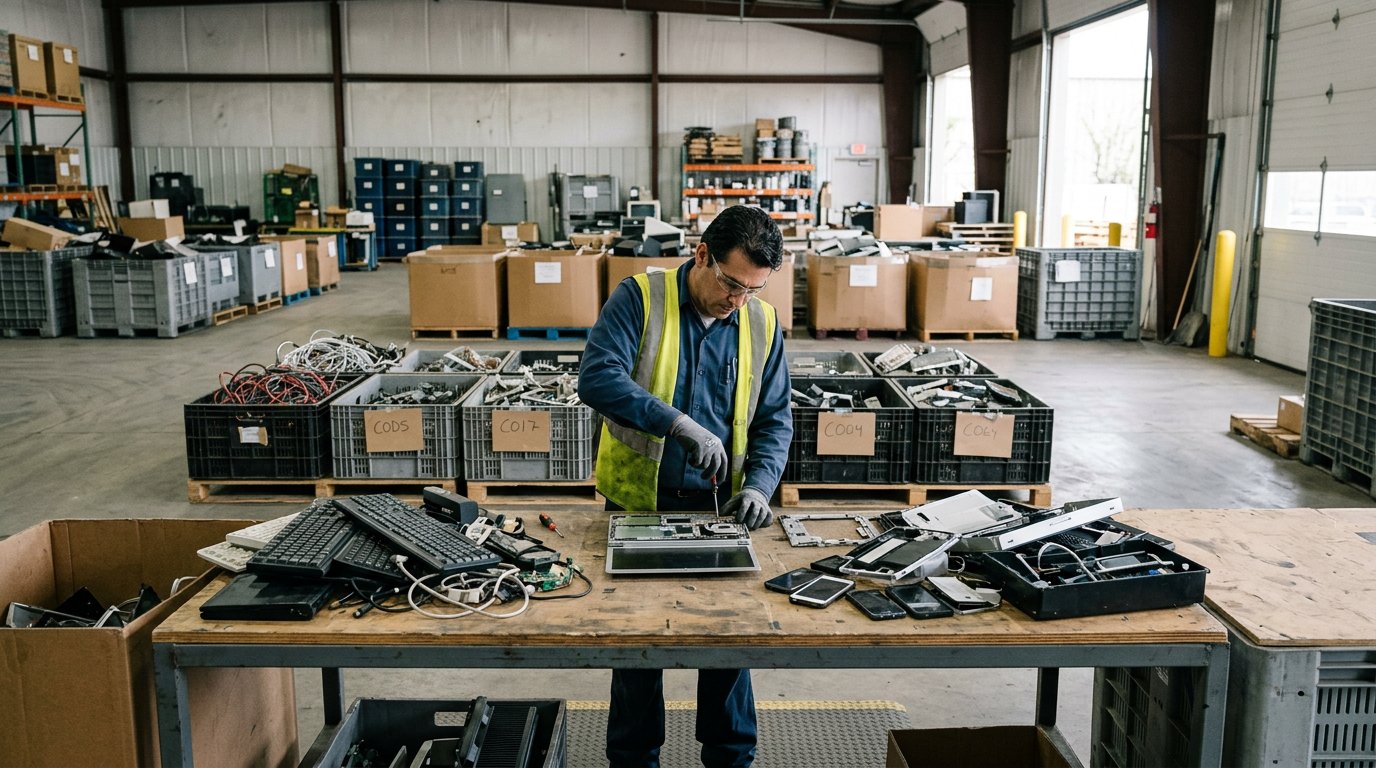
Stage 2: Manual sorting
Workers sort devices by type - battery-bearing devices separated for de-batterying, refrigerant-bearing devices separated for gas recovery, intact circuit boards separated for precious-metal refining.
Stage 3: De-batterying
Lithium batteries are removed and sent to specialist battery recyclers (Li-Cycle, Redwood Materials in the US; Northvolt Revolt, Umicore in EU). See our
EV Battery Aftermarket Dashboard for the equivalent at scale.
Stage 4: Refrigerant recovery
For fridges, freezers, AC units, dehumidifiers - refrigerant is recovered by EPA Section 608-certified technicians (US) or F-Gas Regulation-certified technicians (EU/UK). See our
refrigerator recycling verification checklist.
Stage 5: Mechanical processing
Remaining device hulks are shredded, then sorted by: - Magnetic separation (steel removal) - Eddy current separation (aluminium and copper extraction) - Density separation (plastic versus metal) - Optical sorting (plastic colour and type identification)
Stage 6: Refining
Materials enter the broader commodity supply chain: -
Steel to electric arc furnaces (recycled steel uses 60% less energy than primary steel) -
Copper to refineries (recycled copper uses 85% less energy than primary copper) -
Plastics to pellet manufacturers for new product use -
Circuit boards to integrated metals refineries (Aurubis, Umicore, Boliden) for precious metal recovery
Stage 7: Hazardous component handling
Components that cannot be recovered - CRT lead glass, mercury switches, brominated-flame-retardant plastics - are isolated for specialist disposal under hazardous waste rules.
The overall recovery rate at modern integrated facilities is approximately 95% by weight (UNEP E-Waste Monitor methodology).
Country and state regulations
E-waste regulations vary dramatically by jurisdiction. Some highlights:
United States
No federal e-waste law - regulation is state-by-state.
25 US states have mandatory e-waste recycling laws. Browse the deep-dive guide for each: -
California Electronics Recycling Law (the strictest) -
New York Electronics Recycling Law -
Texas Electronics Recycling Law -
Illinois Electronics Recycling Law
Plus 25 voluntary-programme states (browse all in our state law tracker series).
United Kingdom
WEEE Regulations 2013 (implementing EU WEEE Directive). All UK retailers selling electronics must offer free in-store takeback or contribute to a Distributor Takeback Scheme. The Environment Agency operates the Producer Compliance Scheme.
European Union
WEEE Directive 2012/19/EU - sets collection targets (65% of average annual put-on-market). Every EU member state has implementing legislation. Strictest implementation: Germany, Sweden, Belgium.
Australia
National Television and Computer Recycling Scheme (NTCRS) - manufacturer-funded since 2011. Free drop-off at participating Officeworks and council collection points.
Canada
Provincial regulation (Ontario's RPRA, BC's Encorp, Quebec's RECYC-QUEBEC each set rules). All major provinces have free residential drop-off.
Japan
Home Appliance Recycling Law - consumer pays a recycling fee at point of sale (yen 1,500-4,500 per unit) which funds collection.
Switzerland
SENS / SWICO - voluntary industry programme. Highest collection rate in Europe (over 16kg per capita per year).
Environmental impact (the actual numbers)
Recycling 1 tonne of electronics versus landfilling that same tonne:
| Material | Landfill impact | Recycling benefit |
|---|
| Steel | Slow oxidation, no toxicity | 1.5 tonnes CO2 saved per tonne recycled |
| Copper | Heavy-metal soil contamination | 6.7 tonnes CO2 saved per tonne |
| Aluminium | Slow degradation | 9.0 tonnes CO2 saved per tonne |
| Gold | Effectively lost | 17,000 tonnes CO2 saved per tonne (vs primary mining) |
| Plastic | 500+ years to degrade | 1.5 tonnes CO2 saved per tonne |
| Lithium | Battery fire / leaching risk | Critical for EV transition |
Globally, the UN E-Waste Monitor 2024 estimates that the 22% of e-waste formally recycled saves approximately 26 million tonnes of CO2 emissions per year versus the alternative of primary mining and refining. Doubling formal recycling rates (a stated UN target for 2030) would save the same emissions as taking ~30 million cars off the road.
What it costs (and who pays)
Free routes - Manufacturer takeback (mail-back labels prepaid by the manufacturer) - Most retailer drop-off - Council collection at Household Waste Recycling Centres - Charity donation
Paid routes - Retailer haul-away with new appliance delivery: $25-$50 per item - Junk removal services: $90-$150 per item - Mattress and large-appliance collection (UK councils): £15-£50
Who actually pays at system level
In manufacturer-funded EPR jurisdictions (EU, UK, 20+ US states): recycling cost is bundled into product price - you paid for it when you bought the device.
In advance-fee jurisdictions (California, Japan): you paid a small recycling fee at the point of sale (CA: $5-$7 per video display device).
In non-mandatory jurisdictions (25 US states, Australia in part): cost falls on whoever takes responsibility for disposal - usually the consumer, sometimes the retailer accepting takeback voluntarily.
Common myths debunked
Myth 1: "It all gets exported and dumped in Africa anyway." Partially true 10 years ago, much less so now. R2 and e-Stewards certified recyclers prohibit export to non-OECD countries. The illegal export trade still exists but is shrinking - Basel Convention enforcement and EU WEEE export rules have meaningfully reduced flows since 2018.
Myth 2: "Free recycling means it's not really being recycled." Free at the consumer end - paid for by manufacturers and the recovered material value. Modern e-waste recycling is profitable per tonne due to recoverable metal value; the economics work without consumer fees.
Myth 3: "I should hoard my old electronics in case the data gets out." A factory-reset modern smartphone is essentially impossible to extract data from (file-based encryption with hardware keys). Hoarding is more risky than recycling - devices in attics and drawers are often stolen in burglaries or lost in moves.
Myth 4: "Burning is fine." Absolutely not. Incineration of electronics releases dioxins, mercury vapour, and brominated flame retardant breakdown products into the atmosphere. Burning is illegal in every developed country.
Myth 5: "Newer devices are designed to fail so manufacturers can sell more." There's truth to planned obsolescence (Apple settled a $113M case in 2020 over throttling old iPhones), but it's more nuanced than blanket conspiracy. See our Manufacturer Recycling Scorecard 2026 for which brands actually score well on repairability.
Frequently asked questions
Where can I recycle electronics for free near me? Best Buy, Staples, Currys (UK), or your local council Household Waste Recycling Centre. Use our recycling locator for specific addresses near you.
Can I get money for recycling old electronics? Sometimes. Working devices retain trade-in value via Gazelle, Apple Trade In, etc. Non-working devices have material scrap value (typically $0.50-$50 per device - see our Scrap Value Calculator). Most recyclers don't pay for individual residential drop-offs but do for bulk lots.
Is it illegal to throw old electronics in the trash? In 25 US states, the EU, UK, Canada, and Australia: yes, for most categories (with varying enforcement). In the other 25 US states: technically legal for most categories, but items with mercury, lithium batteries, or refrigerants remain hazardous waste regardless of state law.
How do I make sure my data is secure? Factory-reset modern devices use hardware encryption - secure for typical consumer purposes. For HIPAA/GDPR/SOX-regulated data, use a certified ITAD provider with notarised destruction certificates. See our Data Wiping Guide.
What about old TVs and CRT monitors? CRT glass contains lead (1-3kg per unit). Most US states ban CRTs from landfill. Best Buy charges $25 for CRT TV drop-off. Council recycling centres typically free.
What about refrigerators and air conditioners? Refrigerant gases (HFCs, CFCs) require certified recovery before disposal. Use retailer haul-away with new appliance delivery or council large-appliance collection - never DIY disposal. See our refrigerator recycling verification checklist.
What's the difference between R2 and e-Stewards certifications? Both are voluntary recycler certifications. e-Stewards is stricter - prohibits export to non-OECD countries entirely. R2 allows controlled export under specific conditions. For maximum certainty about ethical disposal, choose an e-Stewards certified recycler.
Are batteries recycled separately from electronics? Increasingly yes. Lithium batteries cause 70%+ of recycling-facility fires when mixed with general e-waste. Most modern programmes have separate battery streams. Specialist battery recyclers (Li-Cycle, Redwood Materials) handle them at scale.
Can I recycle solar panels? Yes - and the industry is growing fast. EU has had mandatory solar panel recycling since 2014 (under WEEE). US: voluntary recycling, with Washington State first to enact mandatory programme (2017). A typical solar panel contains 16.5kg of recoverable silver - the recovery value funds the recycling process. See our solar recycling guide.
What about EV batteries? EV batteries are large (10-100 kWh), valuable ($5,000-$15,000 per pack at scrap), and dangerous to handle (fire risk, high voltage). All major EV manufacturers operate takeback programmes. See our EV Battery Aftermarket Dashboard.
How much e-waste does the world generate? The UN Global E-Waste Monitor 2024 estimates 62 million tonnes per year (2022 data) - equivalent to a 1km-wide ring of waste girdling the Earth's equator. By 2030, expected to reach 82 million tonnes per year.
Why is the formal recycling rate only 22%? Three main reasons: (1) lack of collection infrastructure in developing countries; (2) consumer convenience friction in developed countries; (3) economic competition from informal-sector recyclers (lower cost, lower environmental and labour standards).
Sources and further reading - UN Global E-Waste Monitor 2024 - most authoritative source on e-waste volumes, rates, and impacts. Published by ITU + UNITAR. - US EPA Sustainable Materials Management programme - current US data and policy - EU WEEE Directive 2012/19/EU - full text via eur-lex.europa.eu - WRAP UK - UK-specific e-waste data and recyclenow.com - Basel Convention - international treaty on hazardous waste movement - R2 Standard at sustainableelectronics.org - e-Stewards at e-stewards.org - iFixit Repairability Scores for evaluating repair-vs-recycle decisions - NCSL State Electronic Waste Recycling Laws database - complete US state tracker - OECD Environmental Outlook to 2050 - long-term projections
Disclaimer
This guide reflects regulations and industry practices as of 2026. Statutory amendments, regulatory updates, and enforcement priorities change. For binding legal advice or current compliance status, consult a qualified environmental attorney or contact your state environmental agency. eCycling Central is an independent information directory operated by Defining Style Limited (UK Companies House 10572391).