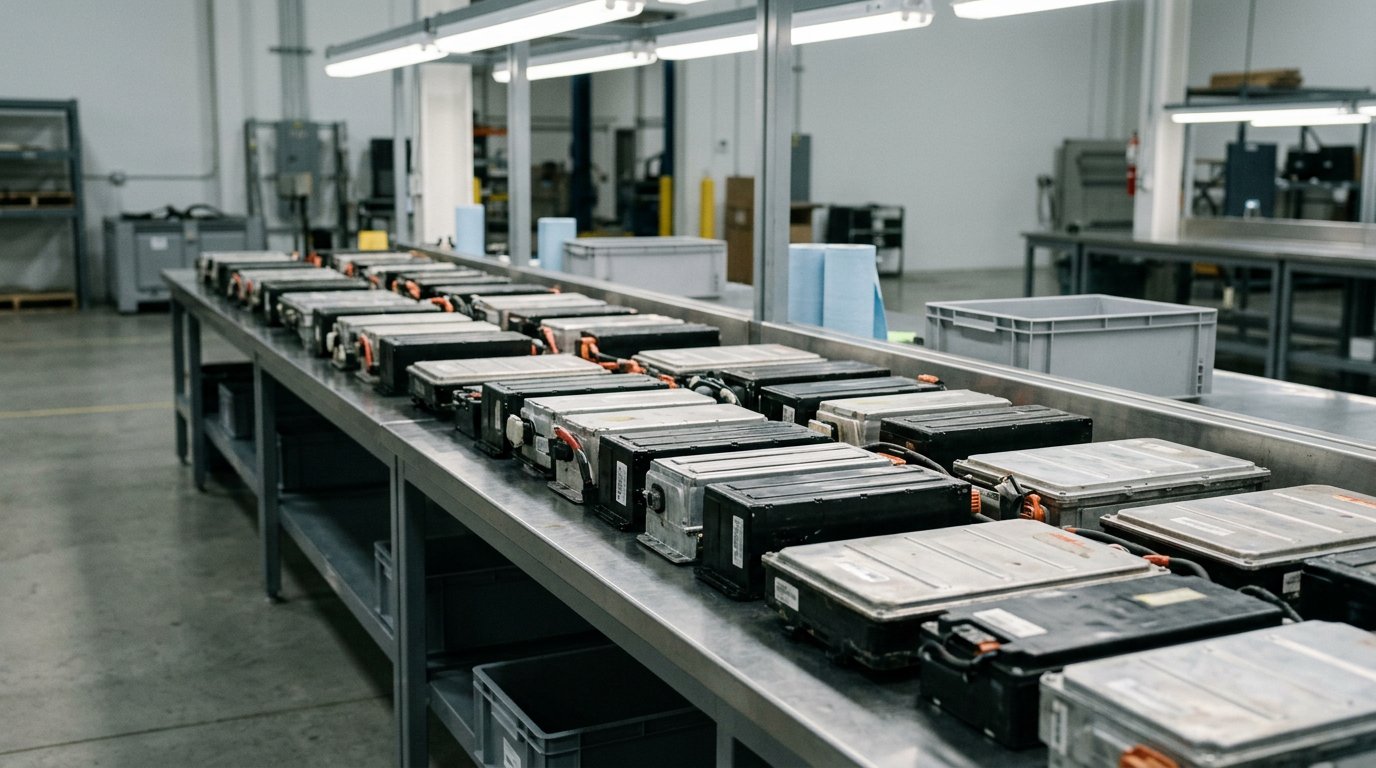
Why EV battery aftermarket pricing matters
Electric vehicle batteries are the single most valuable recoverable component on a modern car - typically worth more in materials and second-life applications than the entire scrap value of an internal-combustion vehicle's powertrain. As the first generation of mass-market EVs (Tesla Model S 2012, Nissan Leaf 2010-2017, Chevy Bolt 2017-2022) reaches 8-12 year service life, a meaningful aftermarket has emerged.
This dashboard tracks the going rates for replacement packs (new from manufacturer), used packs (salvage yards and EV repair specialists), and second-life valuations (energy storage applications) for the 12 highest-volume EV models in the US/EU market as of 2026.
Pack pricing by model (2026)
| Vehicle (Year) | Capacity | Chemistry | New Replacement | Used Pack | EPA Range |
|---|
| Tesla Model Y Long Range (2024) | 75 kWh | NCA | $16,500 | $5,500 | 310 mi |
| Tesla Model 3 Long Range (2024) | 82 kWh | NMC/LFP | $14,200 | $4,800 | 341 mi |
| Tesla Model S Long Range (2023) | 100 kWh | NCA | $22,500 | $7,200 | 405 mi |
| Ford F-150 Lightning Extended Range (2024) | 131 kWh | NMC | $28,500 | $10,200 | 320 mi |
| Ford Mustang Mach-E Premium (2024) | 91 kWh | NMC | $18,200 | $6,500 | 310 mi |
| Rivian R1T Quad-Motor (2024) | 135 kWh | NMC | $32,000 | $11,500 | 328 mi |
| Rivian R1S Adventure (2024) | 135 kWh | NMC | $32,000 | $11,500 | 321 mi |
| Chevrolet Bolt EV (2023) | 66 kWh | NMC (Ultium predecessor) | $16,000 | $4,200 | 259 mi |
| Hyundai IONIQ 5 Long Range (2024) | 77 kWh | NMC | $15,800 | $5,500 | 303 mi |
| Kia EV6 Long Range (2024) | 77 kWh | NMC | $15,800 | $5,500 | 310 mi |
| Volkswagen ID.4 Pro (2024) | 82 kWh | NMC | $14,500 | $5,000 | 275 mi |
| Polestar 2 Long Range (2024) | 82 kWh | NMC | $18,500 | $6,200 | 320 mi |
How to read this table
- Capacity (kWh) - usable energy storage. Larger packs have proportionally more recoverable lithium, cobalt, nickel, copper.
- Chemistry - NMC (Nickel-Manganese-Cobalt) packs have higher cobalt content (~10kg in a 75kWh pack), making them more valuable to recyclers. LFP (Lithium Iron Phosphate) packs have no cobalt but 5-8x longer cycle life, making them more valuable for second-life storage applications.
- New Replacement - dealer/manufacturer price for a like-new replacement pack. Includes labor estimate where pack-only pricing isn't published.
- Used Pack - typical price for a salvage-yard or specialist-supplier pack with verified state-of-health (SoH) of 80-92%.
- EPA Range - manufacturer's EPA-rated range when new. Used packs typically deliver 75-90% of original range depending on age and miles.
Where used EV battery packs come from
- Salvage from collision-damaged vehicles - largest single source. The pack survives most accidents intact even when the vehicle is totalled. Insurance auctions (Copart, IAA) sell salvage EVs which specialist breakers strip for usable components.
- Warranty replacement returns - manufacturers replace packs under warranty for capacity loss or specific cell failures. The replaced packs go to manufacturer reverse-logistics for refurbishment, second-life sale, or recycling.
- End-of-vehicle-life recycling - first generation Teslas, Leafs and Bolts are now reaching 8-12 years service life. Some batteries still have 70-80% capacity remaining.
- Recall pools - notable example: GM's 2020-2022 Bolt battery recall created a large pool of low-mileage replacement packs.
Second-life applications by chemistry
NMC packs (Tesla NCA variant, most non-Tesla manufacturers):
- High energy density makes them suitable for residential and commercial energy storage
- Typical second-life service: 5-8 years in stationary applications after vehicle service
- Companies actively buying: Redwood Materials, B2U Storage Solutions, Element Energy
LFP packs (Tesla Model 3 Standard Range, BYD, newer Model Y RWD):
- 5,000-8,000 cycle life makes them ideal for grid-scale storage
- Lower per-kWh value but longer service life
- Often deployed in renewable energy buffering, microgrids, off-grid applications
Recyclers handling EV batteries (US and EU)
| Recycler | Region | Specialty |
|---|
| Li-Cycle | US, Canada, Norway | Hub & Spoke recycling, lithium hydroxide recovery |
| Redwood Materials | US (Nevada) | Cobalt, nickel, copper, lithium recovery; cathode active material production |
| Ascend Elements | US | Hydro-to-Cathode direct cathode regeneration |
| American Battery Technology Company (ABTC) | US | Lithium recycling and primary mining |
| Aqua Metals | US | AquaRefining electrochemical recycling |
| Northvolt Revolt | Sweden, Germany | EU manufacturer-led closed-loop |
| Umicore | Belgium, Germany, Poland | Pyrometallurgical battery recycling |
| Stena Recycling | Sweden, UK | Mechanical disassembly and material recovery |
Most EV recyclers offer free pickup for end-of-life packs because the recovered materials value (estimated $5,000-$15,000 per pack depending on chemistry and capacity) exceeds collection cost.
Disposal considerations - critical safety information
EV batteries cannot be transported as ordinary waste. Federal regulations (US DOT 49 CFR, EU ADR Class 9) classify lithium-ion battery packs above 100Wh as Class 9 hazardous materials. Specific requirements:
- Cannot be transported in private vehicles beyond very small quantities (laptop-pack scale). Pack-scale units require certified hazmat carriers.
- Cannot be stored in residential garages long-term - thermal runaway risk if cells are damaged. Damaged packs must be quarantined and processed within 30 days per most state regulations.
- Cannot be disposed of in landfill under any circumstances - both fire risk and material loss.
- Insurance policies typically void if non-OEM packs are installed by non-certified technicians.
For end-of-life or damaged packs, contact the vehicle manufacturer's authorized recycling program first. They will arrange certified pickup at no charge to the owner in most cases.
Cost trajectory and 2027-2030 outlook
EV battery pack prices have followed a steep downward trajectory:
- 2010: $1,200/kWh (BloombergNEF benchmark)
- 2018: $214/kWh
- 2023: $139/kWh
- 2024: $115/kWh
- 2026 (projected): $97/kWh
Continued price decline means second-hand pack values will also decline in absolute terms - but the recovered material value (lithium, cobalt, copper) tracks commodity prices and has remained relatively stable. Recycling economics improve as collection volumes scale.
Frequently asked questions
Can I sell my dead EV battery to a recycler? Most major recyclers (Li-Cycle, Redwood Materials) will collect packs from end-of-life vehicles for free. They do not typically pay for individual packs because their economics depend on scale (truckload-quantity collections from salvage yards and OEM partnerships). Salvage yards may offer $1,000-$8,000 for a pack with verified state-of-health depending on chemistry and capacity.
What is the second-life value of my EV pack after the car is totalled? A pack with 80%+ remaining capacity from a totalled vehicle is worth between $3,000 (smaller LFP) and $15,000 (large NMC like F-150 Lightning extended range) on the salvage market. Specialist breakers like 057 Tech, Hybrid Auto Center, and EV West buy these for resale to DIY EV converters and second-life energy storage projects.
Are EV battery packs really recyclable? Yes - modern hydrometallurgical and direct cathode regeneration processes recover 95%+ of cobalt, nickel, copper, and lithium. The challenge is logistics and collection scale, not technical feasibility. Redwood Materials has demonstrated commercial-scale recovery at its Nevada facility since 2022.
How do I know if my used EV pack has good remaining capacity? Battery management system (BMS) data from the vehicle reports state-of-health (SoH). Get a Hybrid/EV Battery Capacity Test from a specialist (typically $150-$300) before buying any used pack. Reputable salvage yards provide SoH printouts.
Sources
- BloombergNEF Lithium-Ion Battery Price Survey (annual)
- US Department of Energy Vehicle Technologies Office Battery Statistics
- Argonne National Laboratory EVERBATT model
- IDTechEx EV Battery Recycling 2024-2034 report
- iFixit EV teardowns (Tesla Model 3, Model Y, F-150 Lightning, Bolt)
- Manufacturer service publications (Tesla Service Information, Ford Motorcraft, etc.)
- US National Highway Traffic Safety Administration EV recall data
Related guides
Frequently Asked Questions
Is ev battery aftermarket dashboard 2026: pack pricing, second-life value & recyclers actually recyclable?
Yes, in most jurisdictions. Whether ev battery aftermarket dashboard 2026: pack pricing, second-life value & recyclers can be recycled depends on the material composition and local collection programmes. Most electronics + appliances are recyclable via manufacturer take-back, retailer drop-off, or certified local recycler. Find compliant routes via our [Recycling Locator](/tools/recycling-locator).
Is recycling ev battery aftermarket dashboard 2026: pack pricing, second-life value & recyclers free?
For most consumer items dropped off at retailers (Best Buy, Currys, Apple, Samsung, Walmart) or via manufacturer mail-in programmes: yes, free at point of use. Funded by Producer Compliance Scheme contributions under EU WEEE + UK WEEE + voluntary US programmes. Exceptions: bulk appliances ($25-$50 pickup), CRT TVs/monitors ($19-$50), oversized batteries.
What happens if I just throw it in the regular bin?
In most jurisdictions, electronics in general waste is illegal. Penalties typically: £5,000-£50,000 (UK) or $1,500-$25,000 (US state-level) per incident. Curbside refuse collection rejects flagged loads, returning them to the household. Check your jurisdiction's specific rules + penalty exposure via our [E-Waste Fines Checker](/tools/e-waste-fines-checker).
Should I wipe data before recycling?
Yes, for any data-bearing device. (1) Sign out of all cloud services. (2) Factory reset via Settings menu. (3) For sensitive data, use a certified ITAD provider with NIST 800-88 sanitisation. Free Certificate of Destruction template: our [GDPR Data Erasure Certificate Generator](/tools/gdpr-erasure-certificate-generator).
Could I get money for it instead of recycling?
Working devices typically retain meaningful trade-in value for 3-5 years. A 5-year-old smartphone often fetches £25-£80 trade-in vs $0 from recycling. Compare 7 buyback prices in 30 seconds via our [Trade-In Best Price Finder](/tools/trade-in-best-price-finder) before committing to recycling.