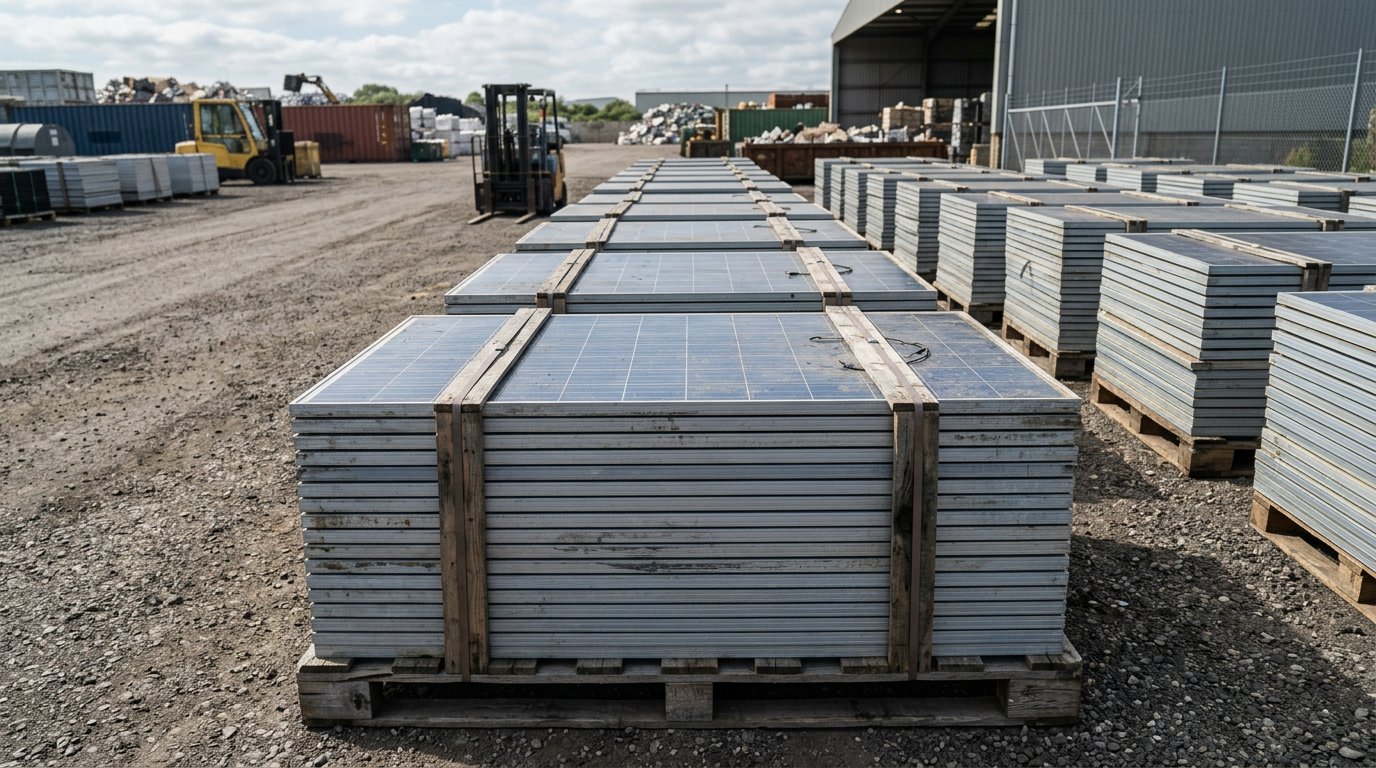
A solar panel is a laminated sandwich of glass, aluminium, silicon and polymer, bonded so tightly that separating it is the whole problem. That is why there is no free kerbside route and why the disposal price is per panel rather than per load.
Where to take old solar panels
The installer fitting the replacements. On a repowering job the installer normally removes and handles the old panels, and it is worth confirming that they go to a recycler rather than to landfill. This is the easiest route and usually the cheapest.
A specialist panel recycler. A growing number of processors handle panels directly, charging per panel or by weight. Delivering them is cheaper than collection.
Manufacturer take-back. Some manufacturers operate their own return route, particularly for panels still inside a warranty period or for a whole failed batch.
A construction and demolition waste facility, which will accept panels in some areas but generally as disposal rather than recycling. Ask what happens to them before choosing this.
What it costs
| Route | Typical cost |
|---|
| Installer removal during replacement | Included or modest per panel |
| Specialist recycler, delivered | Charged per panel |
| Manufacturer take-back | Free where a scheme exists |
| Junk removal | Highest, and unlikely to recycle |
What is actually recovered
The aluminium frame and the junction box come off easily and are straightforwardly recyclable. The glass is roughly three quarters of the weight and is recoverable if it can be separated cleanly. The difficulty is the encapsulant bonding the glass to the cells, which has to be broken down thermally or chemically before the silicon and the small quantities of silver can be reached. Processes that do this economically at scale are still maturing, which is why the cost sits where it does.
A working panel is not waste
Panels degrade slowly, and one replaced during a repowering may still produce most of its rated output. There is an active secondhand market, and reuse beats recycling on every measure. Test before you scrap, and keep any panel with intact glass and a working junction box separate from the broken ones.
Handling them safely
A panel that has been in the sun is generating, and a string of them generates at a voltage that is dangerous whether or not it is connected to anything. Have the array isolated and disconnected by the installer or an electrician before anything is moved, and treat a panel as live until it is.
Panels are heavy, awkward and mostly glass. Two people, gloves and eye protection, and keep them vertical in transit rather than stacked flat, which is how they crack. Wrap a broken panel before it moves.
Do not break panels up to make them easier to carry. The laminate holds small quantities of lead and cadmium, and smashing it releases them and destroys the recycling value at the same time. A cracked panel is still worth more intact than in pieces.
Related guides