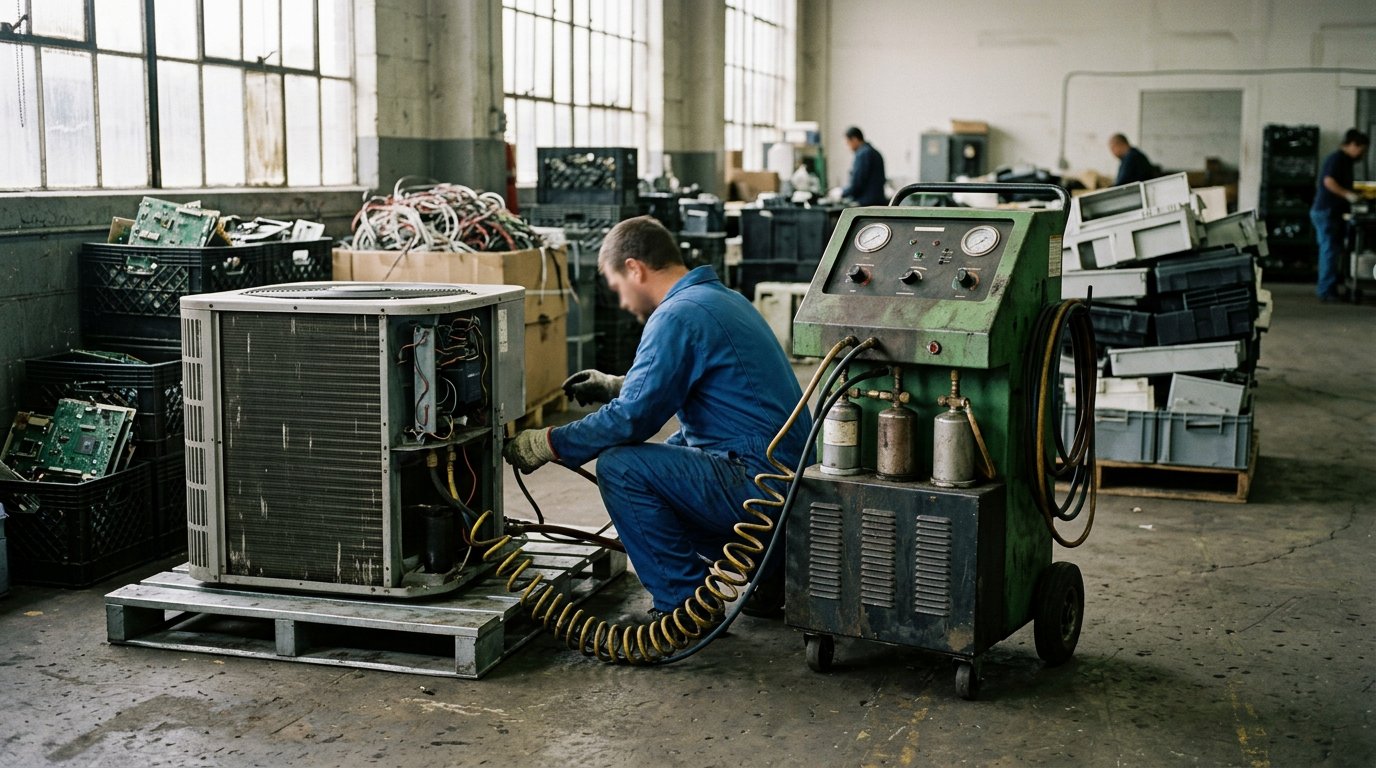
In the United States, F-Gas Certified Disposal in United States (2026) plays a crucial role in managing fluorinated greenhouse gases used in refrigeration and air conditioning units. According to the EPA SNAP program and the AIM Act 2020, these regulations mandate an 85% phase-down of HFCs by 2036. This necessitates that all F-Gas Certified Disposal in United States (2026) follows strict protocols for handling refrigerants, ensuring they are recovered properly before disposal to prevent environmental harm.
single-handedly)
- For domestic use, proof of replacement purchase if going through retailer take-back
Penalty for non-compliance in United States
Depends on the specific regulation but typically ranges from a fixed-penalty fine for first-time domestic offences (£200-€500) to substantial commercial penalties (€100,000+ for repeat or wilful venting under EU F-Gas Regulation).
Sources
- EPA SNAP program, AIM Act 2020 phase-down 85% by 2036
- EU F-Gas Regulation 517/2014 (where applicable)
- ASHRAE Standard 34 (refrigerant classification)
- IPCC Sixth Assessment Report (AR6)
F-gas regulatory framework - United States
| Field | Value |
|---|
| Country | United States |
| Primary legislation | Clean Air Act §608 (40 CFR Part 82) + AIM Act of 2020 (HFC phase-down) |
| Lead regulatory authority | US EPA Stratospheric Protection Division + state agencies (CARB in California) |
| Required technician certification | EPA Section 608 Technician Certification (Type I, II, III, Universal) |
| Maximum penalty | $37,500 per violation under CAA §608(c)(2); criminal liability for intentional release |
| HFC phase-down schedule | AIM Act: 85% HFC phase-down by 2036 (production + import quotas) |
| Kigali Amendment status | Yes - ratified September 2022 |
| Typical residential disposal cost | $85-$900 |
| Last verified | 2026-05-20 |
Why certified disposal matters in United States
Refrigerants (HFCs like R134a, R410A, R32) are extremely potent greenhouse gases. R410A has a Global Warming Potential (GWP) of 2,088 - meaning 1 kg of R410A in atmosphere has the warming effect of 2.1 tonnes of CO2. A typical home AC unit contains 1.5-3 kg of refrigerant. Improper disposal = the equivalent of driving a car for 1-3 years released into the atmosphere from a single appliance.
United States's regulation (Clean Air Act §608 (40 CFR Part 82) + AIM Act of 2020 (HFC phase-down)) requires certified technicians to recover refrigerant before disposing of any sealed system. Penalties for non-compliance: $37,500 per violation under CAA §608(c)(2); criminal liability for intentional release.
Top certified providers in United States
- ESCO Institute
- Air Conditioning Contractors of America (ACCA)
- RSES (Refrigeration Service Engineers Society)
For commercial/industrial scale operations (commercial refrigeration, walk-in coolers, VRF AC systems), use providers with the highest certification level + proven institutional clients. For residential (window AC, fridge, freezer, dehumidifier): use local domestic-class certified providers - typically the lower cost end of the range above.
How to verify your contractor is certified
- Ask for the certification number + the registry where it can be verified. Legitimate contractors carry credentials they're proud to share.
- Cross-check on the issuing body's public database. Most countries publish a searchable database of certified contractors (e.g. REFCOM in UK, EPA's section 608 certification status, NCEC in Saudi Arabia).
- Request the Refrigerant Recovery Certificate after the job. This is your legal proof of compliant disposal - keep with property records for 6+ years.
- Refuse "cash-in-hand" jobs without paperwork - non-paperwork jobs typically mean illegal venting.
Phase-down schedule context
The Kigali Amendment to the Montreal Protocol (entered force 1 January 2019) commits 197 countries to phase down HFC consumption + production. Developed countries (US, EU, UK, Canada, Australia, Japan): 85% reduction by 2036 vs 2011-2013 baseline. Developing countries (Article 5 Group 1: China, Brazil, South Africa, etc.): 80% by 2045. Developing countries (Article 5 Group 2: India, Pakistan, Gulf states): 80% by 2047.
This means refrigerant prices are RISING over the next decade as supply tightens. End-of-life equipment containing recoverable refrigerant is INCREASINGLY VALUABLE - proper recovery isn't just compliance, it's increasingly economic.
Frequently asked questions
Can I dispose of a sealed system in regular waste in United States?
No. All countries in this guide prohibit landfill of sealed refrigerant systems without prior certified recovery. Penalty: $37,500 per violation under CAA §608(c)(2); criminal liability for intentional release. Even smaller appliances (window AC, dehumidifier) fall under the regulation in most jurisdictions.
What if the equipment is broken / leaking?
Damaged equipment with broken refrigerant lines is the most regulated scenario - fugitive refrigerant emissions are exactly what F-gas regulations are designed to prevent. Call your certified contractor for damaged-equipment pickup - they have special procedures. Do NOT attempt DIY removal or transport on suspicion of leakage.
Is there a free disposal option?
In most EU member states (covered by WEEE Directive 2012/19/EU): one-for-one retailer take-back is free when buying a replacement appliance. In the UK: council bulky-waste collection often free or £15-£35. In the US: utility-run appliance recycling programmes (PG&E, ConEd, Duke Energy etc.) often free + provide rebate. Outside these jurisdictions: residential disposal is paid (typically the lower end of the cost range above).
Who is legally responsible if a contractor vents refrigerant illegally?
Both the contractor (primary liability) AND the equipment owner (secondary liability) can be prosecuted in most jurisdictions - including United States. Always retain the Refrigerant Recovery Certificate as proof of compliant disposal, and verify the contractor's certification number before hire.
Is there a charge for the refrigerant itself?
Generally no - the contractor reclaims the refrigerant and either re-sells it back into the supply chain (rising prices = positive revenue) or sends it to a Section 608 / F-gas certified destruction facility. Your cost covers technician time + logistics + paperwork.
Related guides
---
Data verified against US EPA Stratospheric Protection Division + state agencies (CARB in California) published guidance, Kigali Amendment to the Montreal Protocol on Substances that Deplete the Ozone Layer, and country-specific F-gas / refrigerant regulation as of 2026-05-20. Operated by Defining Style Limited (UK Companies House 10572391, ICO Registration ZA711914).