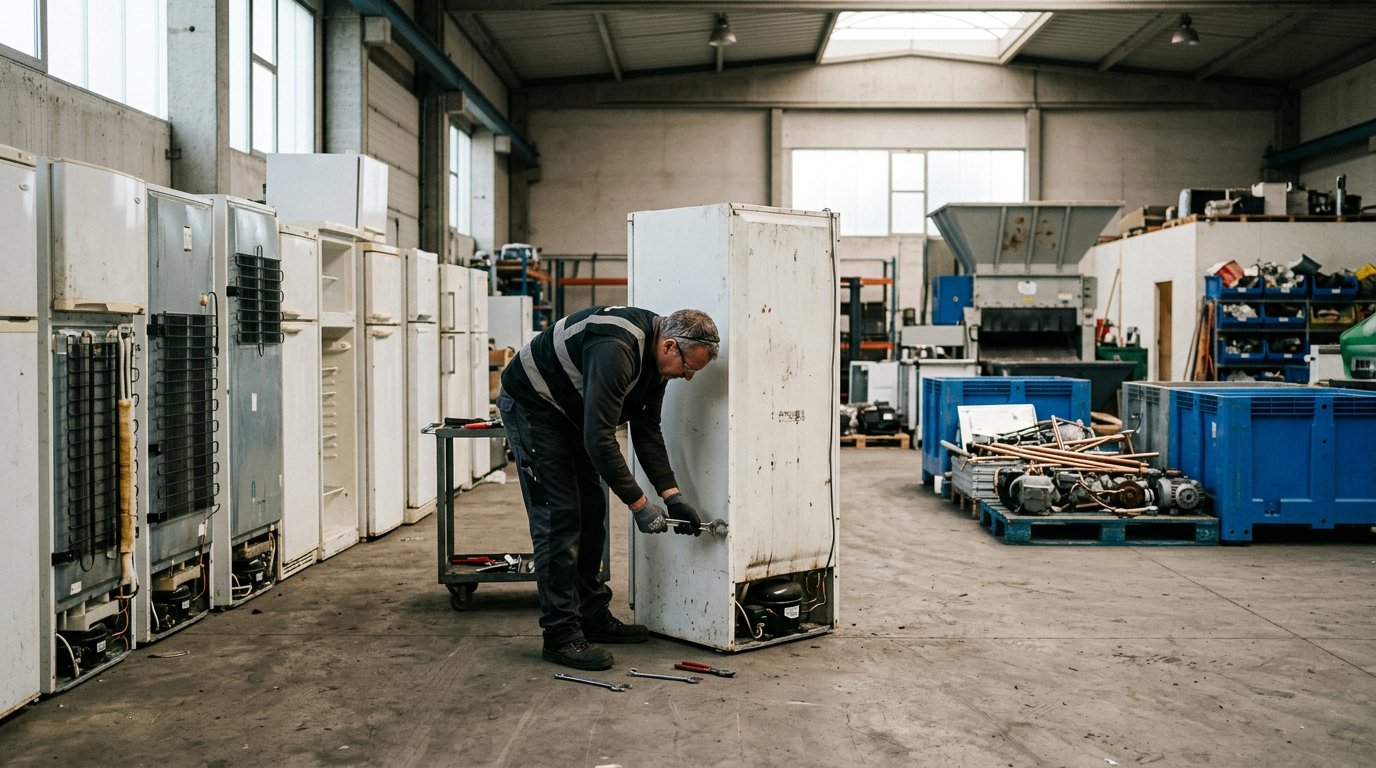
Domestic refrigerator disposal: cost, process, refrigerant rules (2026) is a critical environmental practice that varies by jurisdiction. This guide addresses how to properly dispose of domestic refrigerators, focusing on the necessary steps and costs involved. In any area with F-Gas regulation, a domestic refrigerator cannot be discarded as regular waste due to the hazardous nature of its refrigerant. The refrigerant must be safely recovered by a certified professional before disposal can occur.
Domestic refrigerator disposal: cost, process, refrigerant rules (2026) typically ranges from $30 to $80 for collection and handling fees. The most economical option is often through manufacturer take-back programs when purchasing a new unit, which frequently offer free or discounted recycling services. For standalone disposal, costs vary by region; in the UK, it can range from £0 to £50, while in the US, it typically falls between $20 and $80, and across the EU, fees are generally €15 to €60.
Real disposal cost by jurisdiction (2026)
| Field | Value |
|---|
| Appliance | Domestic refrigerator |
| Category | Refrigeration |
| Typical weight | 70-130 kg |
| Refrigerant type | HFC R134a (1995-2020) or R600a isobutane (2018+) |
| Refrigerant charge | 80-200 g |
| United States cost | $15-$45 (with rebate) / $35-$85 (without) |
| United Kingdom cost | £0 (council collection) / £15-£35 (private removal) |
| EU member state cost | €0-€25 (WEEE compliance scheme covers most) |
| Australia cost | A$30-$80 (ResourceCo, Stewart Brothers, certified) |
| US utility rebate | PG&E ($35), ConEd ($50), Duke Energy ($35) - local utility programmes |
| Last verified | 2026-05-20 |
Why this appliance needs certified disposal
This is a sealed refrigerant system - meaning it contains fluorinated refrigerant gases that are extremely potent greenhouse gases (R410A has Global Warming Potential of 2,088, vs CO2 at 1). Federal + EU + UK regulations require qualified technician removal:
United States: YES - Section 608 certification required for refrigerant removal. The US EPA's Clean Air Act Section 608 (40 CFR Part 82, Subpart F) prohibits intentional venting of HFC, HCFC, or CFC refrigerants. Penalty: Up to $37,500 per violation under Clean Air Act §608(c)(2).
United Kingdom: Environmental Protection Act 1990 + F-gas Regulations 2015 (post-Brexit retained). Requires F-gas certified technician (categories I-IV depending on charge size). Penalty: unlimited fines for commercial violators under Section 33 EPA.
European Union: F-gas Regulation (EU) 2024/573 (in force 11 March 2024, replacing 517/2014). Mandates refrigerant recovery + manifests; HFC phase-down schedule reduces high-GWP refrigerants 95% by 2050.
Pre-1995 / pre-2010 units: Pre-1995 units may contain R12 CFC - banned since 2010, requires Type 1 certified technician
Compliant disposal routes
Free / lowest-cost option (US):
- Utility appliance-recycling programme (PG&E, ConEd, Duke Energy, NEEA region utilities) - usually includes free pickup + $20-$50 rebate. Use the EPA's Responsible Appliance Disposal (RAD) Partner locator: epa.gov/rad.
- Municipal HHW (Household Hazardous Waste) collection days - most US counties run 2-4 per year.
- Best Buy + Home Depot in-store haul-away ($25-$50 when buying replacement).
Free / lowest-cost option (UK):
- Council kerbside bulky-waste collection - typically free for white goods (check your local council; some charge £15-£35).
- Currys appliance haul-away - included free with new appliance delivery; £25 standalone.
- HWRC (Household Waste & Recycling Centre) - free drop-off if you can transport.
Free / lowest-cost option (EU):
- WEEE compliance scheme one-for-one take-back at retailer when buying replacement (mandatory under EU WEEE Directive 2012/19/EU).
- Local kommune/comune household waste collection (free in most EU member states for white goods).
Commercial / high-charge units:
- F-gas certified technician on-site removal - see our Manufacturer Take-Back Finder for accredited service providers.
- Major brands (Carrier, Daikin, Trane, LG, Samsung, Mitsubishi Electric) all run partner-network removal programmes.
Step-by-step DIY-safe preparation (before professional removal)
- Document the refrigerant type from the rating plate on the unit (usually back/side panel). Photograph the label.
- Note the appliance age - pre-2010 units almost certainly contain higher-GWP refrigerant requiring more expensive reclamation.
- Empty the appliance (food, water from defrost tray, accessories).
- Defrost completely if applicable - heat pumps + freezers shouldn't be moved while frozen contents shift.
- Disconnect from power + water supply. Leave plug visible for technician.
- Do NOT cut copper lines - releases refrigerant illegally. Do NOT puncture compressor. Do NOT crush the unit before refrigerant removal.
- Schedule certified pickup - the technician will use evacuation equipment to recover the refrigerant into a recovery cylinder before any mechanical disassembly.
- Request the Refrigerant Recovery Certificate (EPA Section 608 or F-gas equivalent) - your legal proof of compliant disposal. Required by some commercial property sale + insurance contracts.
What a typical disposal looks like
- Day 1: book pickup via utility/recycler/retailer.
- Day 5-14: certified technician arrives with recovery equipment (typically Robinair or CPS recovery machine + NIST-traceable refrigerant scale).
- At site: technician connects to high + low service ports, evacuates refrigerant into recovery cylinder (15-45 min depending on charge size), seals appliance.
- Documentation: receives + signs Refrigerant Recovery Certificate.
- Off-site processing: appliance shredded; copper + aluminium + steel + ferrous separated and resold; plastic insulation (often pre-2005 contains CFC-11 blowing agent) sent to EPA RAD-partner specialist processor; electronics + control boards sent to certified electronic waste recycler.
Carbon impact of compliant vs non-compliant disposal
Per the EPA RAD programme, one improperly-disposed domestic refrigerator releases the equivalent of approximately 8-22 tonnes of CO2 over the next 50 years (the refrigerant escapes to atmosphere as the unit decomposes in landfill). Compliant recovery captures 95%+ of the refrigerant for reuse or destruction at high-temperature incinerator. One compliant disposal = equivalent CO2 reduction of taking a car off the road for 2 years.
See our E-Waste Carbon Footprint Calculator for project-specific impact estimates.
Frequently asked questions
Can I disconnect + transport the appliance myself before recovery?
US: technically yes for residential, but if any refrigerant is released during transport you become liable under Section 608. UK + EU: same - F-gas Regulation places liability on whoever causes the release. Safer to book on-site recovery first.
Does it need to be empty / clean inside?
Yes - refrigerator interiors with food residue create biohazard for recyclers + may delay pickup. Wipe clean + leave doors open for 24+ hours to dry.
What if the appliance still works - can I sell or donate it?
Yes if it's <10 years old + working. Charities (Goodwill, Salvation Army, British Heart Foundation) accept working white goods. Selling on eBay / Facebook Marketplace: legal, but verify buyer pickup arrangements + transport regulations apply.
Do I need a special permit to throw it out?
Most US states: no permit needed for residential disposal via compliant channel. California: AB 1953 requires labelled disposal record. UK: no permit but council collection rules vary. EU: WEEE Producer Compliance Scheme covers most retail-purchased units.
Can I claim a tax deduction?
US: Charitable donation of a working appliance to a 501(c)(3) - get IRS Form 8283 from receiving charity. UK: Gift Aid not applicable to physical goods donations. EU: varies by member state.
Related guides
---
Data verified against US EPA RAD Partner Programme, UK F-gas Regulations 2015 (post-Brexit retained), EU F-gas Regulation 2024/573, and 2026 published rates from PG&E, ConEd, Duke Energy, Currys + major utility appliance-recycling schemes. Operated by Defining Style Limited (UK Companies House 10572391, ICO Registration ZA711914).