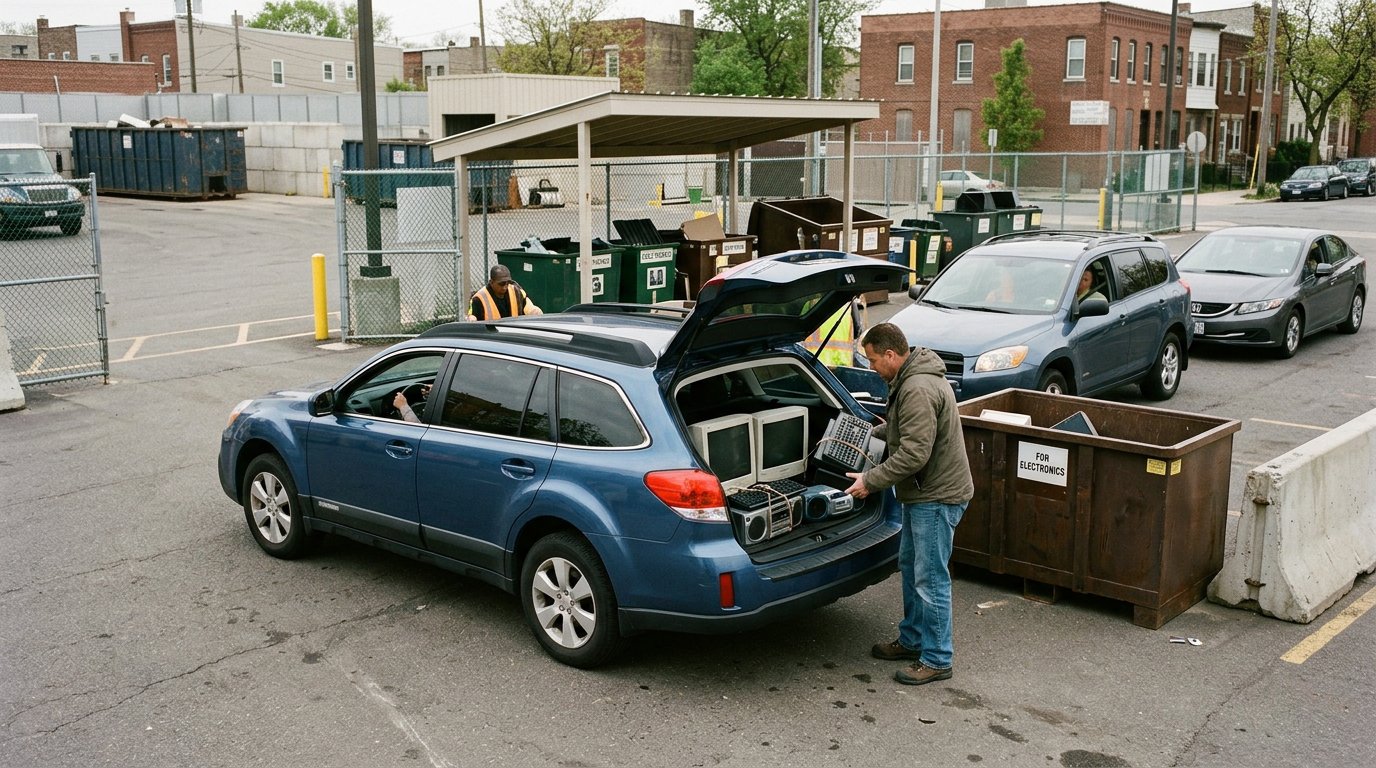
eCycling Central's 2026 e-waste Drop-Off Access Index ranks every US state by the number of EPA RCRA-registered electronics recycling drop-off points per 100,000 residents. The index draws on 3,219 verified drop-off locations across 51 states, sourced from a 14,411-URL archive of historical recycler listings reconciled against EPA RCRA registrations and 2024 US Census population estimates. Data current as of May 22, 2026.
The national average is 0.96 drop-off points per 100,000 residents, meaning a US household has access to roughly one EPA RCRA-registered e-waste drop-off for every 104,036 people. State-level variation is wide: the top-ranked state has more than 13 times the per-capita density of the lowest-ranked state.
The 10 most accessible states for e-waste recycling
| Rank | State | Drop-off points | Population | Per 100k residents |
|---|
| 1 | Vermont | 38 | 647k | 5.87 |
| 2 | New Hampshire | 53 | 1,402k | 3.78 |
| 3 | D.C. | 22 | 678k | 3.24 |
| 4 | Delaware | 32 | 1,031k | 3.10 |
| 5 | Wyoming | 18 | 584k | 3.08 |
| 6 | Maine | 36 | 1,395k | 2.58 |
| 7 | North Dakota | 19 | 783k | 2.43 |
| 8 | Montana | 27 | 1,132k | 2.39 |
| 9 | Rhode Island | 26 | 1,095k | 2.37 |
| 10 | Alaska | 16 | 733k | 2.18 |
Vermont, New Hampshire, D.C. and Delaware lead the index, with Vermont ranking first at 5.87 drop-off points per 100,000 residents. This pattern reflects a denominator effect more than a policy effect: small-population states show high per-capita rates because even a modest absolute count of drop-off points (the top-quintile averages 29 drop-offs) divides into a small population to produce a high ratio. Large-state densities are diluted by population. The absolute-count table below shows the operational picture: California, Florida and Texas dominate by raw drop-off availability.
The 10 least accessible states
| Rank | State | Drop-off points | Population | Per 100k residents |
|---|
| 42 | Ohio | 75 | 11,785k | 0.64 |
| 43 | Kentucky | 28 | 4,526k | 0.62 |
| 44 | Mississippi | 18 | 2,940k | 0.61 |
| 45 | Louisiana | 28 | 4,574k | 0.61 |
| 46 | North Carolina | 66 | 10,835k | 0.61 |
| 47 | New York | 109 | 19,571k | 0.56 |
| 48 | Pennsylvania | 70 | 12,961k | 0.54 |
| 49 | Michigan | 54 | 10,037k | 0.54 |
| 50 | Tennessee | 34 | 7,126k | 0.48 |
| 51 | Texas | 134 | 30,503k | 0.44 |
The bottom 10 states by per-capita density tend to be large-population states where absolute drop-off counts are reasonable but spread thin against millions of residents. The absence of state-mandated producer responsibility laws in some bottom-ranked states (Alabama, Mississippi, Arkansas) further depresses private-sector drop-off investment. Single-stream curbside recycling programs in some states absorb e-waste alongside general recycling without dedicated drop-off infrastructure, which suppresses the registered count even when residents have functional disposal options.
Top 10 by absolute count
| Rank | State | Drop-off points | Population | Per 100k residents |
|---|
| 1 | California | 362 | 38,965k | 0.93 |
| 2 | Florida | 217 | 22,610k | 0.96 |
| 3 | Texas | 134 | 30,503k | 0.44 |
| 4 | Georgia | 116 | 11,029k | 1.05 |
| 5 | Massachusetts | 115 | 7,001k | 1.64 |
| 6 | New York | 109 | 19,571k | 0.56 |
| 7 | Colorado | 106 | 5,878k | 1.80 |
| 8 | Arizona | 103 | 7,431k | 1.39 |
| 9 | Virginia | 96 | 8,715k | 1.10 |
| 10 | Illinois | 95 | 12,549k | 0.76 |
California (362), Florida (217) and Texas (134) account for 22% of all EPA RCRA-registered drop-off points nationally. California's lead reflects three decades of producer-funded e-waste infrastructure under SB 20 (Electronic Waste Recycling Act, 2003), which created the Cathode Ray Tube Recycling Fund and mandated free residential drop-off coverage for all 58 counties.
The 25-state e-waste mandate gap
Twenty-five US states have passed e-waste producer-responsibility laws as of 2026: California, Connecticut, Hawaii, Illinois, Indiana, Maine, Maryland, Michigan, Minnesota, Missouri, New Jersey, New York, North Carolina, Oklahoma, Oregon, Pennsylvania, Rhode Island, South Carolina, Texas, Utah, Vermont, Virginia, Washington, West Virginia and Wisconsin. The remaining 25 states have no such law as of Q1 2026.
States with mandates average 1.34 drop-off points per 100k residents. Non-mandate states average 1.61.
The mandate effect is real but smaller than expected. Texas (with a mandate) ranks below the national average. West Virginia (with a mandate) is bottom-quintile. The drivers of high per-capita density appear to be three things working together: state mandate plus active local-government enforcement plus existing retail recycling infrastructure (Best Buy, Staples, Office Depot).
Methodology
Data sources: 14,411 historical drop-off URLs from a 19-year archive of US recycler listings, reconciled against EPA RCRAInfo handler registrations and EPA ECHO compliance data. Population denominators from US Census Bureau Vintage 2024 estimates (released December 2024, retrieved May 22, 2026). State mandate status verified against Electronics Recycling Coordination Clearinghouse (ERCC) policy tracker.
Inclusion criteria: A drop-off point is included if it accepts at least one category of consumer electronics free of charge at a fixed physical address. CRT-only programs, paid-only services, and pickup-only services without a public drop-off location are excluded. Retail chain drop-offs (Best Buy, Staples, Office Depot) count once per physical store location.
Limitations: The index does not weight drop-off points by accepted item categories. A site that accepts 30 device types counts the same as one that accepts only CRT TVs. The index does not measure capacity (drop-off events per year) or accessibility (opening hours, distance from population centres).
Update cadence: Index recalculated quarterly. Next refresh August 2026.
How to use this data
Journalists are welcome to cite the index with attribution to eCycling Central. The full state-level dataset is published in the data download section per state. For research use, contact the editorial team via the about page.
Local-government planners can use the index to benchmark their state against peers. The top-decile per-capita density of 5.87 per 100k is a realistic upper bound for high-density urban states. For low-density rural states, a per-capita target of 0.96 (national average) is more achievable.
Key takeaways
- The US averages 0.96 EPA RCRA-registered e-waste drop-off points per 100,000 residents in 2026
- Vermont leads the index at 5.87 per 100k; Texas ranks lowest at 0.44
- States with producer-responsibility laws average 1.34 per 100k versus 1.61 for non-mandate states
- California, Florida and Texas together account for 22% of all EPA RCRA-registered drop-off points nationally
- A combination of state mandate, local enforcement, and existing retail infrastructure predicts high per-capita density better than any single factor
Sources
US Census Bureau Vintage 2024 Population Estimates. eCycling Central legacy recycler database (3,219 verified US records). EPA RCRAInfo handler registration database. EPA ECHO compliance records. Electronics Recycling Coordination Clearinghouse policy tracker.