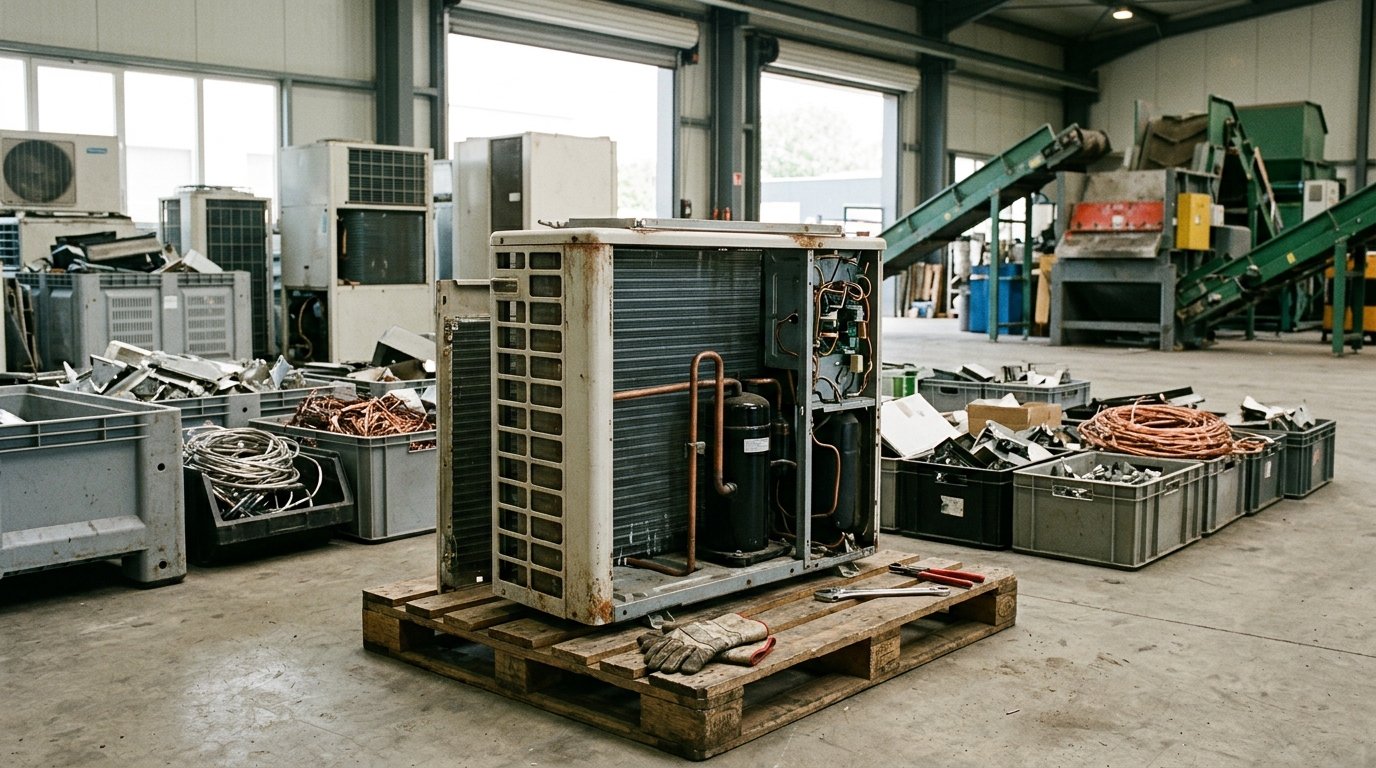
How to recycle a Toshiba Air Conditioning split-system air conditioner (single-zone)
Reviewed by the eCycling Central editorial team on April 2026
A Toshiba Air Conditioning split-system air conditioner (single-zone) cannot be placed in regular kerbside waste in any jurisdiction with F-Gas regulation - the refrigerant must be captured by a certified handler before the cabinet is broken down. This guide covers the refrigerant inside, the F-Gas rules that apply, and the disposal routes available.
Refrigerant in your Toshiba Air Conditioning unit
Modern Toshiba Air Conditioning split-system air conditioner (single-zone)s (post-2018) typically use R32 (HFC, single-component) at a charge of 600-1200g. The global warming potential (GWP) of R32 (HFC, single-component) is 675 - meaning each kilogram released to atmosphere has the same climate impact as 675 kg of CO2.
Older Toshiba Air Conditioning units (typically pre-2018) used R410A (HFC blend) at a charge of 800-1800g, with GWP 2088. EU and US restricting new equipment from 2025.
To check what refrigerant your specific unit uses, look at the data plate on the back or inside the cabinet door - the refrigerant type is printed alongside the model number.
F-Gas rules that apply
Toshiba Air Conditioning units are F-Gas regulated equipment under EU Regulation 517/2014, the UK F-Gas Regulations 2015, and the US AIM Act 2020. That means:
- The refrigerant must be recovered by a holder of an F-Gas Category I (or equivalent) certificate before disposal
- Placing the unit in regular waste is a regulatory offence in the EU, UK, and US states with WEEE-equivalent laws
- Penalty for illegal disposal ranges from £200 (UK fixed-penalty notice) to $25,000 per violation (US EPA)
How Toshiba Air Conditioning handles take-back
Toshiba Air Conditioning (a JP-headquartered manufacturer) operates take-back through:
- Manufacturer programme: Toshiba Air Conditioning sustainability and recycling page - check your country page for the specific drop-off or collection process available to you
- Retailer take-back: when buying a replacement, ask the retailer about old-for-new collection. UK retailers like Currys, John Lewis, and AO are obliged under WEEE to take an old unit when delivering a new one
- Local-authority bulky-waste collection: most UK councils, US municipalities, and EU local authorities run bulky-waste collection that includes white goods - check whether yours requires a booking and whether there is a fee
What it costs
Typical disposal cost for a Toshiba Air Conditioning split-system air conditioner (single-zone) runs $150-400 decommissioning + capture. Variation comes from:
- Whether it is a take-back-with-purchase (often free)
- Whether the local authority charges per collection (£0-£50 in UK, $20-$80 in US)
- Whether the unit needs special handling (very large commercial fridges or units with damaged cabinets cost more)
Material recovery
After refrigerant capture, a Toshiba Air Conditioning split-system air conditioner (single-zone) is broken down into:
- Steel cabinet (60-80% by weight) - melted and reused
- Aluminium evaporator and condenser coils (5-12%)
- Copper tubing (2-5%) - high recovery value at LME spot prices
- ABS / polystyrene insulation foam - typically 5-15%, may contain blowing agents requiring controlled disposal
- Plastic interior parts - mixed-grade recycled where possible
A typical 200L domestic fridge contains roughly 40 kg of recoverable steel, 3 kg of aluminium, and 1.2 kg of copper.
Sources
- Toshiba Air Conditioning sustainability page:
- EU F-Gas Regulation 517/2014
- UK F-Gas Regulations 2015 (SI 2015/310)
- US AIM Act 2020 (HFC phase-down)
- IPCC Sixth Assessment Report (AR6) - GWP coefficients
- F-Gas certified contractor required for installation, service, AND end-of-life refrigerant recovery
How to Recycle a Toshiba Air Conditioning Split-system air conditioner (single-zone) (2026): full breakdown (2026-05-20)
Why this disposal route matters
Appliances contain refrigerants, oils, mercury switches, or heavy metals that EPA + state rules require segregated handling. Skipping compliant disposal triggers Resource Conservation and Recovery Act (RCRA) penalties up to $76,764 per day per violation as of 2026 (40 CFR Part 273). For consumers, the practical risk is much higher fees if a downstream landfill rejects the load and you pay for re-collection.
Three compliant options (compared)
| Option | Typical cost | Best for | Watch-outs |
|---|
| Manufacturer take-back on new purchase | $0-$25 | Replacing the unit | Must order same-day with delivery; some retailers (Lowe's, Home Depot) charge $25-$50 haul-away fee |
| Local certified ITAD or recycler | $0-$75 | Standalone disposal, no new purchase | Verify R2v3 or e-Stewards certification certification before booking. Find via our Recycling Locator |
| Municipal bulky waste pickup | $0-$50 | Tax-funded route, no commercial premium | Often 2-6 week wait; some jurisdictions exclude refrigerant appliances entirely |
Refrigerant and HFC handling (refrigerators, AC units, dehumidifiers, heat pumps)
EPA Clean Air Act Section 608 requires certified technician recovery before disassembly. Penalties up to $51,796 per day under 40 CFR Part 82, Subpart F (2026 inflation-adjusted). Confirm any quote includes a refrigerant recovery certificate; otherwise the disposer is shifting liability to you as the appliance owner of record.
Common consumer mistakes
- Setting unit at the curb without scheduled pickup. Most US municipalities require advance booking; uncollected appliances draw $50-$200 illegal-dumping fines.
- Removing the compressor before disposal. Federal law (40 CFR 82.156) bars venting refrigerant to atmosphere. Even draining oil first counts as venting if any HFC residue remains.
- Cutting power cords before scrap. Some scrap-metal yards reject prepared units because they can't verify safety; others reward intact units with $5-$20 cash.
Frequently asked questions
Can I just take it to a scrap yard? Sometimes - but only if refrigerants are already certified-recovered and a Recovery Certificate is on hand. Without it, most yards refuse the unit. Cash payout: $15-$60 depending on metal content + scrap market price.
Does the manufacturer have to take it back free? Under EU WEEE Directive 2012/19/EU and UK WEEE Regulations 2013: yes, retailers must offer free take-back on like-for-like purchases. In the US: voluntary in most states; New York, Connecticut, Maine, Vermont, Minnesota mandate manufacturer programs for specific categories (mostly electronics, not all appliances).
What if my unit still works? Don't recycle - donate. Working appliances under 10 years old are eligible for Habitat for Humanity ReStore, Salvation Army, or local charities. Average tax-deduction value: $50-$200 (US, IRS Form 8283 for >$500). See Appliance Donation Tax Deduction guide for current valuation tables.
Related guides + tools
---
Disposal rules verified against EPA 40 CFR Parts 82 + 273 + EU WEEE Directive 2012/19/EU + UK WEEE Regulations 2013 as of 2026-05-20. Operated by Defining Style Limited (UK Companies House 10572391, ICO Registration ZA711914). Rules update annually - verify state-specific fees on your municipal solid waste authority site before transporting.