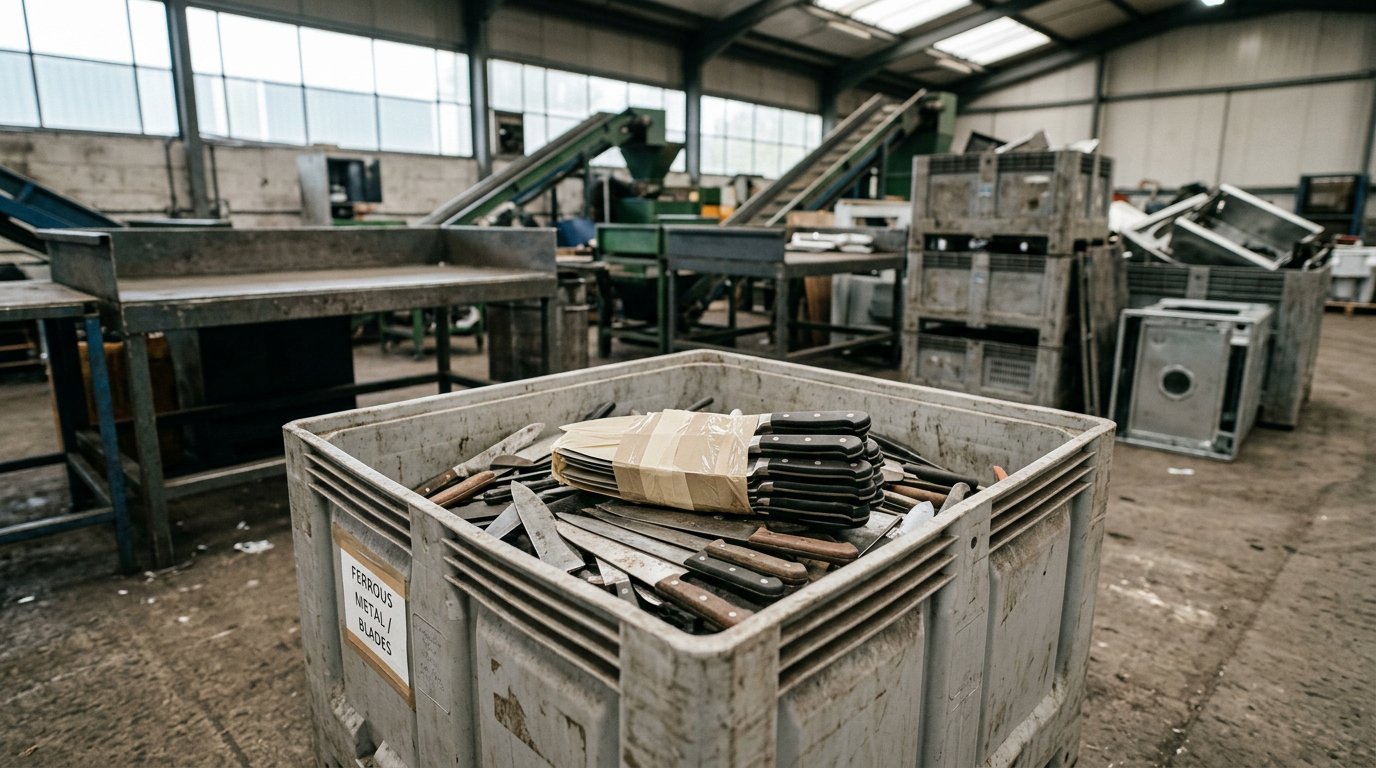
Why kitchen knives need special disposal
Carrying a kitchen knife in public in the UK is a criminal offence under the Offensive Weapons Act 2019 unless you have a "good reason" (such as transporting one to a knife amnesty bin or scrap dealer). In the US, transport rules vary by state but disposing of knives in regular bins risks injury to refuse collectors plus possible legal liability.
The two safe disposal questions: how do I get rid of them, and how do I transport them without breaking the law.
UK disposal options (legal and safe)
Option 1: Police knife amnesty bins
Most UK police forces operate permanent or periodic knife bins where any knife can be deposited anonymously and without consequence. Locations:
- Met Police (London): 25+ permanent knife surrender bins across boroughs. Find your nearest at met.police.uk/knife-crime
- West Midlands Police: rotating amnesty programme, search "knife amnesty Birmingham" or your local town
- Manchester, Liverpool, Newcastle: each force runs periodic amnesties; permanent bins at select stations
- Police Scotland and PSNI Northern Ireland: similar programmes
The transport step: wrap each knife in thick newspaper or bubble wrap, then tape securely so the blade cannot work loose. Carry in a closed bag (rucksack or supermarket bag inside the rucksack). This counts as a "good reason" for the journey.
Steel kitchen knives have salvage value. Scrap metal dealers accept them, typically priced by weight (£0.15-£0.40 per kg in 2026). For a household clear-out of 5-10 knives:
- Wrap as above for transport
- Phone ahead to confirm acceptance (many dealers want notice for sharp items)
- Bring photo ID (Scrap Metal Dealers Act 2013 requires it)
Option 3: Recycling centre (Household Waste Recycling Centre)
UK HWRCs accept knives in the metal recycling skip. Wrap before transport, hand directly to staff at the gate - do not place in any container yourself. Most sites have specific procedures; some may direct you to the residual waste skip if their metal stream cannot process sharps.
Option 4: Charity shops (working knives only)
Working kitchen knives in good condition can be donated to charity shops, though some refuse them due to safety policy. Call ahead. Options: Oxfam, British Heart Foundation, Sue Ryder, Cancer Research UK, Emmaus. Wrap blades for transport; hand to staff at the counter.
US disposal options
US scrap yards accept steel kitchen knives. Pricing varies $0.10-$0.30 per pound. Most states do not require ID. Bring wrapped knives directly to staff.
Option 2: Sharps disposal (some California counties)
A few California counties classify kitchen knives as household hazardous waste alongside needles and razors. Drop-off at HHW collection events. Check your county environmental services website.
Option 3: City bulk waste pickup
In cities like New York and Chicago, bulk waste pickup accepts knives if wrapped and labelled. NYC Sanitation guidelines: wrap in cardboard, tape securely, label "knife - sharp" in marker, place at kerb on bulk pickup day. Other cities have similar programmes.
Option 4: Goodwill, Salvation Army, local charity (working knives)
US thrift stores accept working knives by donation in many states. Policies vary by location. Call ahead. Knives often re-shelved at $1-3 each.
How to transport safely (UK and US)
Both legal and practical safety:
- Wrap the blade: 3-4 layers of newspaper, then duct tape around the wrapped section
- Wrap the handle: separate layer of tape to make the bundle rigid
- Box if multiple: small cardboard box, knives flat, taped shut
- Carry in bag: inside a closed rucksack, supermarket bag, or shopping bag
- Direct route: travel directly from home to disposal point, do not divert
UK transport tip: keep proof of intended destination (screenshot of council website, knife amnesty bin photo, scrap merchant address) on your phone in case of police stop.
What absolutely not to do
- Never put unwrapped knives in any bin: serious injury risk to refuse collectors. Council collectors are entitled to refuse to handle visibly dangerous items.
- Never throw knives in skips or open dumps: same injury risk.
- Never give knives to children to take to charity shops: under-18s carrying knives is an offence in most jurisdictions regardless of intent.
- Never sell on eBay UK or Facebook Marketplace: knife sales require buyer age verification, and eBay UK bans most kitchen knife listings.
Specialty knives (Japanese, antique, collector)
Higher-value knives have specialist routes:
- Japanese knives (Yanagiba, Deba, Santoku): enthusiasts on r/chefknives, Knife Forums, or sharpening services like Korin will buy. Wrapped courier dispatch.
- Antique or collectible knives: dealers via Antiques Trade Gazette, Bonhams. Often worth £50-£500+.
- Inherited military knives: some require licensing to transfer (UK). Check the Restriction of Offensive Weapons Act 1959.
Sharpening as alternative
Before disposing, consider whether the knife is dull rather than broken. Professional sharpening (£8-£20 per knife) restores most kitchen knives. Mobile sharpeners service most UK and US cities. A re-sharpened 10-year-old knife often outperforms a new £30 supermarket knife.
Key takeaways
- UK has dedicated police knife amnesty bins as the simplest route
- Scrap metal merchants accept knives for small salvage value (£0.15-£0.40/kg UK, $0.10-$0.30/lb US)
- Always wrap blades thoroughly before transport (3-4 layers newspaper + duct tape)
- UK Household Waste Recycling Centres accept wrapped knives at the metal stream
- Never put unwrapped knives in any bin - injury liability is real
Sources
UK Offensive Weapons Act 2019. Metropolitan Police knife crime amnesty programmes. Scrap Metal Dealers Act 2013. NYC Department of Sanitation bulk waste pickup guidelines. Restriction of Offensive Weapons Act 1959 (UK).
Frequently Asked Questions
Where can I dispose of old kitchen knives in the UK?
Police knife amnesty bins (Met Police runs 25+ permanent locations in London, other forces run periodic amnesties), scrap metal merchants (£0.15-£0.40/kg, photo ID required under Scrap Metal Dealers Act 2013), Household Waste Recycling Centres (wrap and hand to staff), or charity shops for working knives in good condition.
Is it legal to transport kitchen knives to a recycling centre in the UK?
Yes, with caveats. Under the Offensive Weapons Act 2019, you need a good reason to carry a knife in public. Direct transport to a disposal point (recycling centre, scrap merchant, police knife bin) qualifies. Wrap thoroughly, carry in a closed bag, travel directly to destination, keep proof of intent on your phone.
How do I wrap a knife safely for disposal?
Three to four layers of newspaper around the blade, secured with duct tape. Add a separate tape layer around the handle to make the bundle rigid. For multiple knives, place flat in a small cardboard box and tape shut. The goal is that the blade cannot work loose if dropped.
Can I put knives in my regular recycling bin?
No. Unwrapped knives in any bin pose serious injury risk to refuse collectors who handle bags by hand. Council collectors can legally refuse to handle visibly dangerous items. Use a council Household Waste Recycling Centre instead, where staff process metal sharps separately.
Will scrap metal merchants accept old kitchen knives?
Yes, both in the UK and US. UK pricing runs £0.15-£0.40 per kg in 2026; US pricing $0.10-$0.30 per pound. Phone ahead to confirm acceptance, bring photo ID (required in the UK under the Scrap Metal Dealers Act 2013), and hand knives directly to staff, never to a collection bin.