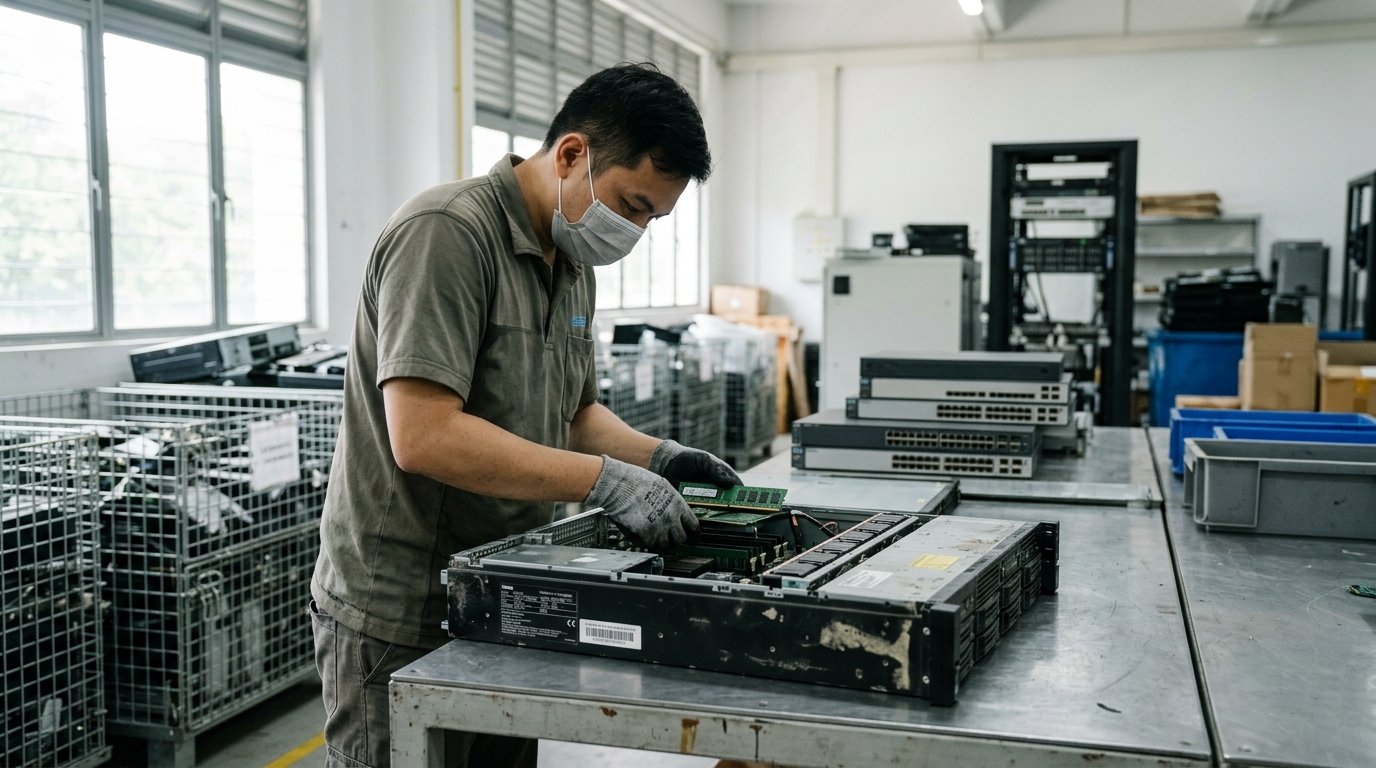
Data Centre Decommissioning in Singapore (2026) involves the planned and systematic removal of outdated or redundant infrastructure within the country's robust tech ecosystem. This process, critical for maintaining environmental sustainability and regulatory compliance, is increasingly important as Singapore aims to reduce its e-waste by 50% from 2019 levels by 2030. Data Centre Decommissioning in Singapore (2026) requires adherence to strict local regulations while leveraging the expertise of certified vendors like Iron Mountain and Sims Recycling Solutions, who ensure secure data handling and environmentally friendly disposal methods.
t at door
- Documentation - CoD + R2 chain-of-custody returned within 5-10 days
Sources
- Uptime Institute Decommissioning Best Practices
- NIST SP 800-88 Rev. 1
- Singapore regulatory guidance (national environment / data protection agency)
- R2v3 Standard for Responsible Recycling
Singapore data centre market (2026)
| Field | Value |
|---|
| Global market rank | #1 in Southeast Asia |
| Operational colocation capacity | ~480 MW operational + government moratorium on new builds (lifted 2022 with sustainability requirements) |
| Top colocation operators | Equinix, Digital Realty (formerly Keppel + GIC), Global Switch, NTT, ST Telemedia |
| Hyperscaler presence | AWS (ap-southeast-1), Microsoft Azure (Southeast Asia), Google Cloud (asia-southeast1) |
| Certified ITAD providers in metro | 12+ |
| Skilled labour rate | SGD $35-$65 per hour |
| Typical decommissioning cost | SGD $480-$880 per rack |
| Regulatory framework | NEA waste regulations + Singapore Personal Data Protection Act + Critical Information Infrastructure cyber security framework |
| Climate / cooling profile | Tropical (year-round cooling load - significant operating cost) |
| Wholesale power cost | SGD $0.18-$0.26/kWh wholesale |
| Last verified | 2026-05-20 |
What makes Singapore different for decommissioning
The Singapore market is shaped by three factors that drive decommissioning project economics:
1. Operator concentration - Singapore hosts Equinix, Digital Realty (formerly Keppel + GIC), Global Switch, NTT, ST Telemedia, meaning most enterprise decommissioning projects are within 5 km of one of these data halls. Logistics costs are lower than tier-3 markets where transport adds 15-25% to per-rack pricing.
2. ITAD provider density - with 12+ certified ITAD providers (R2v3 / e-Stewards / ISO 14001) operating in the metro, multiple competitive bids are achievable on any project. Use our free B2B ITAD quote service to get 3 bids in 1 business day.
3. Regulatory framework - NEA waste regulations + Singapore Personal Data Protection Act + Critical Information Infrastructure cyber security framework dictates the data destruction + reporting + recovery requirements. Penalty for non-compliance varies but typically scales with rack count + data sensitivity classification.
Standard decommissioning project phases for Singapore
A typical 50-rack decommissioning in Singapore runs through these stages:
- Audit + planning (Week 1): inventory each server, classify data sensitivity, plan sanitisation method (NIST 800-88 Clear/Purge/Destroy decision).
- Data sanitisation (Week 2-3): software wipe of operational drives, certified destruction of failed/encrypted drives, witnessed for regulated data.
- Hardware removal (Week 3-4): cable management, server pull, rack dismantling. Typical labour at SGD $35-$65 per hour = ~$3,000-$8,000 per 50-rack project.
- Resale routing (Week 4-6): high-residual-value servers go to refurbishment market; commodity hardware to scrap. Net: typically positive cashflow on modern hardware (less than 5 years old).
- Certificate of destruction (Week 6): issued by ITAD provider, signed by client representative, stored 6+ years for audit defensibility.
Top hyperscaler decommissioning practices in Singapore
The hyperscale operators in Singapore (AWS (ap-southeast-1), Microsoft Azure (Southeast Asia), Google Cloud (asia-southeast1)) set the standards local enterprise customers benchmark against:
- Asset tracking via RFID per server, automated end-of-life flagging at 4-5 years
- Mass-destruction of all drives via physical shred (NIST 800-88 Destroy) - software wipe not used at hyperscale due to volume + risk economics
- Sustainability targets - most hyperscalers commit to 95%+ material recovery rates from decommissioned servers via reverse-logistics partners
- Refurbishment pipelines - older hardware redeployed to secondary regions or sold to specialised refurbishers (e.g. SunBird, ITRenew acquired by Iron Mountain)
For enterprise customers in Singapore, the practical advice: benchmark your destruction policy against the local hyperscalers' - they've already done the cost/risk analysis at scale.
Cost-optimisation strategies specific to Singapore
Bundle with hardware refresh. Most ITAD providers in Singapore offer 15-30% discount on decommissioning when bundled with vendor-direct hardware refresh (Dell, HPE, Cisco). Negotiate at procurement, not after.
Time decommissioning for end-of-financial-quarter. ITAD providers compete more aggressively on volume in Q3-Q4 to hit annual targets. Schedule project pickup in late September or late December for typical 10-20% price improvement.
Use the secondary market. For hardware under 4 years old (Dell PowerEdge R6515+, HPE DL360 Gen10+, Cisco UCS C220 M5+), residual value typically exceeds removal cost. Provider may pay you net positive.
Negotiate the Certificate of Destruction format upfront. Some providers charge extra for per-serial chain-of-custody documentation. For regulated data, this MUST be in the base contract - not an add-on.
Frequently asked questions
How long does a typical decommissioning take in Singapore?
For 50 racks: 6-8 weeks end-to-end. For 5 racks: 2-3 weeks. Hyperscale-scale projects (1,000+ racks) take 6-18 months with phased migration.
What's the cheapest legitimate ITAD route?
Bundled hardware refresh through your existing vendor (Dell Trade-In, HPE Asset Recovery Services, Cisco Refresh). Typically 30-50% cheaper than third-party. Trade-off: less flexibility on data destruction method + slower processing.
Can I do data sanitisation in-house and only outsource physical disposal?
Yes - common for organisations with strict data classification requirements. Use Blancco Drive Eraser or KillDisk for in-house wipe, then handoff to certified destruction provider. Reduces per-server ITAD cost by 30-40% but requires internal labour + audit trail capability.
What about the actual power-down sequence?
The ITAD provider typically handles only the physical hardware removal - your team or facilities provider handles the orderly shutdown (1-3 hours per rack typical), networking de-cabling, and rack de-energisation. Coordinate scheduling carefully - many providers charge "idle truck" fees if the racks aren't ready for pickup at the scheduled time.
Are there local incentives in Singapore for sustainable disposal?
NEA waste regulations + Singapore Personal Data Protection Act + Critical Information Infrastructure cyber security framework dictates this. In EU member states: WEEE Producer Compliance Schemes refund some collection costs to compliant disposers. In US states with CalRecycle (CA) or NY EWRA equivalents: similar manufacturer-funded recovery programmes. Check with the local ITAD provider for current applicable schemes.
Related guides
---
Data verified against Equinix, Digital Realty (formerly Keppel + GIC), Global Switch, NTT, ST Telemedia published rates + Uptime Institute 2026 Data Centre Industry Survey + JLL Global Data Centre Outlook 2026 + Synergy Research Group Q1 2026 market data. Singapore market rankings reflect operational capacity (excluding planned/announced). Operated by Defining Style Limited (UK Companies House 10572391, ICO Registration ZA711914).