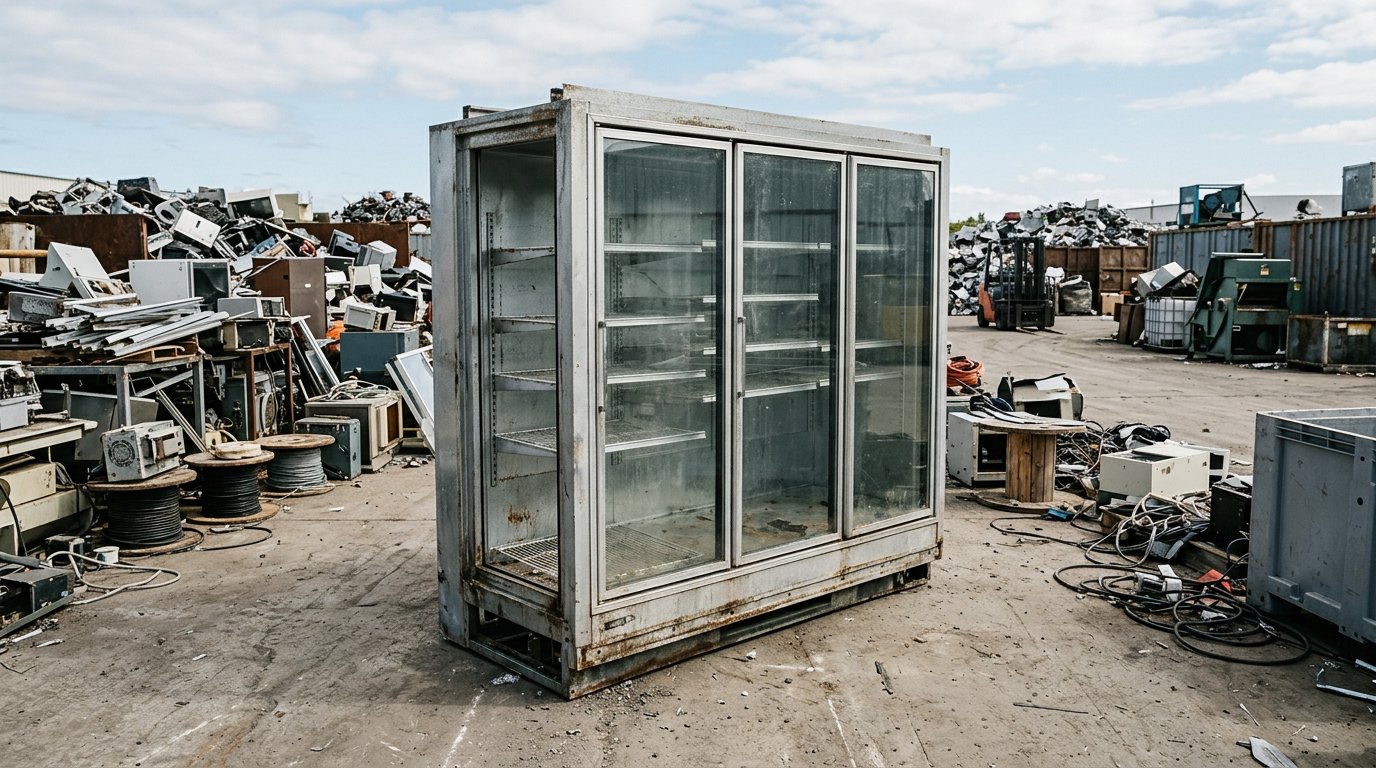
Commercial refrigerator (display case, walk-in) disposal: cost, process, regulations
Reviewed by the eCycling Central editorial team on April 2026
A commercial refrigerator (display case, walk-in) cannot be placed in regular waste in any jurisdiction with F-Gas regulation. The refrigerant inside (typically R290 (propane) for modern units, R404A (HFC blend) for older ones) must be recovered by a certified handler. This guide covers what to expect on cost, process, and which routes apply.
What it costs
Typical commercial refrigerator (display case, walk-in) disposal cost is $200-1,500 commercial decommissioning. The cheapest route is take-back with purchase of a replacement (often free). Standalone disposal through a council booking ranges from £0-£50 in UK, $20-$80 in US, and €15-€60 across the EU.
Commercial disposal of large units (walk-in cold rooms, multi-split AC systems, ground-source heat pumps) costs significantly more due to the volume of refrigerant and the size of the cabinet - expect £500-£3,500 depending on charge.
Refrigerant types you might find
| Era | Refrigerant | GWP | Charge weight |
|---|
| Modern (post-2018) | R290 (propane) | 3 | 150-1500g |
| Older (pre-2015) | R404A (HFC blend) | 3922 | 2000-15000g |
To check, look at the data plate on the back or inside of the unit.
The disposal process
- Identify the refrigerant from the data plate
- Choose a route: manufacturer take-back, retailer old-for-new collection, council bulky-waste, or commercial F-Gas certified contractor
- Refrigerant recovery: certified handler captures the refrigerant into a sealed recovery cylinder
- Cabinet processing: steel, aluminium, copper recovered for recycling. Insulation foam (which may contain blowing-agent gases on older units) handled separately
- Documentation: in commercial contexts, request the recovery certificate as end-of-life compliance evidence
Regulatory rules
F-Gas Regulation 517/2014 (EU) and EPA SNAP (US) require certified technician for recovery; commercial CO2-equivalent reporting required.
Typical lifespan before disposal becomes appropriate: 10-15 years. Beyond that, energy efficiency drops noticeably and refrigerant-leak risk increases.
Material recovery from a typical commercial refrigerator (display case, walk-in)
- Steel cabinet (60-80% by weight)
- Aluminium evaporator and condenser
- Copper tubing (high-value at LME spot pricing)
- ABS / polystyrene insulation
- Mixed plastic interior parts
Sources
- EU F-Gas Regulation 517/2014
- UK F-Gas Regulations 2015 (SI 2015/310)
- US AIM Act 2020 and EPA SNAP database
- ASHRAE Standard 34 (refrigerant safety classification)
- IPCC Sixth Assessment Report (AR6) - GWP coefficients
Real disposal cost by jurisdiction (2026)
| Field | Value |
|---|
| Appliance | Commercial refrigerator (display case, walk-in) |
| Category | Commercial refrigeration |
| Typical weight | 200-2,000+ kg |
| Refrigerant type | R404A, R448A, R449A (HFC blends); newer units R290 or CO2 |
| Refrigerant charge | 500-15,000 g |
| United States cost | $280-$1,400 (Section 608 mandatory + larger refrigerant charge) |
| United Kingdom cost | £180-£800 (F-gas Regulations 2015 enforcement) |
| EU member state cost | €220-€1,200 (F-gas Regulation 2024/573 phase-down) |
| Australia cost | A$320-$1,600 |
| US utility rebate | No rebates - commercial owner pays full disposal cost |
| Last verified | 2026-05-20 |
Why this appliance needs certified disposal
This is a sealed refrigerant system - meaning it contains fluorinated refrigerant gases that are extremely potent greenhouse gases (R410A has Global Warming Potential of 2,088, vs CO2 at 1). Federal + EU + UK regulations require qualified technician removal:
United States: YES - typically Type II or Universal certified technician required for high-charge units. The US EPA's Clean Air Act Section 608 (40 CFR Part 82, Subpart F) prohibits intentional venting of HFC, HCFC, or CFC refrigerants. Penalty: Up to $37,500/day under Clean Air Act §608(c)(2) for commercial intentional release.
United Kingdom: Environmental Protection Act 1990 + F-gas Regulations 2015 (post-Brexit retained). Requires F-gas certified technician (categories I-IV depending on charge size). Penalty: unlimited fines for commercial violators under Section 33 EPA.
European Union: F-gas Regulation (EU) 2024/573 (in force 11 March 2024, replacing 517/2014). Mandates refrigerant recovery + manifests; HFC phase-down schedule reduces high-GWP refrigerants 95% by 2050.
Pre-1995 / pre-2010 units: Pre-2020 R22 HCFC walk-ins still common - phase-out completed 1 Jan 2030
Compliant disposal routes
Free / lowest-cost option (US):
- Utility appliance-recycling programme (PG&E, ConEd, Duke Energy, NEEA region utilities) - usually includes free pickup + $20-$50 rebate. Use the EPA's Responsible Appliance Disposal (RAD) Partner locator: epa.gov/rad.
- Municipal HHW (Household Hazardous Waste) collection days - most US counties run 2-4 per year.
- Best Buy + Home Depot in-store haul-away ($25-$50 when buying replacement).
Free / lowest-cost option (UK):
- Council kerbside bulky-waste collection - typically free for white goods (check your local council; some charge £15-£35).
- Currys appliance haul-away - included free with new appliance delivery; £25 standalone.
- HWRC (Household Waste & Recycling Centre) - free drop-off if you can transport.
Free / lowest-cost option (EU):
- WEEE compliance scheme one-for-one take-back at retailer when buying replacement (mandatory under EU WEEE Directive 2012/19/EU).
- Local kommune/comune household waste collection (free in most EU member states for white goods).
Commercial / high-charge units:
- F-gas certified technician on-site removal - see our Manufacturer Take-Back Finder for accredited service providers.
- Major brands (Carrier, Daikin, Trane, LG, Samsung, Mitsubishi Electric) all run partner-network removal programmes.
Step-by-step DIY-safe preparation (before professional removal)
- Document the refrigerant type from the rating plate on the unit (usually back/side panel). Photograph the label.
- Note the appliance age - pre-2010 units almost certainly contain higher-GWP refrigerant requiring more expensive reclamation.
- Empty the appliance (food, water from defrost tray, accessories).
- Defrost completely if applicable - heat pumps + freezers shouldn't be moved while frozen contents shift.
- Disconnect from power + water supply. Leave plug visible for technician.
- Do NOT cut copper lines - releases refrigerant illegally. Do NOT puncture compressor. Do NOT crush the unit before refrigerant removal.
- Schedule certified pickup - the technician will use evacuation equipment to recover the refrigerant into a recovery cylinder before any mechanical disassembly.
- Request the Refrigerant Recovery Certificate (EPA Section 608 or F-gas equivalent) - your legal proof of compliant disposal. Required by some commercial property sale + insurance contracts.
What a typical disposal looks like
- Day 1: book pickup via utility/recycler/retailer.
- Day 5-14: certified technician arrives with recovery equipment (typically Robinair or CPS recovery machine + NIST-traceable refrigerant scale).
- At site: technician connects to high + low service ports, evacuates refrigerant into recovery cylinder (15-45 min depending on charge size), seals appliance.
- Documentation: receives + signs Refrigerant Recovery Certificate.
- Off-site processing: appliance shredded; copper + aluminium + steel + ferrous separated and resold; plastic insulation (often pre-2005 contains CFC-11 blowing agent) sent to EPA RAD-partner specialist processor; electronics + control boards sent to certified what is e-waste recycler.
Carbon impact of compliant vs non-compliant disposal
Per the EPA RAD programme, one improperly-disposed commercial refrigerator (display case, walk-in) releases the equivalent of approximately 8-22 tonnes of CO2 over the next 50 years (the refrigerant escapes to atmosphere as the unit decomposes in landfill). Compliant recovery captures 95%+ of the refrigerant for reuse or destruction at high-temperature incinerator. One compliant disposal = equivalent CO2 reduction of taking a car off the road for 2 years.
See our E-Waste Carbon Footprint Calculator for project-specific impact estimates.
Frequently asked questions
Can I disconnect + transport the appliance myself before recovery?
US: technically yes for residential, but if any refrigerant is released during transport you become liable under Section 608. UK + EU: same - F-gas Regulation places liability on whoever causes the release. Safer to book on-site recovery first.
Does it need to be empty / clean inside?
Yes - refrigerator interiors with food residue create biohazard for recyclers + may delay pickup. Wipe clean + leave doors open for 24+ hours to dry.
What if the appliance still works - can I sell or donate it?
Yes if it's <10 years old + working. Charities (Goodwill, Salvation Army, British Heart Foundation) accept working white goods. Selling on eBay / Facebook Marketplace: legal, but verify buyer pickup arrangements + transport regulations apply.
Do I need a special permit to throw it out?
Most US states: no permit needed for residential disposal via compliant channel. California: AB 1953 requires labelled disposal record. UK: no permit but council collection rules vary. EU: WEEE Producer Compliance Scheme covers most retail-purchased units.
Can I claim a tax deduction?
US: Charitable donation of a working appliance to a 501(c)(3) - get IRS Form 8283 from receiving charity. UK: Gift Aid not applicable to physical goods donations. EU: varies by member state.
Related guides
---
Data verified against US EPA RAD Partner Programme, UK F-gas Regulations 2015 (post-Brexit retained), EU F-gas Regulation 2024/573, and 2026 published rates from PG&E, ConEd, Duke Energy, Currys + major utility appliance-recycling schemes. Operated by Defining Style Limited (UK Companies House 10572391, ICO Registration ZA711914).