Where to recycle clothes and textiles (UK 2026)
The UK throws away an estimated 350,000 tonnes of clothing per year (WRAP UK 2024 figures). Only 8% gets reused or recycled; 92% goes to residual waste, landfill, or incineration. Free drop-off options cover most of the UK.
Option 1: Retailer take-back banks
Most major UK clothing retailers operate free take-back schemes:
- H&M: drop unwanted clothing from any brand at any UK store. Receive a 15% discount voucher per bag. Items sorted into wear-again, repair, or material reuse.
- Marks & Spencer Shwopping: drop unwanted M&S clothing at any UK store. Items partner with Oxfam for resale or material recovery.
- John Lewis: accept clothing donations at most stores. Partner with Newlife Foundation. Discount voucher applies.
- Levi's: accept any-brand denim at participating stores via the Levi's Renewal Workshop.
- Boohoo, ASOS: postal returns programmes for unwanted clothing.
Coverage: 6,000+ UK locations across the major chains.
Option 2: Council textile banks
UK councils typically place textile banks at supermarket car parks, recycling centres, and community sites. Search "textile bank [your postcode]" on your council website.
Major operators:
- JMP Wilcox Group: 5,000+ UK textile banks
- TRAID: 1,400+ banks across London and South East
- Salvation Army Trading: 8,000+ banks UK-wide
- British Heart Foundation: 9,500+ banks plus 700 furniture and electrical stores
Most accept clothing, shoes, bags, and household textiles (curtains, bedding, towels) in any condition.
Option 3: Charity shop donation
Direct donation to charity shops accepts both wearable and unwearable items. Charities sort and route appropriately:
- Oxfam: 600 UK shops, accepts most items
- British Heart Foundation: 700+ shops, plus furniture/electrical
- Cancer Research UK: 600+ shops
- Sue Ryder, Mind, Barnardo's, Age UK: 200-500 shops each
Items in good condition stocked for resale. Damaged items sold to textile reclamation merchants who separate into rag, insulation stuffing, and material recovery streams.
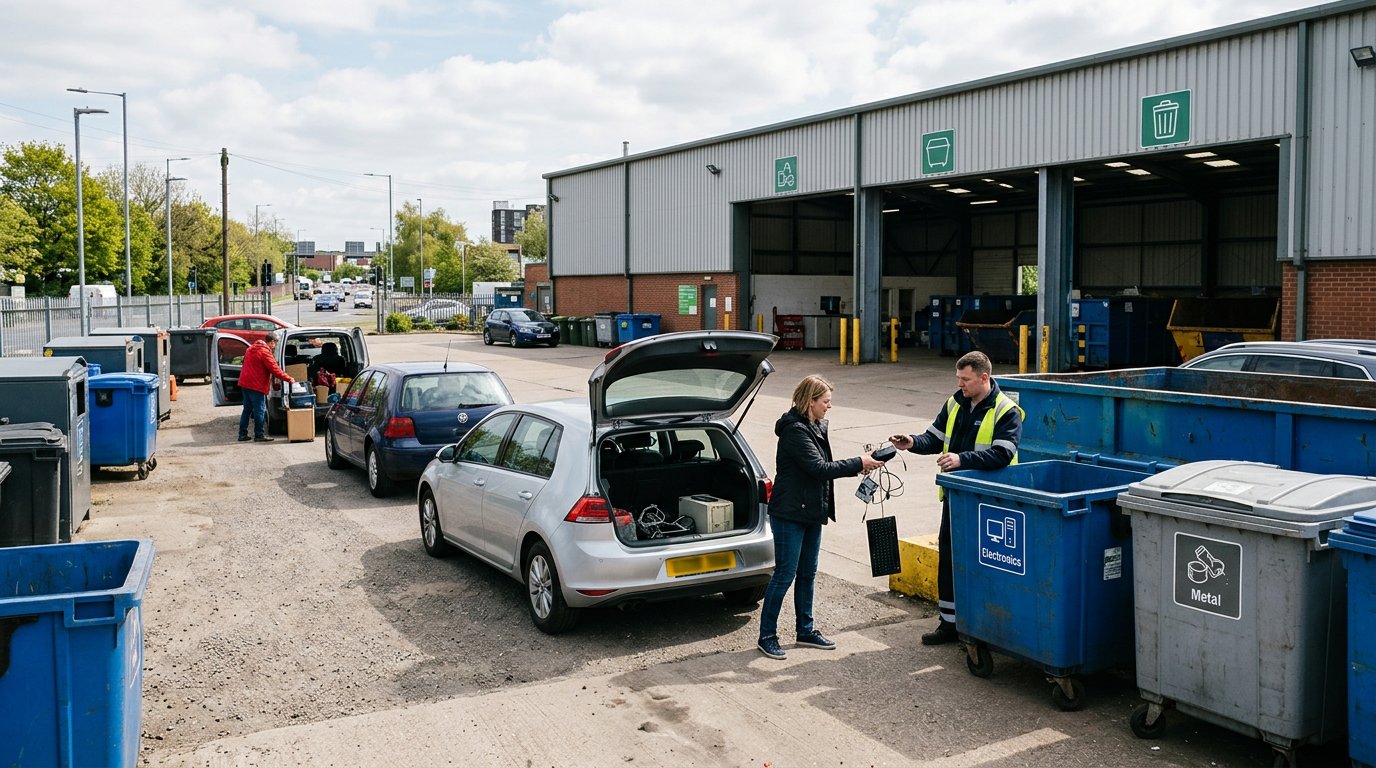
Option 4: Household Waste Recycling Centre
UK HWRCs typically accept textiles in a dedicated bay. Bring in tied bags, hand to staff at the gate. No charge.
Where to recycle clothes (US 2026)
US clothing recycling options vary more by state than UK:
Option 1: Goodwill and Salvation Army
- Goodwill: 3,400+ US locations, free drop-off at any store or attended drop-bin
- Salvation Army: 1,400+ family stores plus pickup service for large donations
Both sort donations: 50% sold in stores, 25% to wholesale rag merchants, 25% recycled into material streams.
Option 2: Retailer take-back
- H&M US: same global programme; any-brand drop-off at any US store
- Levi's US: SecondHand programme at participating stores
- The North Face: Clothes the Loop programme at any US store
- Madewell: denim take-back at any US store
Option 3: TerraCycle clothing programmes
TerraCycle operates specific programmes for items most charities refuse:
- Used Clothing Zero Waste Box: USD 159 per box, accepts any clothing condition
- Shoe and Footwear Zero Waste Box: USD 145 per box
- Bra and Underwear Zero Waste Box: USD 99 per box
Best for businesses, schools, and organisations collecting at scale.
Option 4: Municipal textile programmes
Limited US cities operate municipal textile collection:
- New York City: refashionNYC bins at apartment buildings + Salvation Army partnership
- San Francisco: SF Environment collection at fire stations
- Seattle, Portland: kerbside textile pickup pilots
Accepted in most schemes:
- All clothing (any condition - including damaged, stained, single shoes)
- Shoes (tied in pairs)
- Bedding, curtains, towels, table linens
- Bags and belts
- Soft toys
Refused in most schemes:
- Wet, mouldy, or biohazard contaminated textiles
- Pillows, cushions (filled with mixed materials)
- Carpet, rugs, mattress fabric
- Heavily soiled work clothing with chemicals
What happens to recycled clothing
Per WRAP UK 2024 tracking:
| Destination | UK % |
|---|
| Resold in UK charity shops | 18% |
| Exported for resale (Eastern Europe, Africa) | 47% |
| Recycled into industrial rag | 24% |
| Recycled into insulation, stuffing, automotive felt | 6% |
| Fibre-to-fibre recycling (new yarn) | 1% |
| Residual waste / energy from waste | 4% |
The 1% fibre-to-fibre rate is the industry frontier. Companies like Worn Again Technologies, Renewcell, and Infinited Fiber are scaling chemical recycling that can produce new virgin-quality fibres from old clothing.
Best practice before donating
To maximise the value of donated items:
- Wash before donating: clean items are 3x more likely to be resold vs recycled
- Tie shoes in pairs: single shoes go to rag
- Empty pockets: check for personal items
- Separate damaged items: bag separately, label "rag" - saves sorters time
- Avoid donating during peak periods: charity shops often refuse donations during summer due to storage limits
Local council variation in the UK
Council acceptance of textiles in kerbside recycling is rare but growing:
- London Borough of Hackney: kerbside textile collection (2022 trial)
- Greater Manchester: textile collection at HWRCs only
- Most councils: textile banks at supermarkets and recycling centres
The Simpler Recycling reforms (April 2026) do not currently mandate textile separation in household recycling, though this is under DEFRA review for 2028 expansion.
Brands taking responsibility
A handful of clothing brands now offer take-back schemes for their own products with meaningful credit:
- Patagonia Worn Wear: trade-in credit for Patagonia items in good condition
- Eileen Fisher Renew: USD 5 credit per item, resold or remanufactured
- REI Re/Supply: trade-in credit for REI-brand items
- The North Face Renewed: trade-in credit for TNF items
- lululemon Like New: trade-in credit for lululemon-brand items
These schemes typically offer 10-30% of original retail value back as store credit.
Key takeaways
- 92% of UK textile waste is currently disposed via residual waste or landfill
- Major UK retailers (H&M, M&S, John Lewis, Levi's) accept any-brand take-back free at 6,000+ locations
- Council textile banks operated by JMP Wilcox, TRAID, Salvation Army Trading, BHF cover most UK postcodes
- US options include Goodwill, Salvation Army, and TerraCycle Zero Waste Boxes for difficult items
- Fibre-to-fibre recycling remains under 1% of UK textile recycling output
Sources
WRAP UK Textile Recycling Tracker 2024. H&M, Marks & Spencer Shwopping, John Lewis published take-back guidance 2026. TRAID, Salvation Army Trading, JMP Wilcox Group documentation. TerraCycle Zero Waste Box product range 2026. DEFRA Simpler Recycling guidance.