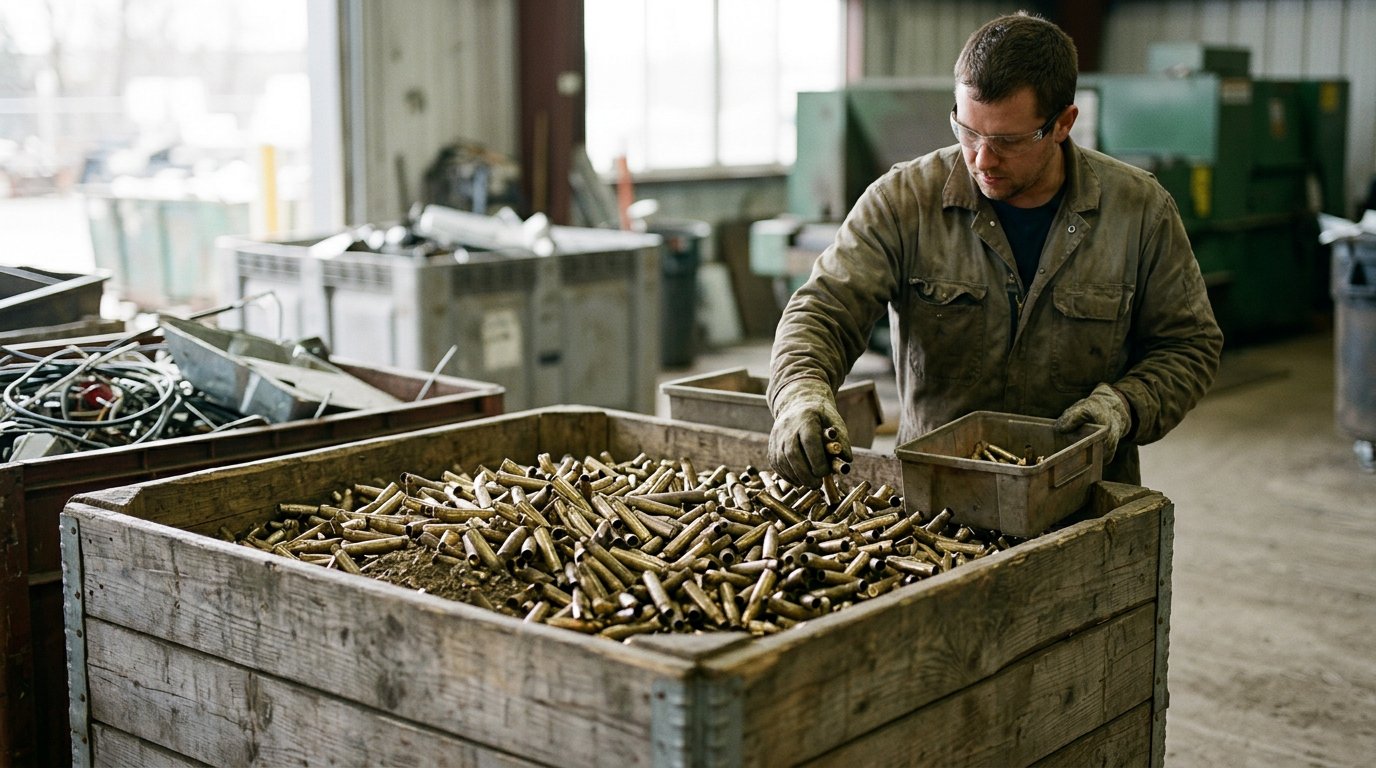
Brass shell casing recycling turns spent ammunition brass into immediate cash plus reloadable raw material. As of May 2026, US scrap yards pay $1.80-$3.20 per pound for clean once-fired brass, mail-in services pay $1.20-$2.10 (less shipping), and reloaders buy graded headstamp-specific brass for $0.05-$0.40 per case. A typical 1,000-round range trip generates 6-8 lbs of brass casings = $11-$24 in scrap value or $50-$400 in reloader value depending on cartridge.
Where to recycle brass shell casings (USA, ranked by payout)
| Option | Payout (per lb) | Best for | Notes |
|---|
| Local scrap yard cash | $1.80-$3.20 | Mixed brass, any quantity, walk-in | Bring photo ID (required in most states for scrap-metal records). Pre-sort: removed primers + tumbled-clean cases pay 10-20% more |
| Specialty reloader buyer (graded headstamp) | $0.05-$0.40 per case | Premium calibres: 5.56, 7.62, .45 ACP, .308, 9mm | Buyer wants specific headstamps (LC, FC, WIN, REM) sorted + de-primed. Highest per-pound return but most labour |
| Mail-in brass services (Brass Buyers, Allegheny Arms) | $1.20-$2.10 | Bulk 50+ lbs, rural areas with no scrap yard nearby | Prepaid USPS label, 14-21 day payment. Buyer pays after weighing your shipment |
| Range donation (private + commercial) | $0 (tax deduction available) | Anyone wanting to support charitable shooting programmes | Some ranges run brass-buyback at $0.50-$1.00/lb; others accept donations for youth programmes (Project Appleseed, NRA Foundation) |
| DIY reloading | $0.40-$2.50 per case saved | Active reloaders with own equipment | Most-economical if you already own a press; saves $300-$1,200 per 1,000 rounds versus buying factory ammunition |
How to prep brass for maximum payout
Scrap yards pay differently for clean vs dirty brass. The grading:
- Yellow brass (clean, deprimed, no contamination): $1.80-$3.20/lb - top rate
- Yellow brass (with primers still in): $1.50-$2.80/lb - 10-15% discount because the smelter has to deal with the primer compound
- Mixed brass (with steel, aluminum, or copper): $0.80-$1.40/lb - heavy discount due to sorting
- Painted or coated brass: $0.70-$1.20/lb - lowest grade
- Tumbled and polished: $1.95-$3.45/lb - premium because the yard saves the labour
The cheapest yield boost: tumble your brass with corn cob or walnut shell media for 2-4 hours before delivery. A $40 vibratory tumbler pays for itself in the first 100 lbs of brass.
State and federal rules on brass recycling
Recycling brass casings is legal in all 50 US states. However:
- California, New York, New Jersey require scrap yards to record seller ID and transaction details under metal-theft-prevention laws (Cal. Bus. + Prof. Code § 21605 and similar)
- Federal ATF rules apply ONLY to firearms components, not spent casings - spent brass is no longer a regulated component
- Lead exposure is real - wash your hands after handling un-tumbled range brass; the primer residue contains lead styphnate dust
- EPA RCRA classifies spent ammunition casings as non-hazardous if depleted; reloaded but un-fired cases with primer still seated may be classified as explosive under DOT 49 CFR if shipped
Mail-in brass recycling services compared
| Service | Calibres accepted | Rate (per lb) | Min shipment | Payment time |
|---|
| Brass Buyers | 9mm, .45 ACP, .223/5.56, .308, .40, 10mm | $1.40-$1.95 | 25 lbs | 14-21 days |
| Allegheny Arms | All centerfire pistol + rifle | $1.20-$1.85 | 50 lbs | 7-14 days |
| Top Brass Reloading | Graded headstamp-specific | $0.04-$0.18 per case | 1,000 cases | 30 days |
| Range Brass Specialists | All centerfire | $1.30-$1.90 | 30 lbs | 14-28 days |
Mail-in services typically pay 20-35% less than walk-in scrap yards but eliminate the trip. The break-even distance: if you'd drive more than 25 miles to the nearest scrap yard, mail-in usually wins.
What about rimfire (.22 LR) brass?
Rimfire brass is much thinner than centerfire and is rarely reloadable. Most scrap yards accept it but at a slight discount because of higher contamination ratios. Some yards combine rimfire brass with general yellow-brass bulk rather than premium once-fired.
Reloading economics (when it's worth keeping vs selling)
The break-even point depends on cartridge cost. For each round reloaded, you save approximately the cost-of-factory minus the cost-of-components:
- 9mm Luger: factory $0.30/round, reload cost $0.13 (bullet $0.08 + powder $0.03 + primer $0.02). Saves $0.17/round.
- .223 Remington: factory $0.60/round, reload cost $0.22. Saves $0.38/round.
- .308 Winchester: factory $1.10/round, reload cost $0.38. Saves $0.72/round.
- .45 ACP: factory $0.55/round, reload cost $0.18. Saves $0.37/round.
If you shoot 500+ rounds per month of any centerfire calibre, reloading saves more than the equipment cost in 8-14 months. The brass IS the most expensive component to source new - having a spent-brass reservoir is the bigger value than scrap cash.
Federal hazardous waste classification
Spent ammunition brass becomes EPA RCRA Resource Conservation and Recovery Act exempt waste after firing (residual primer compound is depleted). However, brass still containing un-fired primers is regulated under DOT 49 CFR 173.59 as Class 1.4S explosive material - this affects mail-in shipping. Always confirm shipping eligibility with USPS or your carrier before sending unfired or partially-fired cases.
How much brass do shooters typically have?
Based on survey data from the National Shooting Sports Foundation (NSSF) 2024 reload-economics report:
- Casual shooter (50-200 rounds/month): 0.5-1.5 lbs brass/month, $1-$5 scrap value
- Regular shooter (200-500 rounds/month): 1.8-4.5 lbs brass/month, $4-$15 scrap value
- Competitive shooter (500-1,500 rounds/month): 4.5-13.5 lbs brass/month, $10-$45 scrap value
- Reloader (depending on volume): may consume own brass entirely; net surplus 2-8 lbs/month
Most shooters discover they have 30-200 lbs of accumulated brass in 2-3 years if they haven't been actively recycling or reloading.
Sources
- Institute of Scrap Recycling Industries (ISRI) brass spot price data
- National Shooting Sports Foundation (NSSF) 2024 reload economics survey
- EPA Resource Conservation and Recovery Act 40 CFR Part 261 (waste classification)
- DOT 49 CFR 173.59 (explosive materials shipping)
- CA Bus. + Prof. Code § 21605 (scrap-metal seller ID requirements)
Last verified: 2026-05-23. Brass spot price fluctuates weekly with copper + zinc commodity markets. Verify current rate with your local scrap yard before transport.
Frequently Asked Questions
How much do scrap yards pay for brass shell casings?
US scrap yards pay $1.80-$3.20 per pound for clean once-fired brass as of May 2026. Tumbled and polished brass earns up to $3.45/lb. Brass with primers still seated discounts 10-15%. Mixed brass with steel or aluminum contamination drops to $0.80-$1.40/lb. Bring photo ID - most states require seller records under metal-theft prevention laws.
Where can I sell brass shell casings near me?
Walk-in local scrap yards pay the highest rate for any quantity. For 1,000+ cases of premium calibres (5.56, 7.62, 9mm, .45 ACP, .308), specialty reloader buyers pay $0.05-$0.40 per case if sorted by headstamp. Mail-in services like Brass Buyers and Allegheny Arms accept 25-50 lb minimum shipments and pay $1.20-$2.10/lb less shipping.
Is brass shell casing recycling legal?
Yes, in all 50 US states. Federal ATF rules do not apply to spent casings (they are not regulated firearms components). California, New York, and New Jersey require scrap yards to record seller ID and transaction details under metal-theft prevention laws. Spent brass is EPA RCRA exempt as non-hazardous waste.
Should I deprime brass before recycling?
Yes if you want top rate. Scrap yards discount 10-15% for brass with primers still in because the smelter must handle the primer compound separately. A simple universal decapping die ($25-$45) pays for itself in 50-100 lbs of brass at the depriming premium. Wash hands after - primer residue contains lead styphnate dust.
What's the difference between selling brass and reloading?
Selling brass at scrap rates yields $1.80-$3.20/lb. Reloading saves $0.17-$0.72 per round depending on calibre. For active shooters (500+ rounds/month), reloading pays back equipment cost in 8-14 months and saves 50-70% on ammunition. Casual shooters (under 200 rounds/month) typically find scrap sale or donation more practical than building a reloading bench.
Do mail-in brass services pay well?
$1.20-$2.10 per pound is typical (less than walk-in scrap yards because of shipping costs). Brass Buyers, Allegheny Arms, Top Brass Reloading, and Range Brass Specialists all run prepaid USPS pickup with 7-30 day payment turnaround. Best for rural areas without a nearby scrap yard or for bulk 50-lb+ shipments.
How do I tumble brass for higher scrap price?
A vibratory tumbler ($40-$80) with corn cob or walnut shell media (about $20 per cycle) cleans 5-10 lbs of brass in 2-4 hours. Tumbled and polished brass earns $1.95-$3.45/lb at scrap yards versus $1.80-$3.20/lb for unprocessed. The $40 tumbler pays for itself after 80-100 lbs.
Can I mail brass with primers still seated?
USPS and most carriers prohibit shipping unfired primers under DOT 49 CFR 173.59 (Class 1.4S explosive material classification). Fully spent (already fired) primers are not regulated. Deprime your brass before shipping or confirm with the buyer that they accept primed cases - most do NOT, due to carrier rules.
What about rimfire (.22 LR) brass?
Most scrap yards accept rimfire brass but at a slight discount versus centerfire because the cases are thinner with more contamination per pound. Rimfire is rarely reloadable due to construction. Lump it with general yellow brass for scrap sale - typical rate $1.40-$2.40/lb.
How much brass do shooters accumulate?
Per NSSF 2024 data: casual shooters (50-200 rounds/month) generate 0.5-1.5 lbs brass/month. Regular shooters (200-500): 1.8-4.5 lbs. Competitive shooters (500-1,500): 4.5-13.5 lbs. Most shooters who don't actively recycle find 30-200 lbs of accumulated brass after 2-3 years - worth $50-$600 at current scrap rates.