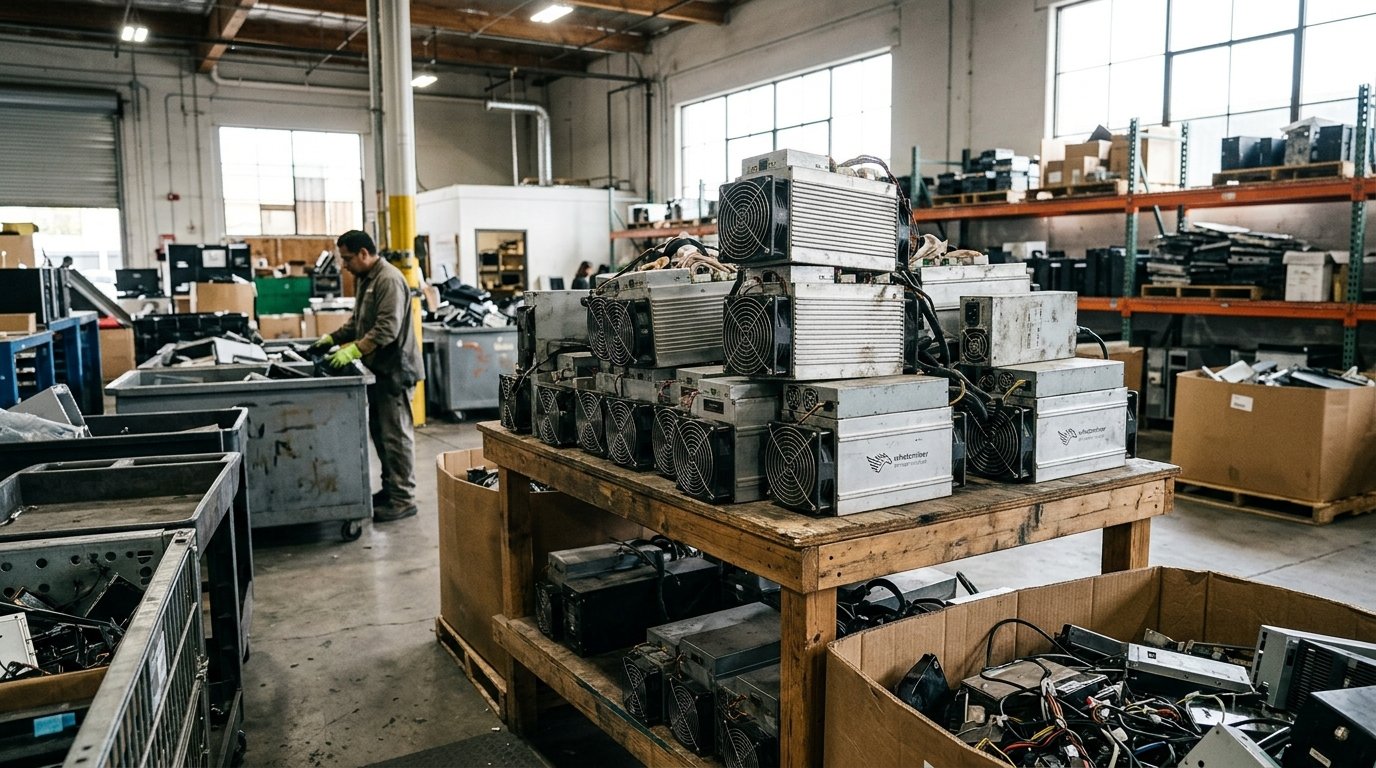
The ASIC Mining Hardware Liquidation Guide (2026): Resale, Hosting, Recycling provides detailed strategies for disposing of outdated cryptocurrency mining equipment. This guide addresses the lifecycle challenges faced by miners as newer and more efficient models enter the market, rendering older ASICs obsolete. With a focus on 22 specific models from leading manufacturers like Bitmain, the guide outlines four primary methods: secondary resale, hosting in cost-effective regions, scrap recovery, and environmentally responsible disposal. For instance, the Bitmain Antminer S21, released in 2024 with a hashrate of 200 TH/s, currently sees resale values ranging from $3200 to $4000, reflecting its ongoing relevance despite obsolescence threats.
econdary-market broker. Active marketplaces:
- Compass Mining (https://compassmining.io) - hosted mining + hardware sales
- Kaboomracks (Telegram broker) - bulk rig deals 10+ units
- SunnySide Digital (https://sunnyside.digital) - reseller
- Direct manufacturer trade-in - Bitmain, MicroBT, Canaan periodic buyback programmes
- eBay - retail-tier transactions, lower prices but immediate liquidity
Liquidation route 2: hosting in low-cost-power region
For units that are uneconomic at your local power cost but still functional, hosting in regions with cheap power can extend earning life by 6-18 months:
- Texas (US): ERCOT grid, $0.04-$0.06/kWh hosted rate
- Paraguay: Itaipu hydro, $0.04-$0.05/kWh
- Ethiopia: Hydroelectric expansion, $0.03-$0.05/kWh
- Iceland: Geothermal, $0.05-$0.07/kWh, geographic remoteness offsets gain
- Kazakhstan: $0.05-$0.07/kWh, regulatory uncertainty as of 2024
Compare hosting cost to break-even-power-cost for the model (function of J/TH and BTC price).
Liquidation route 3: scrap recovery
For end-of-life ASICs (typically generations 3+ behind current flagship), scrap recovery is the legal route. Material breakdown per typical 13kg ASIC:
- Aluminium chassis: ~9 kg, $22 at LME spot
- Copper wiring: ~0.7 kg, $7 at LME spot
- PCB precious metals (Au, Pd, Ta): $8-25 per unit at integrated smelter
Total: $35-55 per unit at modern integrated facilities (Aurubis, Umicore, Boliden).
Liquidation route 4: controlled disposal
ASICs classified as WEEE under EU Directive 2012/19/EU. Must go through:
- EU/UK: registered WEEE Authorised Treatment Facility
- US: R2 or e-Stewards certified electronics recycler
- Canada: provincial-EPR registered facility
- Australia: NTCRS registered processor
Cannot be placed in regular waste in any of the above jurisdictions.
Bitcoin mining e-waste context
Per Cambridge Centre for Alternative Finance (2021 study, updated through 2024), the Bitcoin network generates 30.7 kt of e-waste per year from ASIC obsolescence - approximately equivalent to the total annual IT and telecommunication equipment waste of the Netherlands.
Sources
- Bitmain, MicroBT, Canaan, IceRiver, Goldshell published specifications
- Cambridge Centre for Alternative Finance: Bitcoin Mining Resource Centre
- Compass Mining secondary-market price tracker
- LME spot prices for aluminium, copper
- EU WEEE Directive 2012/19/EU