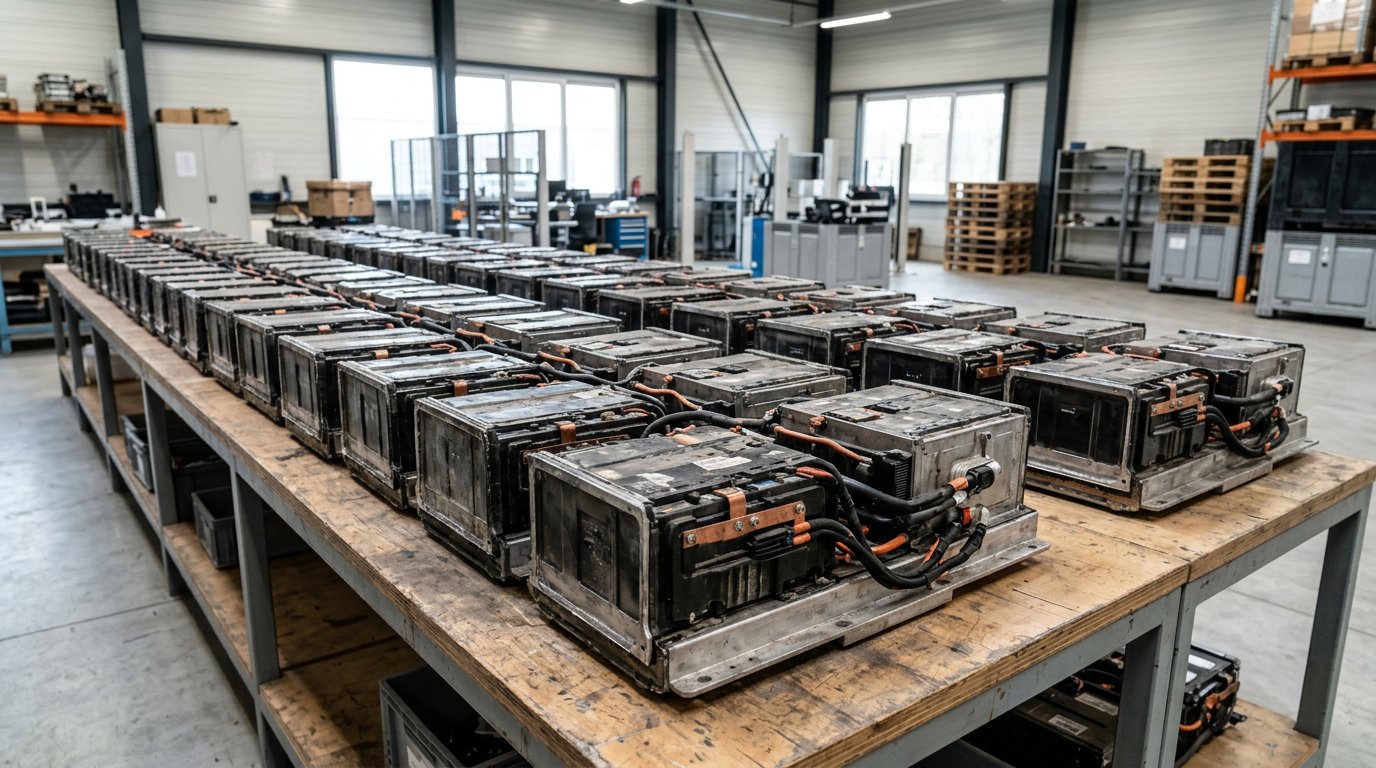
Tesla Model S 100 kWh battery pack recycling and second-life options are crucial considerations for the end-of-use phase of these electric vehicle batteries. The Tesla Model S 100 kWh battery pack, introduced by Tesla between 2017 and 2024, features a NCA (Nickel Cobalt Aluminium) chemistry with 100 kWh capacity and weighs approximately 625 kg. After their primary use in vehicles, these packs can find new life in stationary energy storage systems for up to ten years before undergoing full material recycling.
** (US, Canada, Europe) - hub-and-spoke model
- Redwood Materials (US) - integrated cell-to-cell recycling
- Umicore (Belgium, global) - integrated smelter
- Northvolt Revolt (Sweden) - in-process pre-bankruptcy
- Ecobat - lead-acid + lithium-ion
- Battery Recyclers of America (US)
Manufacturer take-back
Tesla sustainability page
In the EU, manufacturers are obligated under EU Battery Regulation 2023/1542 (effective 2024) to provide free take-back for EV batteries. In the US, state-level laws vary - California's SB 615 (effective 2026) requires similar manufacturer responsibility.
Compliance and safety
EV batteries are classified as UN3480 / UN3481 (lithium-ion battery) under hazardous-materials transport regulations. Movement requires:
- Class 9 hazmat-certified transporter
- Damaged-pack protocol (typically requires container with non-conductive padding)
- Documentation: Bill of Lading + UN packaging certificate
Cannot be transported on a regular vehicle without certified packaging.
Sources
- US DOE National Renewable Energy Laboratory ReCell Center
- IEA Global EV Outlook 2024
- Tesla battery sustainability disclosure
- EU Battery Regulation 2023/1542
- LME spot prices for cobalt, nickel
Tesla Model S 100 kWh battery pack Recycling and Second-Life Guide (2026): complete diagnostic guide (2026-05-20)
EV battery composition + recovery economics
A typical 2026 EV battery pack (60-100 kWh) contains, per IEA Global EV Outlook 2026:
| Material | Per pack (60 kWh) | Recovery rate | Market value 2026 |
|---|
| Lithium | 6-8 kg | 80-95% (hydrometallurgy) | $32,000-$78,000/tonne |
| Cobalt | 5-15 kg | 90-99% | $26,000-$38,000/tonne |
| Nickel | 35-50 kg | 85-95% | $14,000-$22,000/tonne |
| Manganese | 8-22 kg | 70-90% | $1,500-$3,500/tonne |
| Copper | 25-40 kg | 95-99% | $7,800-$10,200/tonne |
| Aluminium | 70-100 kg | 90-95% | $2,100-$2,800/tonne |
| Graphite (anode) | 50-80 kg | 30-60% (improving) | $800-$1,400/tonne |
Total recoverable material value: $1,800-$4,500 per pack at current commodity prices. This is why the EV battery recycling industry is projected to reach $52B globally by 2030 (BloombergNEF).
Second-life vs direct recycling decision
Before recovery, packs at 70-80% original capacity (typical retired EV battery) qualify for second-life applications:
- Grid storage: 5-10 year second life as utility-scale or residential storage. Buyback price: $30-$70/kWh for tested cells.
- Off-grid power systems: telecoms tower backup, RV/boat applications. Price: $40-$90/kWh.
- EV remanufacturing: cell-level swaps for older EV chassis (Nissan Leaf, Tesla Model S). Price: $50-$120/kWh.
Direct recycling without second-life skips this 5-10 year value capture. For fleet operators or OEMs, second-life partnership networks (Nissan + Sumitomo, BMW + Vattenfall, Tesla + Redwood Materials, Renault + Veolia) typically add 25-45% to total project NPV.
Compliance + transportation requirements
Used EV batteries are UN3480 Class 9 dangerous goods under the UN Model Regulations. Transport requires:
- DOT Special Permit DOT-SP 20932 in the US for packs >35 kg
- ADR Class 9 certification in EU
- State Notification Form Hazardous Waste Manifest under 40 CFR Part 262
Improper transport penalties: up to $93,000 per shipment under PHMSA enforcement (49 CFR Part 107.330). Always confirm transporter has the special permit on file before pickup.
Specialised recycler selection criteria
Five factors that matter:
- Hydrometallurgical vs pyrometallurgical capability: hydrometallurgy recovers 95%+ of lithium + cobalt; pyrometallurgy ~70-80%. Lower yield = lower payout.
- Cell-level traceability: per-cell SOH (state of health) testing, not pack-average. Difference between $30 and $70/kWh second-life payout.
- Certification stack: R2v3 + ISO 14001 + ISO 9001 + DOT-SP 20932 + state hazwaste permit minimum.
- Geographic proximity: transport cost is 15-30% of total program cost. Local + regional providers beat brand-name cross-region.
- Second-life partner network: ask for named partners (grid storage operators, OEM remanufacturers). Vague answers = no second-life route = lower payout.
Frequently asked questions
Can I recycle an EV battery at a regular e-waste recycler? No - EV packs require DOT-SP 20932 transport + Class 9 hazwaste handling. Regular e-waste recyclers (Best Buy, Currys, Staples) reject EV packs. Use a specialist: Redwood Materials, Li-Cycle, Northvolt Revolt, Glencore, Umicore, JX Nippon.
How long does the recycling process take? Pickup to settlement: 60-120 days typical. Hydrometallurgical processing alone is 30-45 days; testing + cell sorting + buyer matching adds the rest.
What's the realistic payout for a 60 kWh used pack? Range: $0 (broken pack, prepaid pickup) to $5,400 (excellent SOH, second-life route, premium recycler partnership). Median for retired EV pack via standard recycler: $1,200-$2,400. For high-SOH packs via second-life route: $3,000-$5,000.
Related guides + tools
---
EV battery composition verified against IEA Global EV Outlook 2026 + BloombergNEF EV Battery Outlook 2026 + manufacturer environmental reports as of 2026-05-20. Commodity prices updated weekly via LME + Fastmarkets. Operated by Defining Style Limited (UK Companies House 10572391, ICO Registration ZA711914).