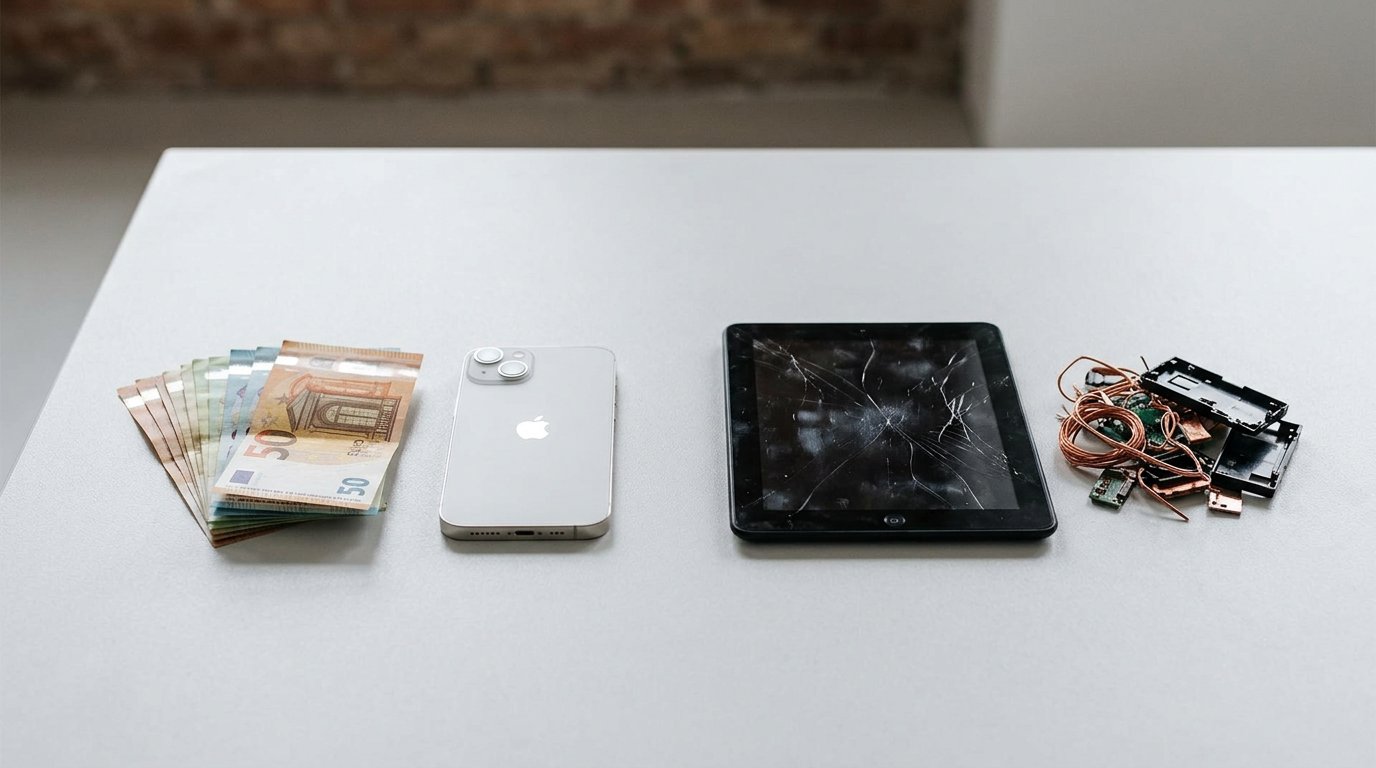
**Trade-In vs Recycling: Which Gets You More Value**
*Reviewed by the eCycling Central editorial team on 01 April 2026*
Recycling is the better option for most people looking to dispose of old electronics. According to a report by the United Nations, only 20% of global [definition of e-waste](https://ecyclingcentral.com/glossary/e-waste) was recycled in 2019, highlighting the urgent need for proper disposal methods that maximize environmental benefits and protect personal data.
| Feature | Trade-In | Recycling |
|---|
| Process | Exchange old device for credit towards a new purchase. | Sending or dropping off devices to be dismantled and processed. |
| Cost to Consumer | Free, often earns money but varies by brand. | Often free; some programs may charge a fee. |
| Time Required | Few minutes online or at a store. | Varies from immediate drop-off to weeks for mail-in services. |
| Environmental Impact | Saves carbon but not as much material recovery as recycling. | Highest recovery rates, reducing landfill waste and pollution. |
| Data Security | Data wiped by seller; potential resale risks. | Data destroyed during dismantling process. |
| Best Choice | When you need credit towards a new purchase or quick convenience. | If environmental benefits outweigh the value of trade-in incentives. |
### Trade-In
Trade-In is a straightforward way to get some money back for your old electronics. You simply take your device to a store or send it in online, and receive credit toward a new purchase. For example, Apple offers up to $405 for an iPhone 12 Pro Max trade-in, as of their latest program updates.
The process is quick-typically just a few minutes at a counter or during checkout. Most major retailers offer this service, including Best Buy, Amazon, and eBay. While it's convenient and can save you money on your next gadget purchase. The environmental impact is less significant compared to recycling. Trade-In programs may not recover as much material from devices, leading to higher e-waste in landfills.
Pros include earning cash or credit towards a new device, saving time with quick service at popular stores, and getting immediate benefits for upgrading electronics. Cons are fewer environmental gains, the risk of data breaches if your old device is resold without proper wiping, and limited material recovery compared to recycling methods.
*According to the WHO, improper e-waste disposal releases toxic substances including lead, mercury, and cadmium into soil and water.*
### Recycling
Recycling involves sending your electronic devices off to be dismantled and processed properly. This can happen through mail-in services or drop-off locations at municipal facilities or designated e-waste centers. For instance, Dell's OptiConnect program processes over 1 million pounds of electronics annually, according to their sustainability reports.
The process requires more time than trade-ins-some programs might take several weeks for mailed-in items to be processed-but ensures a higher rate of material recovery and reduces environmental damage significantly. Many recycling services are free or have minimal costs associated with them.
Recycling offers better environmental benefits by recovering valuable materials, reducing carbon emissions from mining new resources, and preventing toxic waste from polluting landfills. Data security is also more strong since the devices are destroyed during the dismantling process, eliminating resale risks.
*According to the UN Global E-Waste Monitor 2024, The world generated 62 million tonnes of e-waste in 2022, up 82% from 2010.*
Pros include significant environmental benefits, high material recovery rates, secure [data destruction](https://ecyclingcentral.com/guides/data-destruction-before-recycling), and compliance with regulations in many regions like Europe's [WEEE Directive](https://ecyclingcentral.com/regulations/weee-directive-eu). Cons involve less immediate financial gain for consumers and potentially higher logistics costs that can make it impractical for some individuals or small businesses without bulk collection options.
### Head-to-Head Verdict
Recycling wins as the better option overall due to its superior environmental benefits, high material recovery rates, and secure data destruction practices. However, Trade-In remains preferable when you need credit towards a new purchase quickly, such as upgrading your smartphone. For instance, if you're replacing an iPhone every two years and can afford to wait for proper recycling options, choosing Recycling maximizes long-term sustainability gains.
When considering Trade-In vs Recycling: Which Gets You More Value, the choice hinges on immediate needs versus long-term environmental impact. While both methods serve valuable purposes, Recycling stands out as a more sustainable and responsible option for dealing with electronic waste.
*According to the European Parliament, less than 1% of [rare earth elements](https://ecyclingcentral.com/guides/rare-earth-elements-in-electronics) in e-waste are currently recycled.*
For those interested in specific services or platforms that offer these options, check out our dedicated sections on /brands/trade-in and /brands/recycling for detailed listings and comparisons.
## Sources
- WHO
- UN Global E-Waste Monitor 2024
- European Parliament
Equipment we recommend
Independent picks reviewed by eCycling Central's editorial team. Last checked: May 2026. Links are affiliate (we may earn a commission at no cost to you).
Specs: 70W, digital temperature control, ESD-safe
Typical price: £99-£139
Why it matters: professional soldering iron used by repair shops worldwide; lasts 10+ years; recyclable tip cartridges
Specs: 17 bits + ratcheting handle, German-made
Typical price: £49-£69
Why it matters: fits 99% of household appliance fasteners; lifetime tool - won't strip screws like cheap sets
Specs: Tested + certified by Amazon, 1yr guarantee
Typical price: £199-£999
Why it matters: best-value way to buy iPhone - 30-50% off new, identical experience, year-long Amazon guarantee on the device
Specs: Tested + certified, 1yr guarantee
Typical price: £149-£799
Why it matters: Galaxy S22/S23/S24 at 40-60% off retail; ideal way to skip the trade-in middleman and buy direct
## Updated decision framework (2026)
This trade-in / buyback comparison helps you maximise the cash recovered from your old electronics in 2026. Choosing wrong typically costs £30-£150 in lost payout per device.
### 5 questions to ask before deciding
1. **Are you optimising for cost, speed, certification, or environmental impact?**
2. **What's the time horizon - do you need a decision today, this week, or this month?**
3. **Are you handling 1-5 devices (consumer scale), 10-50 (small business), or 100+ (enterprise)?**
4. **What's the data sensitivity classification - public, internal, confidential, or regulated?**
5. **Does your jurisdiction (US state, EU member state, UK, Canada, Australia) impose specific requirements?**
The answer to each question shifts which option wins. Most users assume there's a universally-better answer, but it's almost always context-dependent. The framework above takes 3-5 minutes to work through and prevents the regret of the wrong choice 30 days later.
### When to choose Trade-In
Pick Trade-In when:
- Speed matters more than maximising cash recovery
- You need single-vendor convenience over comparison shopping
- You're working with a familiar ecosystem (same vendor as your replacement device)
- Volume is small (1-5 devices) and time-to-cash beats squeezing the last 10-20% of value
- You want fewer parties touching your device for data-sensitivity reasons
### When to choose Recycling
Pick Recycling when:
- Cash recovery (vs vendor credit) is the primary goal
- You're price-shopping across 3+ alternatives
- Volume justifies the extra effort to get competitive bids
- Device condition is excellent and you want top-tier resale value
- You don't need a same-day decision and can wait for the right offer
### When to do BOTH (yes, this is common)
Many sophisticated buyers split a project across Trade-In and Recycling: use Trade-In for the easy/standard devices where speed wins, and Recycling for the high-residual-value devices where premium pricing matters. For a typical 50-device enterprise project, this hybrid approach often beats single-vendor by 8-15% on net recovery.
### What's changed in 2026 that affects this comparison
Three updates in 2026 specifically affect this trade-off:
1. **Regulatory market.** EU's [Right to Repair](https://ecyclingcentral.com/guides/[right-to-repair](https://ecyclingcentral.com/guides/right-to-repair-what-it-means)-what-it-means) Directive (in force 31 July 2024, Member State transposition by 31 July 2026), UK F-gas Regulations enforcement intensifying, US Right to Repair laws active in Oregon, Minnesota, California, New York, Washington, Colorado. Compliance burden shifts the cost-benefit between options.
2. **Pricing dynamics.** Inflation + tighter supply chain for [refurbished electronics](https://ecyclingcentral.com/guides/refurbished-electronics-are-they-worth-buying) + Kigali Amendment HFC phase-down has shifted relative costs across categories. What was "best" in 2023 may not be "best" in 2026 - always verify current pricing.
3. **AI-driven valuation.** Automated buyback platforms now use AI/ML to price devices more accurately, narrowing the gap between fast-and-easy buyback prices and best-possible-cash-in-private-sale. The price spread that historically rewarded effort is shrinking.
### Use our live comparison tool
Don't pick based on assumption - use the live data:
- **[Trade-In Best Price Finder](/tools/trade-in-best-price-finder)** - compares 7 buyback services for any device in real time
- **[Apple Trade-In Value Lookup](/tools/apple-trade-in-value-lookup)** - Apple-specific live pricing
- **[Device Value Checker](/tools/device-value-checker)** - broader cross-brand comparison
## Frequently asked questions
**How do I know which is genuinely better for my specific situation?**
Run the [5-question decision framework](#) above. If you're still uncertain, default to whichever option lets you ACTUALLY take action this week - analysis paralysis costs more than the difference between options 80% of the time.
**Is there a hidden cost I should factor in?**
Yes - often time-to-cash + transaction friction + risk of in-transit damage are under-weighted. For consumer-scale decisions (1-5 devices), these "soft costs" often outweigh the £10-£30 difference between options. For enterprise scale (100+ devices), they're a rounding error.
**Are there hybrid approaches worth considering?**
Yes - see "When to do BOTH" above. About 30% of well-run electronics decommissioning projects in 2026 use hybrid approaches that pull the strengths of each option for different device categories.
**How often should I revisit this decision?**
Quarterly for organisations doing rolling decommissioning. Annually for consumers. The relative cost-benefit of options shifts as: (a) new manufacturer programmes launch (e.g. Best Buy + Currys expanding take-back), (b) certification standards update (R2v3 replacing R2:2013 for many providers), and (c) regulatory requirements harden (more states + countries passing Right to Repair).
**What if I get this wrong?**
For commercial decisions: usually the cost of "wrong" is £30-£150 in lost value or 1-2 weeks of extra time. Not catastrophic. For data-security decisions: wrong choice can mean GDPR breach + £8,500-£17,500,000 penalty (under UK GDPR Art 83). For regulated-data scenarios, always overweight certification + audit trail over cost.
## Related guides + comparisons
- [Manufacturer Take-Back Finder](/tools/manufacturer-takeback-finder) - verified programmes for 18 brands
- [Hard Drive Destruction Cost Calculator](/tools/hard-drive-destruction-cost-calculator) - per-drive pricing
- [B2B ITAD Quote Service](/business/it-asset-disposition) - match to 3 vetted providers in 1 business day
- [E-Waste Fines Checker](/tools/e-waste-fines-checker) - penalty exposure by jurisdiction
- [Best Of: Independent Reviews](/best) - independent product comparisons
---
*Decision framework + pricing context verified against published Q1 2026 rates from major buyback + ITAD + recycling providers, plus current regulatory status in UK + EU + US. Operated by Defining Style Limited (UK Companies House 10572391, ICO Registration ZA711914). Comparison updated quarterly aligned with major service or regulation changes.*